Reprogramming the Canon: Kent Monkman and the Sovereign Grammar of Vision

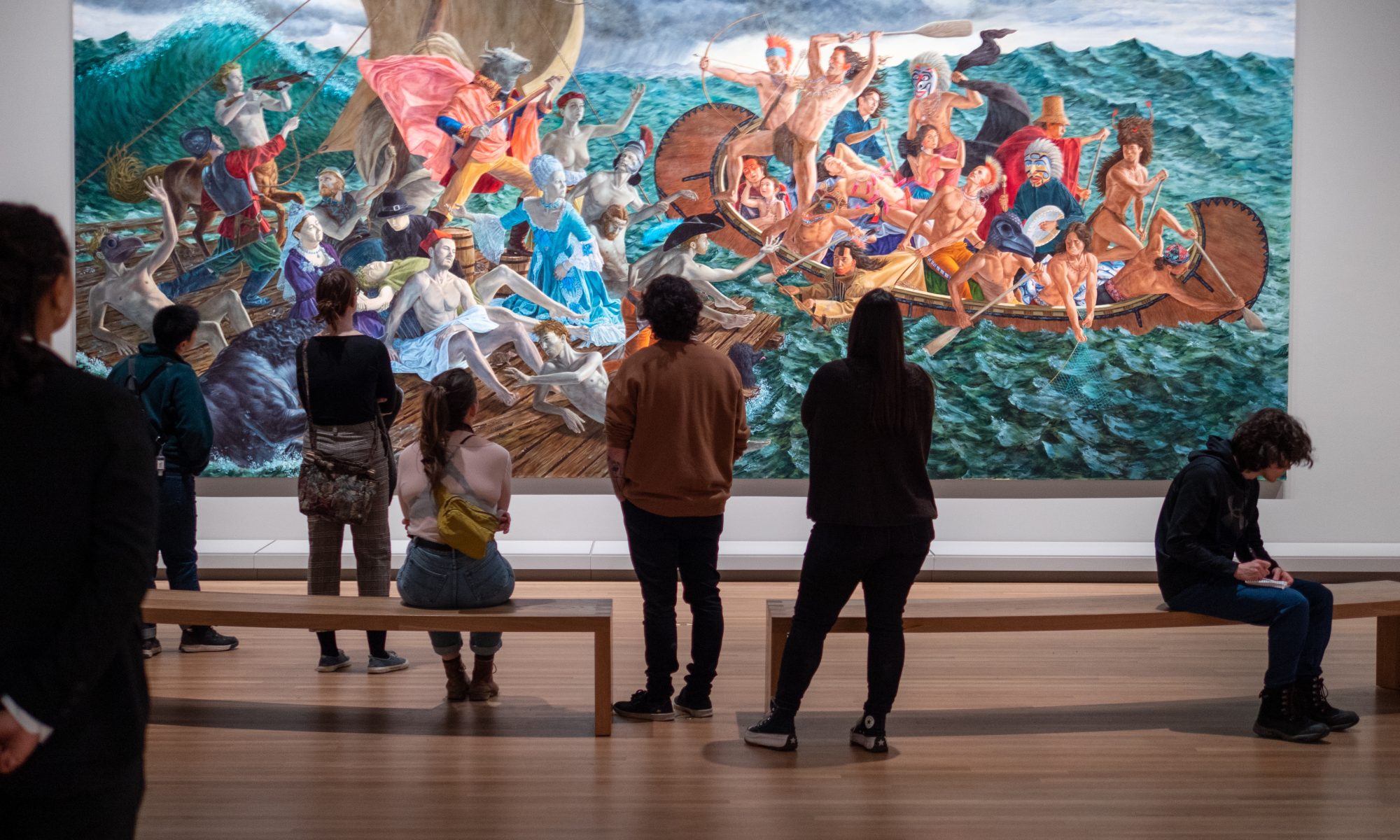
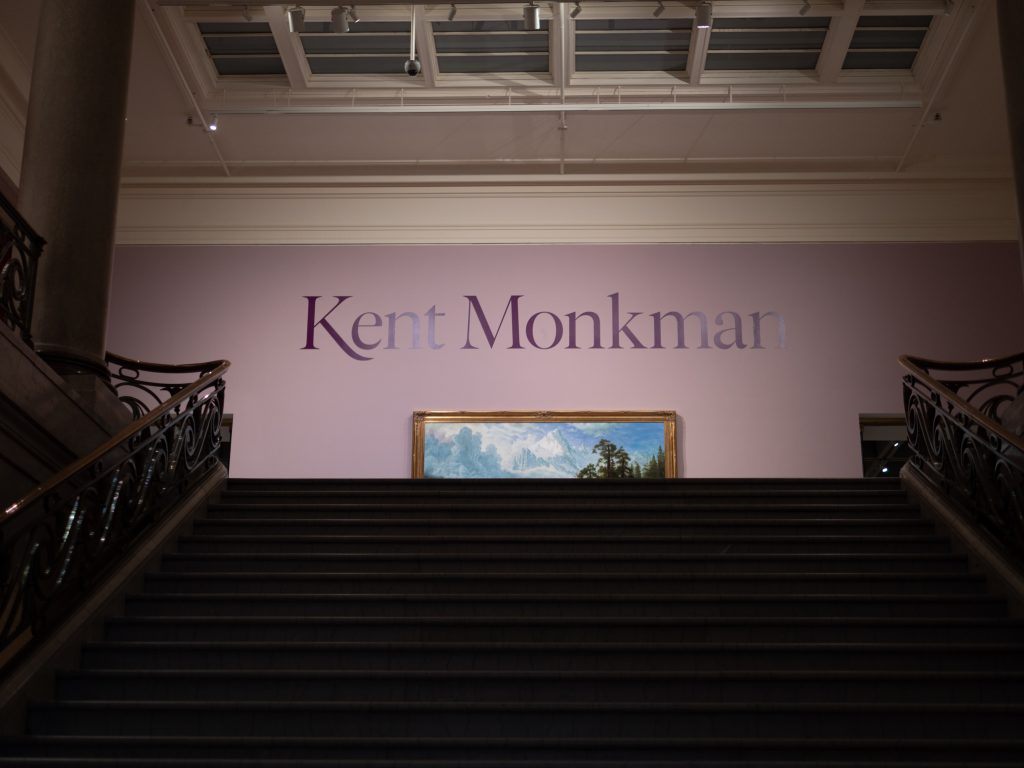
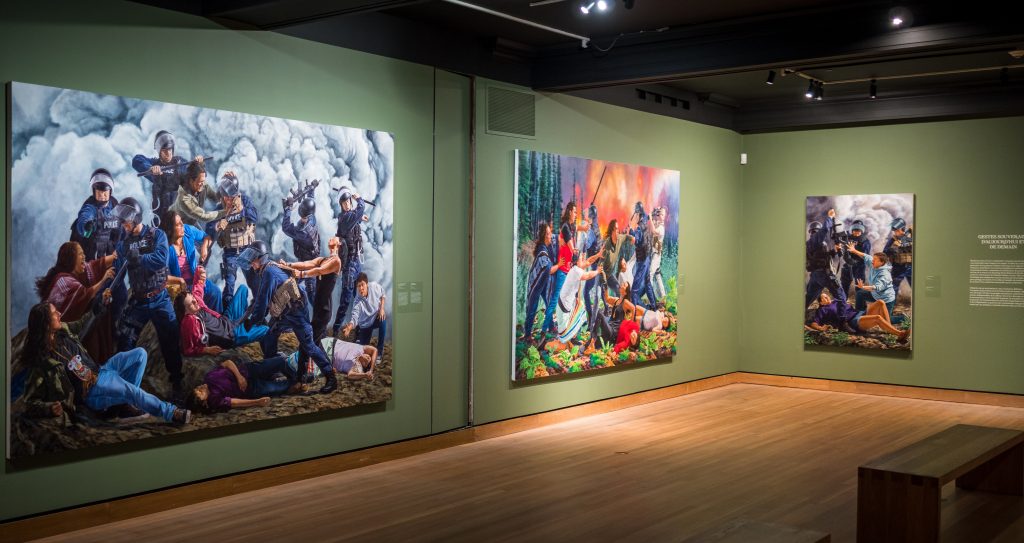
I had just come out of Kent Monkman’s exhibition at the Musée des Beaux Arts de Montréal when it became clear that what distinguishes this work is not critique alone nor reversal but a rare capacity to move fluently across multiple visual cultures and visual civilizations without collapsing them into metaphor. Monkman does not simply cite Western art history and Indigenous visual cultures side by side; he works from within both, mobilizing their internal logics, their modes of authority, and their techniques of address. The result is not hybridity in the decorative sense but a form of visual sovereignty exercised through mastery.

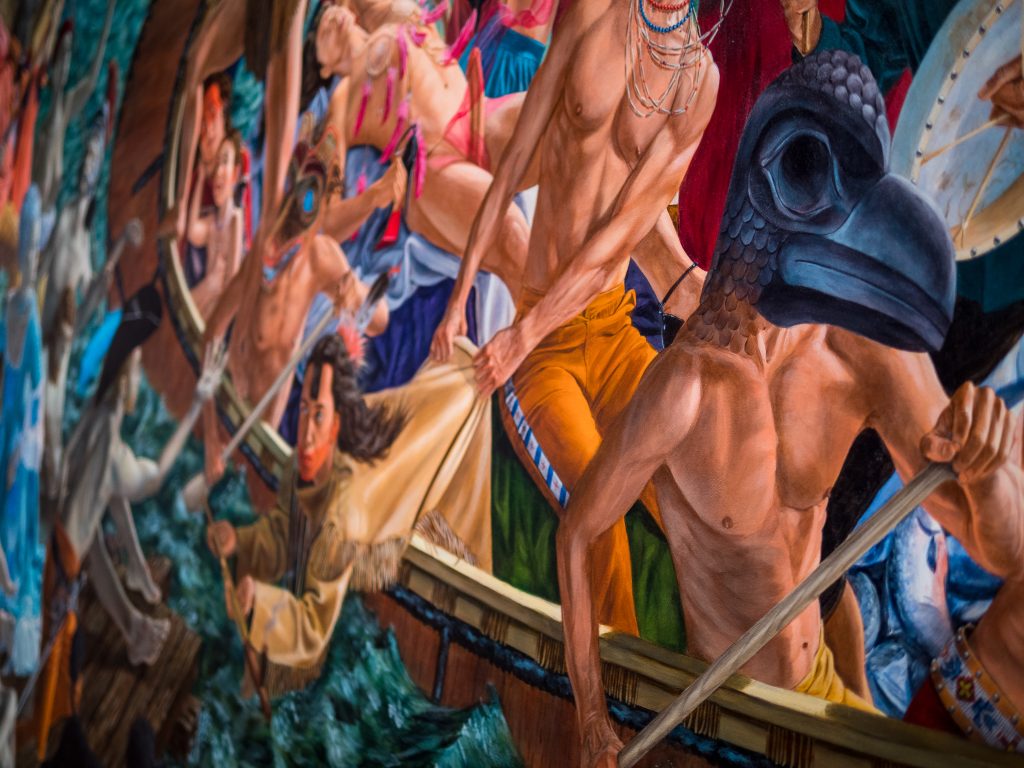
A useful thesis emerges here; Monkman’s paintings function as acts of historical repossession enacted at the level of visual grammar rather than iconography. In other words, his work repossesses history by reconfiguring the rules of representation, not just by changing what is represented. He does not argue against the canon from the outside; he inhabits its most prestigious forms, history painting, baroque theatricality, academic figuration, and dramatic realism, and then reprograms them using Indigenous epistemologies of land, body, and relationality. Indigenous visual traditions are not reduced to symbolic counterweights; they operate as structuring forces that reshape how narrative, space, and temporality behave within the frame.

Monkman’s work is best understood through the idea of medium as a site of governance; the canvas, the museum, the conventions of perspective and realism function as technologies of power, regimes of legibility and perception. These are systems that organize what is visible, what can be apprehended, and what is socially permissible to imagine. Monkman’s intervention is therefore infrastructural; he repurposes the medium itself, demonstrating how forms that once served colonial authority remain operative and can be redeployed to articulate Indigenous sovereignty.

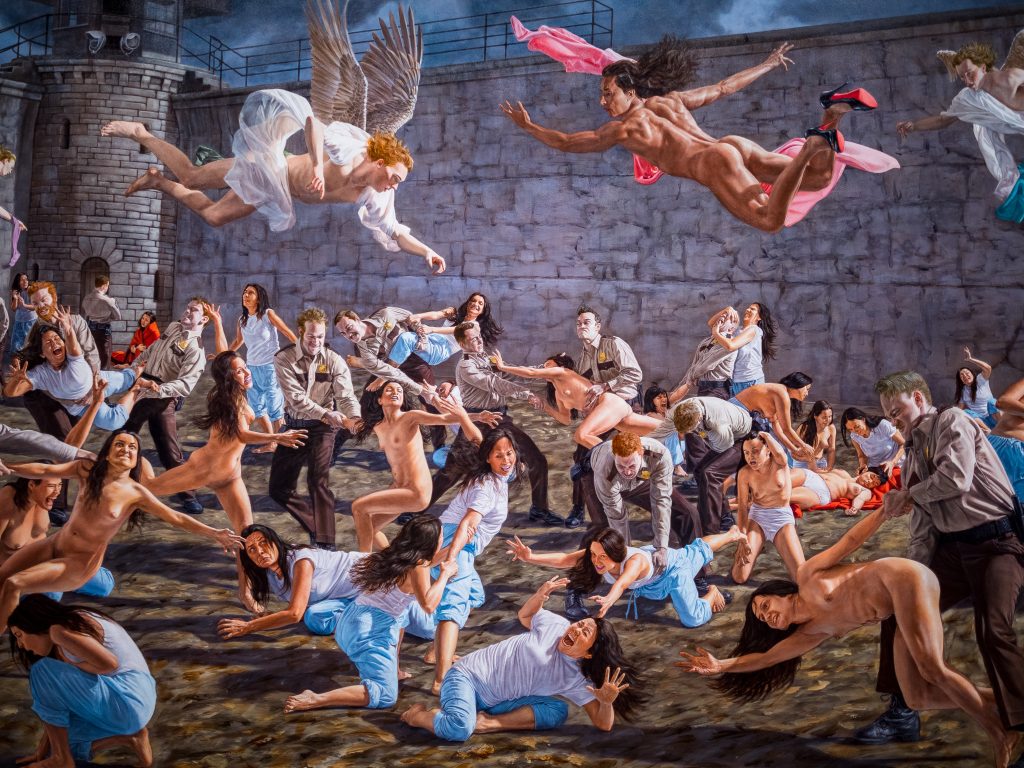
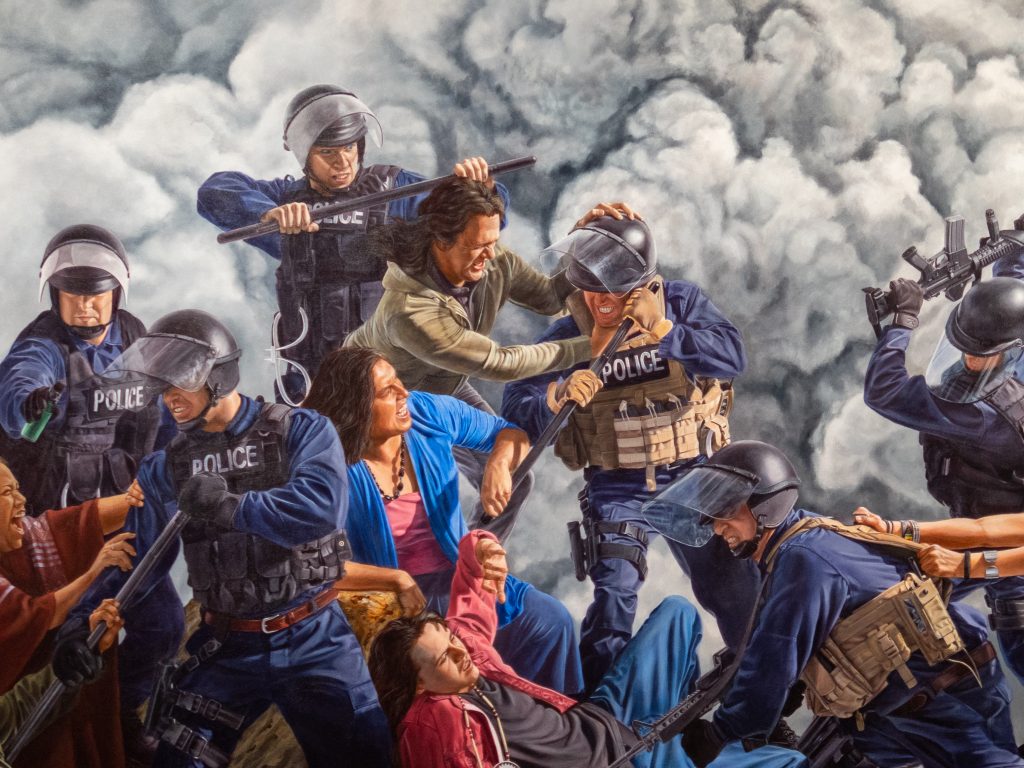
This operation unfolds across multiple scales of attention. In the body, hands and posture carry juridical weight, registering power and consent in ways that recall Caravaggio. Gesture precedes speech, and power is first registered anatomically. A hand resting possessively on a shoulder, a wrist twisted in restraint, a body leaning too far forward or collapsing under its own imbalance; these are not expressive flourishes but signs of command, consent, and coercion. Yet Monkman’s attentiveness extends beyond the gestural into the minutiae of each scene, recalling the densely populated moral ecology of a painter such as Bruegel or Bosch. Small interactions, subtle facial glances, objects in the background, and almost incidental gestures accumulate to form a network of interdependent actions. The paintings do not present a single, legible narrative; they present a field of social relations, a dispersed archive of micro-events.

Landscape functions as a key vector in this operation. The sweeping skies, distant mountains, and panoramic compositions evoke the sublime of Albert Bierstadt and the Hudson River School, yet Monkman retools this language so that land itself becomes legible as contested infrastructure. The horizon is not neutral; it is a site of occupation and resistance. The sublime becomes a device for exposing dispossession rather than producing aesthetic transcendence. In parallel, moments of collective human drama, the twisting, desperate bodies on rafts and in floodwaters, recall early nineteenth-century historical painting. Catastrophe is staged as spectacle, but the audience is made to understand that the spectacle emerges from structural violence rather than narrative fiction.

Monkman’s work registers catastrophe in a way that evokes Géricault’s Raft of the Medusa. The raft is not merely a historical reference; it is a pictorial logic of catastrophe as spectacle, a form of mass suffering staged for the gaze. Monkman appropriates this logic but redirects its vector. The suffering is not only a human tragedy but a structural consequence of colonial regimes. Bodies collapse, reach, recoil, and are propelled through space in ways that dramatize structural inequality without reducing the narrative to melodrama. The spectacle remains, but the audience is forced to recognise that the spectacle is not separate from the structure that produces it.

Miss Chief Eagle Testickle moves through these scenes not as a symbol but as a mobile intelligence; her posture is elastic, theatrical, and strategically excessive. She does not correct history; she exposes how history was staged to begin with. In doing so, Monkman reveals the continuity between techniques of Western visual authority and the colonial administration of bodies and land. Indigenous visual traditions intervene not as opposition but as alternative grammars of space, relationality, and temporality, producing a radically polyphonic field of sight.

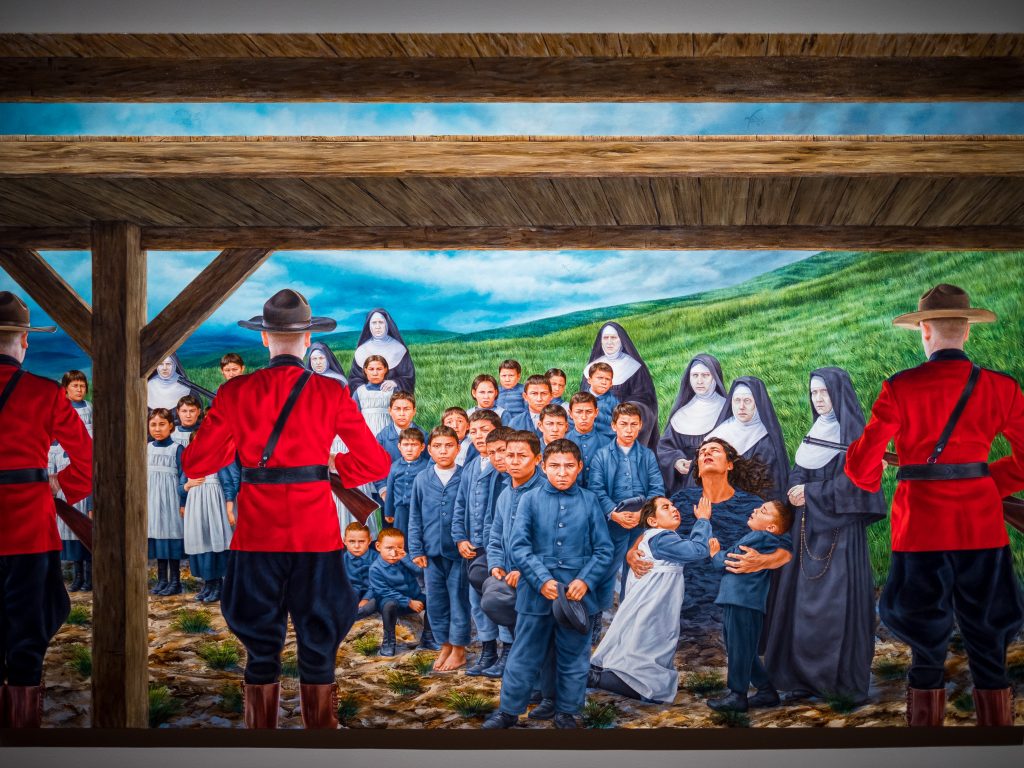
Seen in Montreal, this matters; the city’s visual inheritance is saturated with Catholic baroque, imperial pageantry, and liberal narratives of tolerance. Monkman’s paintings do not reject this inheritance; they turn it inside out, showing how its techniques remain operative and how easily they can be reactivated. In doing so, the work also reaches back toward the twentieth century, where the surrealist project sought to reveal the unconscious structures that govern perception and desire. Like surrealism, Monkman deploys the logic of the uncanny, but he does so not to escape history or to dissolve the social world into dream, but to expose the way colonial power already contains the irrational, the obscene, and the absurd.

The excess does not produce humour; it produces absurdity, a structural mismatch that refuses relief. The paintings have the precision of historical illusion yet the logic of the dream image, so that the viewer experiences a dissonance between what is visible and what is permissible to see. The viewer is not permitted to laugh and move on; the scene is too precise, too intentional, too materially invested in the power it depicts. The absurdity is not an escape hatch; it is a diagnostic tool that reveals how the colonial order depends on spectacle, fantasy, and the staging of bodies as objects of both desire and control.

This exhibition makes a quiet but forceful claim; that the future of history painting does not lie in moral instruction or archival correction but in the strategic reoccupation of visual systems that once claimed universality. Monkman demonstrates that these systems were never neutral and that they are still available to those who understand them well enough to bend them. By drawing on gesture, minutiae, landscape, and catastrophe alike, he produces a visual language that is both encyclopedic and insubordinate; a sovereign grammar capable of registering the full weight of colonial and Indigenous histories simultaneously while insisting that vision itself is a terrain of power and negotiation.

The Fifth Essence in Flesh and Vine: Titian’s Alchemical Bacchus and Ariadne

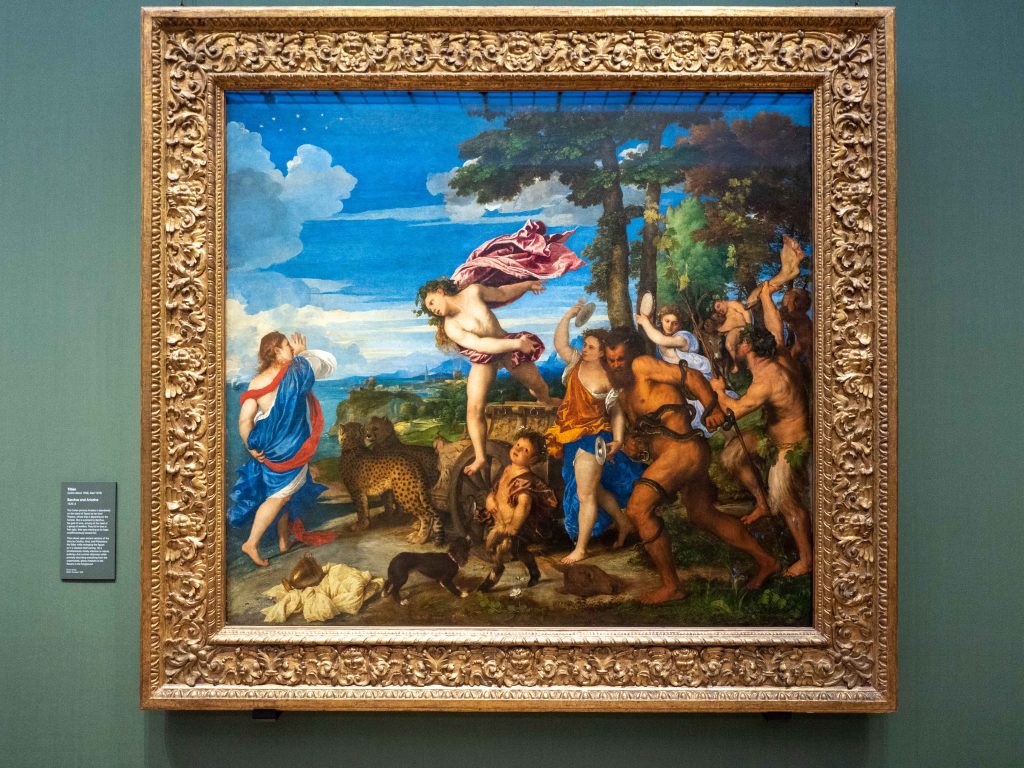
Bacchus and Ariadne was painted by Titian between 1520 and 1523 for Alfonso I d’Este, Duke of Ferrara, as part of a cycle of mythological paintings for the Camerini d’Alabastro, a series of small, private chambers designed to display the duke’s taste, erudition, and engagement with classical culture. The work depicts the moment Bacchus first sees Ariadne on the island of Naxos as told by Ovid and others, blending narrative drama with symbolic and seasonal references, including astrological markers that would have been legible to learned Renaissance viewers.  Today it is housed in the National Gallery in London. This post is dedicated to Sergei Zotov (Frances Yates Fellow, Warburg Institute) who instructed a course titled Visual History of European Alchemy that I enjoyed immensely.

In the early modern imagination, wine was more than a fermented beverage; it was a substance of transformation, a medium through which celestial and terrestrial realms could intersect, and a vehicle for alchemists to apprehend hidden patterns in nature. The fifth essence, that luminous principle distilled from wine, promised vitality, illumination, and the fusion of matter and spirit. Titian’s Bacchus and Ariadne, painted between 1520 and 1523, stages a mythic encounter suffused with this sense of transformation. The painting does not simply narrate a story; it performs an alchemical operation in light, pigment, and gesture, translating material into spirit through the formal language of Renaissance humanist painting.

Titian’s Bacchus and Ariadne at the National Gallery, London 📸 Photo by Me

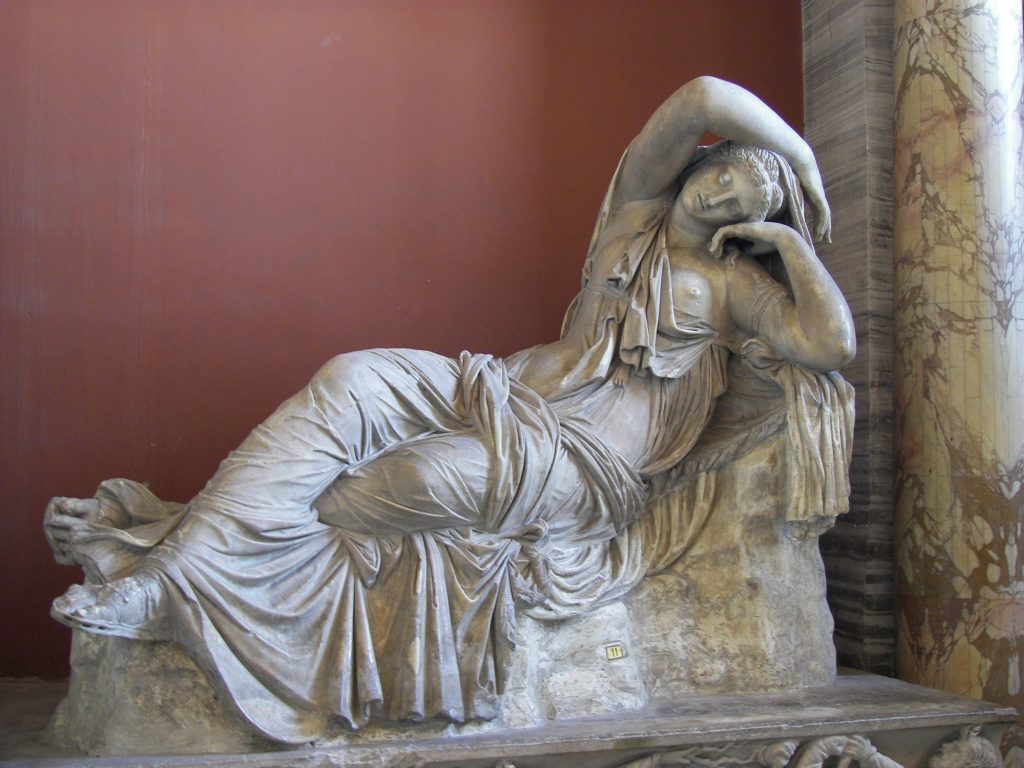
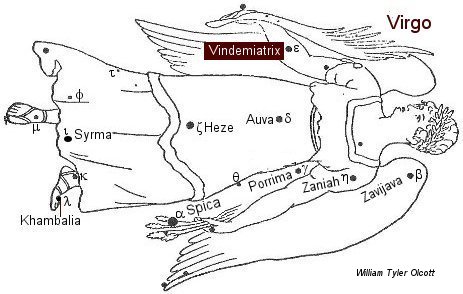
In this composition, Ariadne assumes a role resonant with the constellation Venus. She is luminous, elevated, and poised, a figure whose presence signals fertility, cosmic harmony, and generative force. Renaissance humanists frequently identified Ariadne with Venus in allegorical and poetic discourse, emphasizing her celestial elevation, her beauty, and her function as an agent of natural and human abundance. This identification is reinforced by the sources Titian consulted. Both Ovid’s Metamorphoses and Catullus’ 64 describe Ariadne’s abandonment and subsequent apotheosis into the constellation Corona Borealis. Her celestial transformation aligns her with the principles Venus embodies: the ordering of natural rhythms, the mediation of desire and abundance, and the harmonization of earthly and heavenly forces. In Titian’s painting, Ariadne’s raised right arm marks the heliacal rising of Vindemiatrix (Epsilon Virginis), signalling the beginning of the grape harvest. Her gesture connects the narrative to the cycles of the cosmos and the timing of human labour, situating her simultaneously within myth, season, and celestial order. This temporal tension between the springtime flora and the autumnal astronomical signal creates a poly-temporal tableau in which narrative, season, and cosmos intersect: Ariadne, like us all, is suspended between the life-time of flowering and the death-time of harvest, between growth and fruition, between mortal grief and celestial transformation.

Ariadne at the Louvre. 📸 Photo by Me.

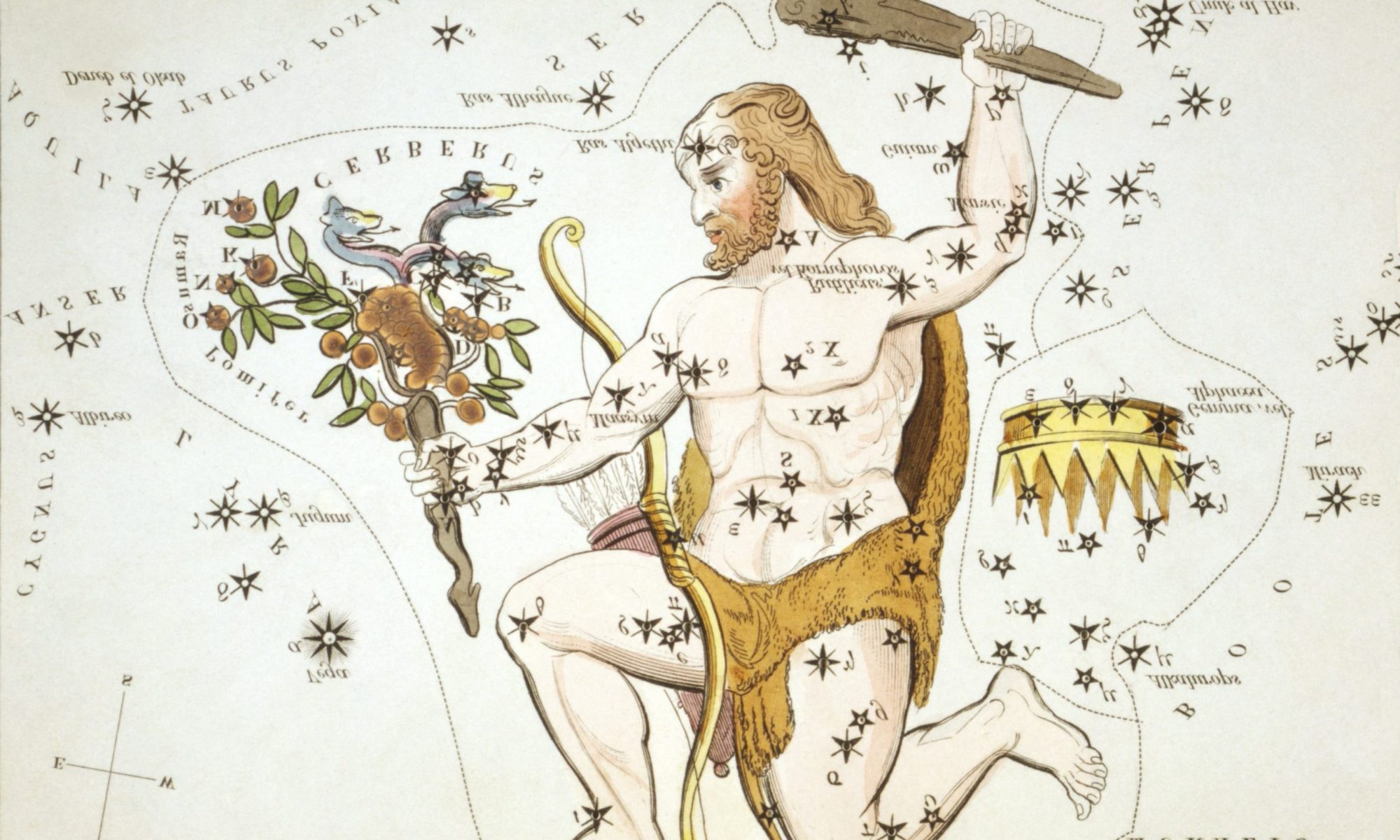
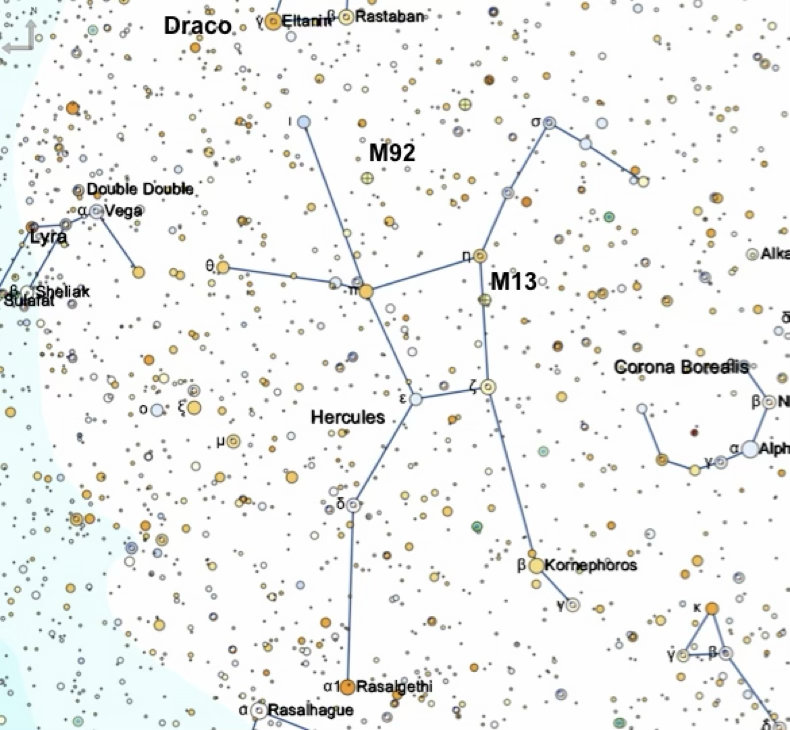
Bacchus is depicted as the constellation Hercules, leaping with muscular tension across the canvas. His leap is kinetic, cosmic, and narrative, connecting vineyard, myth, and sky. Hercules traditionally embodies struggle and ascension; Titian translates this into a corporeal movement that intersects with Ariadne’s stabilizing, Venus-like presence. The interaction of Bacchus and Ariadne is therefore not simply romantic; it is a moment in which cosmic, seasonal, and narrative energies converge, a visual analogue to the distillation of wine into its essential spirit.

The constellation Heracles (Hercules) from my star app.

Titian extends this cosmology into the Bacchic retinue, whose figures echo both mythic and celestial prototypes. Serpentus evokes the constellation Serpens, a visible celestial intermediary during harvest time, signaling transformation, danger, and the mediation between higher and lower realms. A small dog recalls the myth of Icarius, the shepherd of Attica who first learned the art of winemaking from Dionysus. When Icarius shared the fermented grape with his fellow shepherds, they mistook its intoxicating effects for poisoning and killed him; the dog, Maera, survived and led Icarius’ daughter Erigone to his body, marking the mythic origins of human engagement with wine. These figures link human action, natural processes, and celestial observation, embodying the duality inherent in wine and alchemy: vitality and revelation on one hand, peril and misinterpretation on the other.

Ovid, Metamorphoses 8. 175 ff (trans. Melville) (Roman epic C1st B.C. to C1st A.D.) : "She [Ariadne], abandoned [by Theseus], in her grief and anger found comfort in Bacchus' [Dionysos'] arms. He took her crown and set it in the heavens to win her there a star's eternal glory [as the constellation Corona]; and the crown flew through the soft light air and, as it flew, its gems were turned to gleaming fires, and still shaped as a crown their place in heaven they take between the Kneeler [the constellation Hercules] and him who grasps the Snake."

The vegetation further reinforces the alchemical and cosmological logic. Vines, both crown and trailing, signal Bacchus’s domain and the medium through which celestial essence is communicated. Blue iris and columbine mark the late spring season, while Mediterranean caper and horsetail add botanical specificity, suggesting Titian’s careful observation of nature or consultation of botanical illustrations. Wild roses and woodland trees enrich the ecological tapestry, situating the figures in a fertile, transformative landscape. These plants are not merely decorative; they serve as witnesses to and participants in the processes of transformation, linking the narrative to earthly abundance, seasonal rhythm, and the hidden forces alchemists sought to extract from natural substances.

Colour and light function analogously to alchemy. Titian suspends pigment in oil to create surfaces that radiate from within, turning flesh, drapery, and landscape into luminous material that enacts transformation visually. The billowing fabrics, the glow of Ariadne’s blue mantle, and the vivid interplay of greens and golds mirror the extraction of quintessence from matter, providing a painterly analogue to the separation, condensation, and refinement characteristic of distillation.

Alfonso d’Este, Duke of Ferrara from 1505 to 1534, cultivated a court that was intensely invested in both the arts and intellectual experimentation, including interests that intersected with alchemical thought. While there is no evidence that he practiced alchemy personally, his court was closely connected with scholars and natural philosophers who engaged in the study of transformation, the properties of substances, and the hidden order of nature. The Camerino d’Alabastro, for which Bacchus and Ariadne was commissioned, functioned as a site of cultivated curiosity where myth, science, and art converged, and Alfonso’s patronage encouraged painters like Titian to explore complex correspondences between matter, light, and the cosmos. In this environment, the language of transformation inherent in alchemical theory in which the extraction of quintessence, the harmonization of elements, and the revelation of hidden structures would have been intelligible to the duke and his circle, making a painting such as Bacchus and Ariadne resonate not only mythically but philosophically and cosmologically.

Bacchus and Ariadne can be understood as an alchemical tableau in which myth, matter, and cosmos converge. Bacchus brings the fermenting vine and the energy of transformation, while Ariadne, Venus-like, receives and channels these forces; the retinue and surrounding flora encode celestial rhythms and seasonal knowledge. By juxtaposing springtime blooms with the autumnal timing of the grape harvest, Titian emphasizes that transformation is not fixed to a single moment but unfolds across overlapping registers of time—cosmic, terrestrial, and human. In rendering myth, nature, and the heavens in a single luminous scene, the painting enacts the very process alchemists pursued: the extraction of essence, the harmonization of opposites, and the revelation of hidden order. Titian does not merely depict wine; he distills it, making visible the intersection of human imagination, natural processes, and celestial patterns in a work that is both sensual and intellectually radiant.

Flesh in Suspension: Process, Perception, and the Emergence of the Body in Bacon

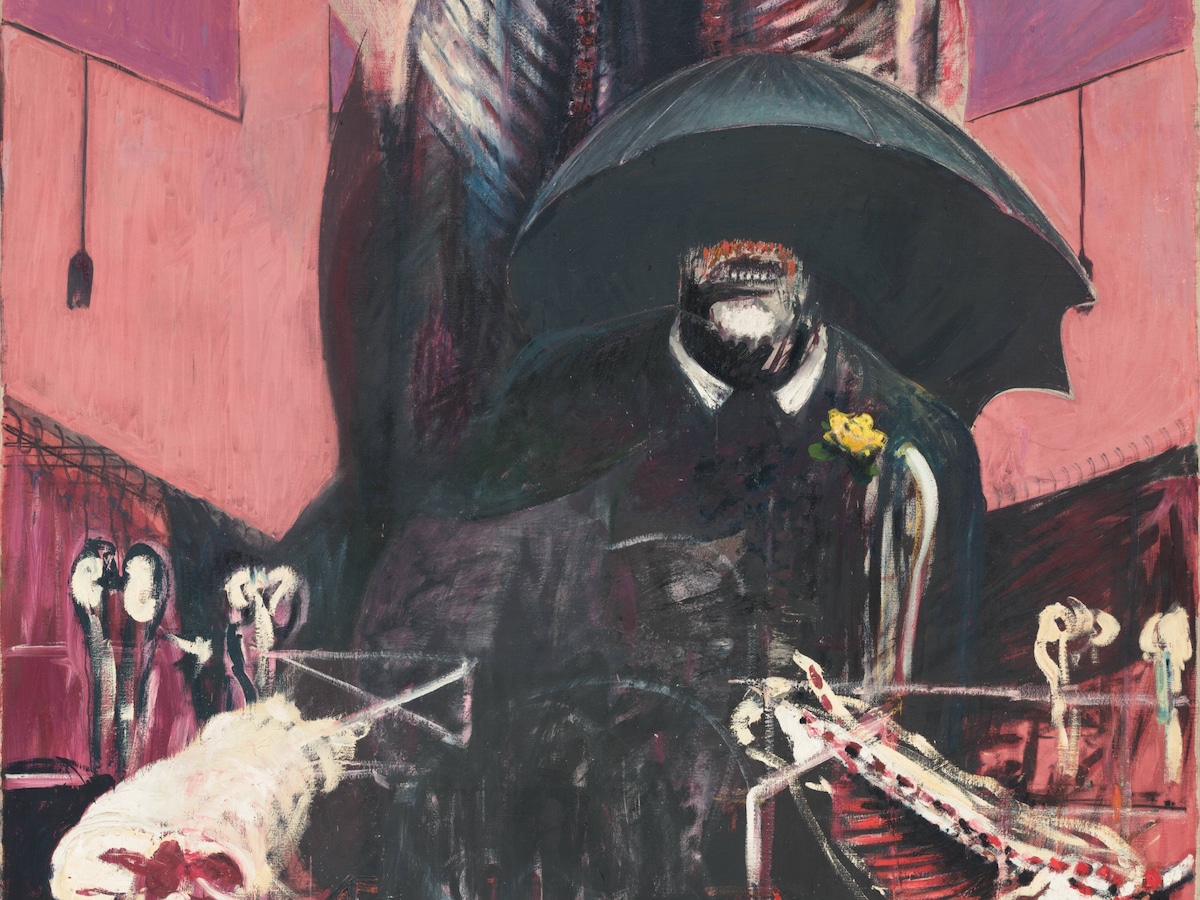
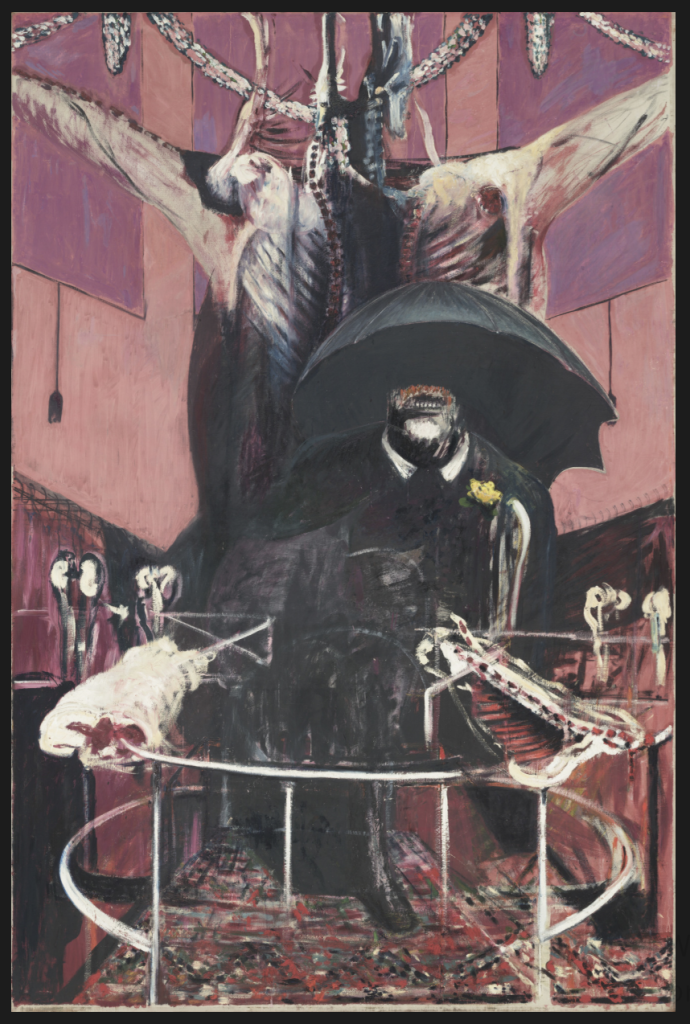
Francis Bacon Painting (1946) From – https://www.moma.org/collection/works/79204

In the spectral interior of Painting (1946), a solitary figure occupies a suspended space, standing or perhaps hovering beneath an umbrella whose ribs inscribe a faint geometry across the violet air. Behind him, carcasses hang in sanguine suspension, their surfaces rendered with visceral immediacy that resists narrative containment, while a yellow boutonnière glows on the figure’s lapel with the precision of a small Rembrandtian sun. Curtains frame the scene like a stage, yet the space itself evades conventional depth, oscillating between theatre, interior, and liminal field. The image, scraped from the residue of catastrophe, does not pursue representation or abstraction in any conventional sense; it enacts the human body as an event within paint, registering its presence through tension, exposure, and gesture.

Before this work, Bacon’s early paintings had already revealed a fascination with the body as a site of dissolution and transformation. His prewar experiments, such as Crucifixion (1933), translated Expressionist and Surrealist vocabularies into a distinctly personal idiom, merging biomorphic abstraction with the residue of figuration. By the early 1940s, this interest in corporeal fragmentation reached its first major articulation in Three Studies for Figures at the Base of a Crucifixion (1944). There, distorted forms occupy a shallow, orange field, their mouths opened in silent convulsion, suggesting both scream and species—part human, part animal. The work’s triptych structure evokes religious painting while stripping it of transcendence, presenting flesh as spectacle and ordeal rather than redemption. The spatial compression and the emphasis on bodily distortion anticipate Painting (1946), where similar compositional tensions are reimagined within a more architectonic field. Between the two works lies a continuity of inquiry: the crucifixion as event becomes the grammar through which Bacon formulates a postwar phenomenology of the body.

Created in the immediate aftermath of the Second World War, Painting (1946) has often been read as an allegory of slaughter, a meditation on human destructiveness and the dehumanization of modernity, sometimes described in terms of “sacred violence.” Yet this reading risks imposing a moral narrative onto what Bacon approached as a phenomenological inquiry: the encounter with the body as matter, sensation, and site of perceptual engagement. In this sense, the painting is not a story about what happened to humanity, but a study of how the human figure emerges in paint, how forms coalesce under the pressures of gravity, space, and attention. The figure, the umbrella, and the surrounding carcasses operate within a unified visual ontology, each element a node in the network of perception that the painting constructs.

Bacon’s sense of embodiment is intensified by the historical moment, as the atomic bomb, the devastation of London from aerial bombing, and the collapse of Britain’s imperial order shaped his perception of the human body and its vulnerability. The postwar image-world, documented in photographs of ruins, mass graves, and the anonymous debris of cities, transformed the visible into a register of loss, where vision and memory were inseparable; to see was to recall, to witness, and to bear the imprint of catastrophe. Within this visual economy, Bacon’s figure appears precarious and contingent, dwarfed by forces political and technological as much as material. It does not restore order to experience but reveals the body as residue, caught within the circulation of destruction and survival that defined postwar perception. The painting enacts a phenomenology in which human finitude is measured against impersonal, almost cataclysmic forces; flesh becomes an emergent property, appearing only through its interaction with the conditions that undo it.

Bacon’s own account of the work underscores the primacy of emergence over prefiguration. He claimed the image “happened” to him, beginning as a bird alighting on a field and transforming into something grotesque, unbidden, and particular. In this methodology, accident is not a lapse of intention but a condition for the work’s very possibility. Each mark, smear, and overpainting becomes both material and event, a residue of process made visible. Art historians have identified a subtle echo of Poussin’s Adoration of the Golden Calf in these chaotic, contorted forms, where the human propensity toward frenzy, disintegration of order, and moral collapse are rendered through the careful choreography of bodies; Bacon internalizes and abstracts this, translating collective panic into a visceral, corporeal experience. The painting’s surfaces, shaped by the interplay of control and contingency, open a space for the viewer to apprehend the body not as symbol or narrative vehicle, but as a dynamic presence in time and space. The human figure appears as both phenomenon and condition of appearance, establishing a template for Bacon’s postwar practice in which body, matter, and perception are inseparable.

The body in Bacon’s work exists as matter before meaning. It is not a symbol, nor a vehicle for narrative; it is a residue of perceptual forces, a site where sensation, gravity, and temporal pressure converge. The surrounding carcasses reinforce this ontology of flesh, presenting mass and texture stripped of moral commentary, while the umbrella and suit, though formally distinct, are subjected to the same forces that govern the composition. Each element registers its presence through the tension of appearance rather than representation, even as critics have noted visceral associations with slaughter; as The Guardian observed, Bacon’s paintings recall the “smell of death” evoked by crucifixions and meat, yet this association emerges from perception rather than imposed narrative. The hanging flowers in the work allude to how butchers would manage this smell in their own shops.

Francis Bacon: Human Presence (2024), published by the National Portrait Gallery, offers a comprehensive look at Bacon’s portraiture from the 1950s onward, highlighting his psychologically charged approach, responses to other artists, and the development of his groundbreaking practice.

This attentiveness to surface, to the way flesh registers and refracts light, aligns with a broader epistemology of vision. Michael Baxandall’s concept of the “period eye,” describing historically contingent structures through which visual culture is perceived, resonates with Bacon’s approach in postwar Britain; the painter’s gaze is informed by photography, medical atlases, and wartime documentation, yet translated through a highly personal material practice. The body is dissected and catalogued not to convey scientific knowledge as Muybridge had done, but to make visible the conditions under which perception and sensation cohere. It is an epistemological inquiry enacted through paint.

Through this method, painting becomes a phenomenological operation. The surface records pressures, accidents, and iterative decisions of the studio while mediating the viewer’s encounter with the body. Portraiture is reflexive. Bacon establishes a principle that will define his postwar oeuvre: the human figure emerges through process and is inseparable from the physical, temporal, and perceptual forces that both produce and destroy it. Flesh is both object and event, and the work’s authority derives from its insistence on presenting the body as an active site of appearance rather than a preordained icon.

Camera: Francis Bacon – Photography, Film and the Practice of Painting by Martin Harrison examines how photographs, film, and media images shaped Bacon’s work. It traces influences from Velázquez, Poussin, Rodin, Muybridge, and Eisenstein, showing how these sources informed his painting practice and contributed to his stylistic development.

The environment around the main figure functions as more than backdrop; it actively shapes the experience of the body. Curtains, partitions, and the umbrella’s geometry organize the composition while simultaneously interrupting the gaze, producing a controlled yet unstable field of perception. These devices create a tension between containment and exposure: the figure is both framed and restrained, present yet partially obscured. The slatted geometry of the umbrella, and faint parallels to blinds or screens, introduces a subtle modulation of vision, suggesting that seeing is always mediated by structural conditions.

Through attention to framing and architecture, Bacon situates painting as an active negotiation between perception and presence. The visible world is not merely represented but interrogated; boundaries, partitions, and light conditions articulate the limits and possibilities of seeing, while the figure registers their effect. In this sense, the work functions simultaneously as a study of corporeal vulnerability and an exploration of the mechanics of vision, demonstrating that spatial organization is intrinsic to both the production and apprehension of the human form.

Francis Bacon: Painting, Philosophy, Psychoanalysis (2019), edited by Ben Ware, brings together essays exploring Bacon’s art through existential, phenomenological, and psychoanalytic lenses, engaging thinkers from Freud to Heidegger to illuminate his work and methods.

Painting (1946) gathers the formal and conceptual motifs that would shape Bacon’s postwar practice: the suspended figure, the carcass, the enclosing partitions, and the slatted geometries that regulate vision. Yet some of these elements predate the work itself and anticipate later developments. The figure’s dark suit and white collar recall the papal vestment in Velázquez’s Portrait of Innocent X (1650), while the partial enclosure evokes the architecture of both tribunal and confessional. These correspondences would resurface with full intensity in Head VI (1949) and the later Pope series, where the seated figure becomes the locus of both containment and exposure. The agape mouth reveals Bacon’s dialogue with the visual archives of the twentieth century, particularly the photograph of Joseph Goebbels at the Berlin Sportpalast, captured mid-oration with his mouth open in a gesture of command and fury. This image, a study in the performative collapse of authority, resonates alongside imagery from Eisenstein’s Battleship Potemkin (1925), where the scream becomes a register of terror and resistance.

Within this visual system, repetition operates not as redundancy but as investigation. Bacon revisits these motifs to test how the body, framed by its architectural and historical conditions, can register sensation without narrative mediation. Each recurrence refines the logic first articulated in Painting (1946), in which the figure is both object and event, suspended between enclosure and eruption. The later Pope paintings can be seen as variations on this initial grammar: they preserve the structure of the isolated body within a bounded field while deepening the tension between visibility and concealment that defines Bacon’s vision of postwar embodiment.

The spatial and material strategies crystallized in Painting (1946) consolidate concerns already present in Bacon’s earlier work, yet they also inaugurate the formal vocabulary of his postwar practice. Motifs (Rosie Broadley calls them ciphers) such as the suspended body, the enclosing framework, and the calibrated interplay of light and shadow had appeared in tentative form before 1946, but here they achieve a structural and conceptual coherence that would persist through the 1950s and 1960s. In the triptychs and later variations on the reclining figure, Bacon returns to these devices not through repetition alone but as a method of inquiry and study; each reengagement tests how flesh, form, and perception are continually reconstituted within the material field of painting.

Ultimately, Bacon’s work is significant not for a single figure or scene, but for the method it establishes, rendering the human body in all its fragility and intensity. His portraits function as studies of others and of himself, with painting acting as both mirror and medium, where perception, gesture, and material presence converge. The body emerges through interaction with space, light, and paint, enacting a subtle phenomenology in which flesh and vision co-arise. Portraiture becomes a site of inquiry, where artist, subject, and viewer intersect, and where the conditions of appearance are examined as rigorously as the forms themselves.


Books consulted in this analysis:

Fragments in Conversation: Imagining Twombly and Guston in Rome

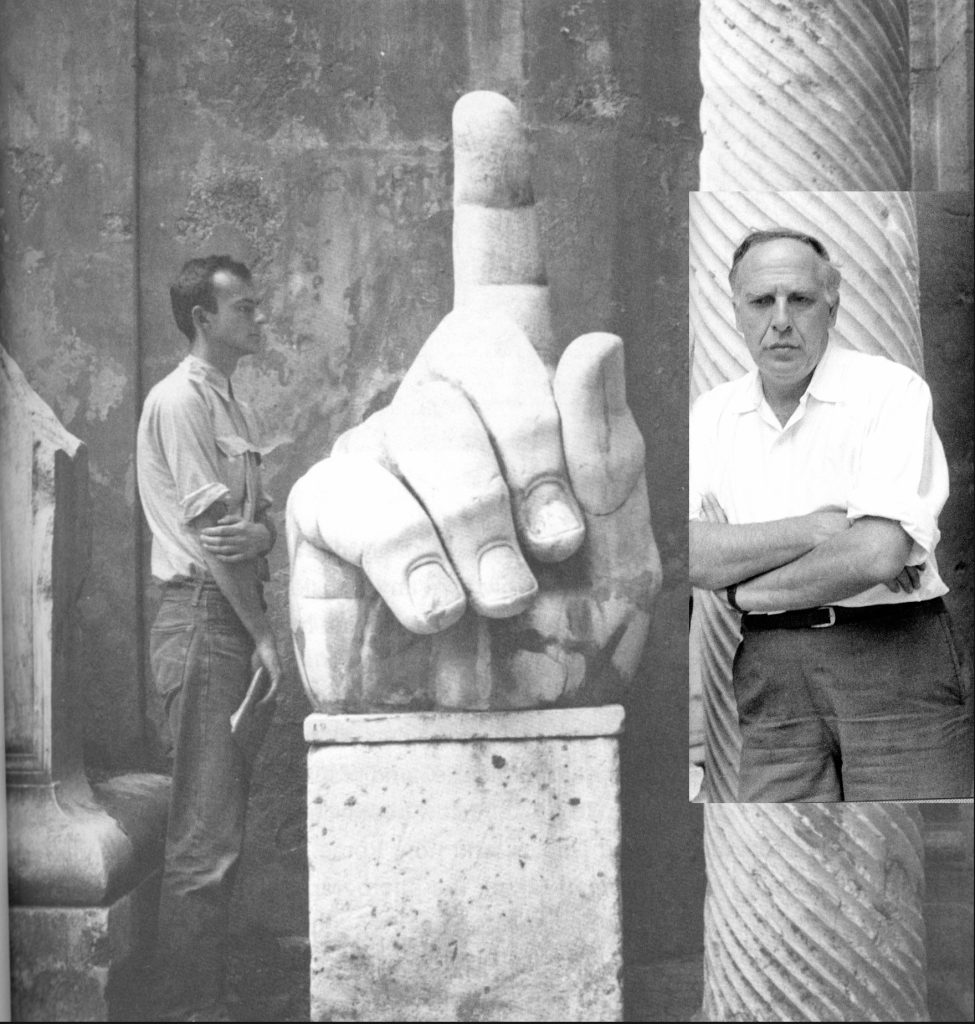
In a quiet courtyard of the Capitoline Museum in Rome, the colossal hand of Constantine rests on its plinth, a fragment of imperial ambition and human scale. Here, Guston and Twombly meet, observing and responding to the same ruin through their very different artistic sensibilities; the hypothetical encounter becomes a meditation on gesture, history, and the ethical weight of mark-making, allowing the past to speak while their own practices converse across time.

The afternoon sun warmed the stones of the Capitoline Museum’s courtyard, its light striking the marble façades with a soft, diffuse glow. The colossal right hand of Constantine rested on a low plinth, isolated from other objects, a fragment of a once-magnificent imperial statue. Its scale was imposing even as a fragment, and the careful carving of the fingers and veins conveyed both power and a subtle human vulnerability.

A collage that I created from a photograph of Twombly (perhaps taken by Robert Rauschenberg) and Philip Guston at the Capitoline Museum in Rome.

The colossal right hand of Constantine, displayed on a plinth in the Capitoline courtyard, is a surviving fragment of a seated statue created between 313 and 324 AD for the Basilica of Maxentius. Originally part of an acrolithic composition, the emperor’s head and exposed body were carved from Parian marble, while the draped cloak was rendered in gilded bronze foil; this suggested both divine authority and imperial grandeur. The statue, which once rose approximately 10 metres, assimilated Constantine to Jupiter, portraying him as a god on earth; the raised index finger, now partially restored, likely held a sceptre, reinforcing the gesture’s symbolic assertion of power.

Today, the hand conveys a mixture of monumental force and fragile humanity. The work’s fragmentary state, seen alongside other preserved sections of the colossal statue, including the head and central arm, reveals the sculpture as a ruin that still communicates its historical and political ambition. As isolated fragments, these remnants encourage reflection on the passage of time; the vulnerability of even the most imposing symbols; and the ethical and aesthetic weight of human representation, themes that resonate profoundly with both Guston’s and Twombly’s concerns in painting.

τῷ σωτηριώδει σημείῳ, τῷ ἀληθεῖ ἐλέγχῳ τῆς ἀνδρείας τὴν πόλιν ὑμῶν ἀπὸ ζυγοῦ τοῦ τυράννου διασωθεῖσαν ἠλευθέρωσα, ἔτι μὴν καὶ τὴν σύγκλητον καὶ τὸν δῆμον Ῥωμαίων τῇ ἀρχαίᾳ ἐπιφανείᾳ καὶ λαμπρότητι ἐλευθερώσας ἀποκατέστησα. -- Eusebius 

Under this singular sign (singularius signum), which is the mark (insigne) of true excellence, I restored (restituo) the city of Rome, the senate, and the Roman people, torn away by the yoke (iugo) of tyrannical rule (tyrannicus dominatio), to their former freedom (libertas) and nobility (nobilitas). -- tr. Rufinus

Guston leaned against a nearby column, sketchbook resting loosely in his hands, eyes fixed on the hand with an intensity that seemed to challenge the world to respond. “Even as a fragment,” he said, tapping his fingers against the page, “this hand carries a grotesque weight. It’s absurd, monumental, human. Every mark here insists on being read as a statement of power and presence. It reminds me of the hooded figures or the shoes in my later paintings: blunt witnesses to human absurdity and moral consequence.”

Guston shifted slightly, letting the weight of the fragment press on him as he traced an invisible line from the marble back to his sketchbook. “Even fractured, it asserts authority; even incomplete, it demands a response. The hand is absurdly large, but it is human; its veins, its fingers, its tension—all of it insists that someone, somewhere, bore responsibility for the act. There is a moral weight in these gestures, whether carved in stone or brushed on canvas.”

Twombly stood a few paces away, tilting his head sideways as he traced the subtle fractures in the marble. “I understand,” he said, voice calm, almost lyrical, “but for me the incompleteness is essential. The gesture does not exist merely to confront; it exists to be felt, to be remembered. The cracks, the missing pieces, the space around it—all of that creates a dialogue between past and present. My marks are like that; they do not dominate the surface; they listen to what is already there, extending the story rather than imposing it. Even in ruin, the hand speaks, but it allows us to speak back.” His words echoed the improvisatory gestures and calligraphic lines of Fifty Days at Iliam, where each mark floated between presence and absence, between history and recollection.

Guston drew a blunt, quick line across his sketchbook, a gesture almost corporeal in its insistence. “I grant you that,” he said, “but there is an ethics in confrontation as well. The past presses on us, and the fragments of history demand recognition; silence or mediation is not always sufficient. When I paint, I confront moral and historical weight directly. This hand, monumental though incomplete, insists that someone accounted for every gesture, every line, every mark. There is responsibility in scale and in execution; the fragment reminds us that grandeur is inseparable from human intention and consequence.”

Twombly’s gaze lingered, following the curvature of the knuckles and the subtle slope of the wrist. “And yet there is also an ethics of receptivity,” he said. “Not every gesture must dominate; some exist to be extended or echoed. In its incompleteness, the hand allows us to inhabit the space it leaves, to feel the gestures that preceded us. The hand already exists. Our gestures extend it, converse with it, but do not dominate it. In its incompleteness, it teaches humility. Every mark we make can be a response rather than a statement. Painting is similar; we mark, we trace, we respond, but we do not always impose. The ruins speak to us precisely because they permit reflection as well as recognition.”

For a long moment, the courtyard fell into silence, the distant shuffle of tourists paling against the quiet gravity of the fragment. Guston’s gaze remained intense and corporeal, measuring the hand as if willing it to yield its secrets, while Twombly’s eyes drifted over the fractures, absorbing the residue of centuries. The colossal hand became a mediator between them, embodying the convergence of human ambition, ethical responsibility, and historical fragility. In that shared attention, both understood the stakes of gesture and mark; one through confrontation, the other through evocation, and both through fidelity to what remains.

Finally, Guston nodded toward the fragment. “They wanted to make power eternal,” he said, “but what survives is fragmentary, grotesque, human. That is the lesson for us: every action, every word, every figure, every mark carries weight.” Twombly turned back, eyes following the line of the fingers. “And in that fragment, in the silence between gestures, I feel history breathing. Painting is its echo—not the hand itself, but the trace it leaves, its shadow.”