Reprogramming the Canon: Kent Monkman and the Sovereign Grammar of Vision

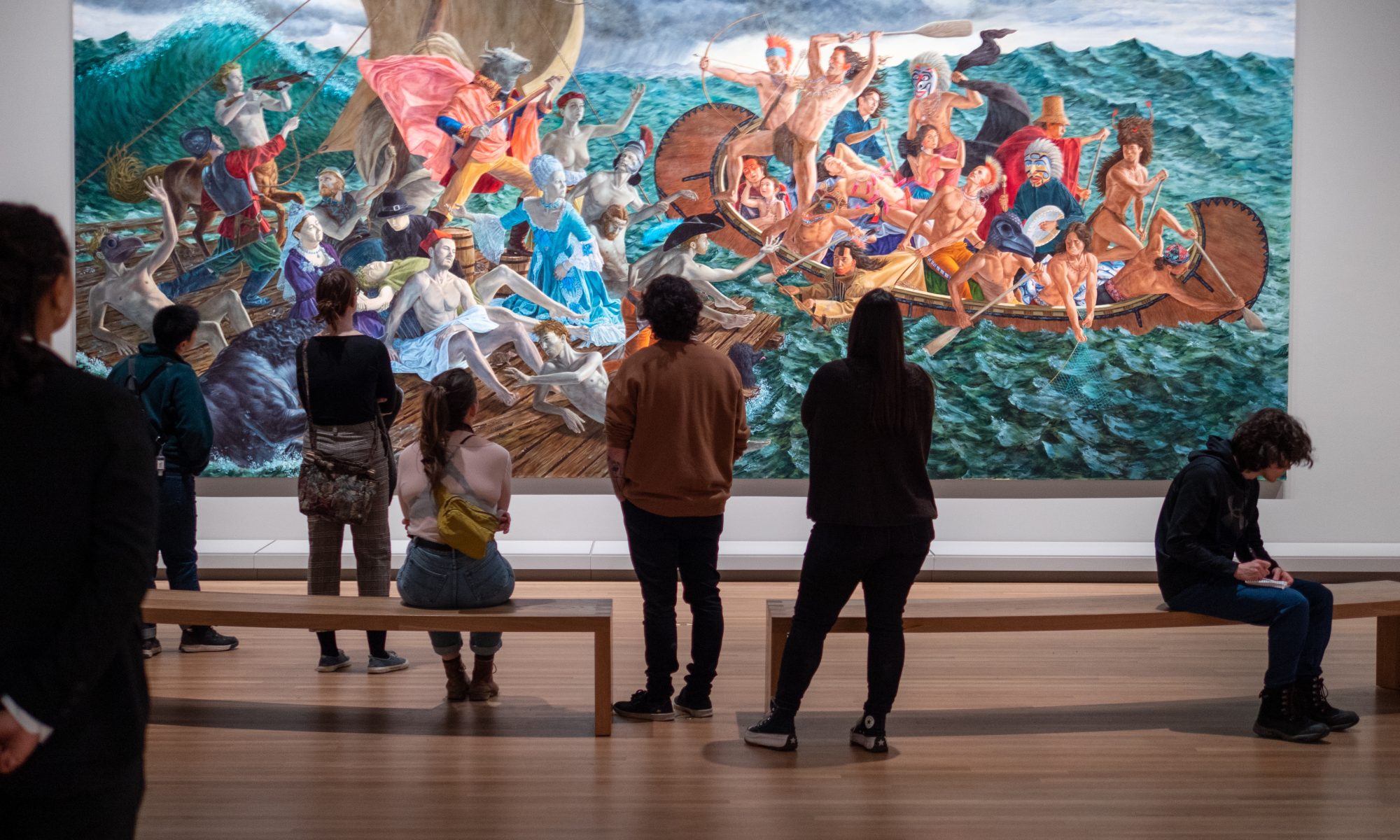
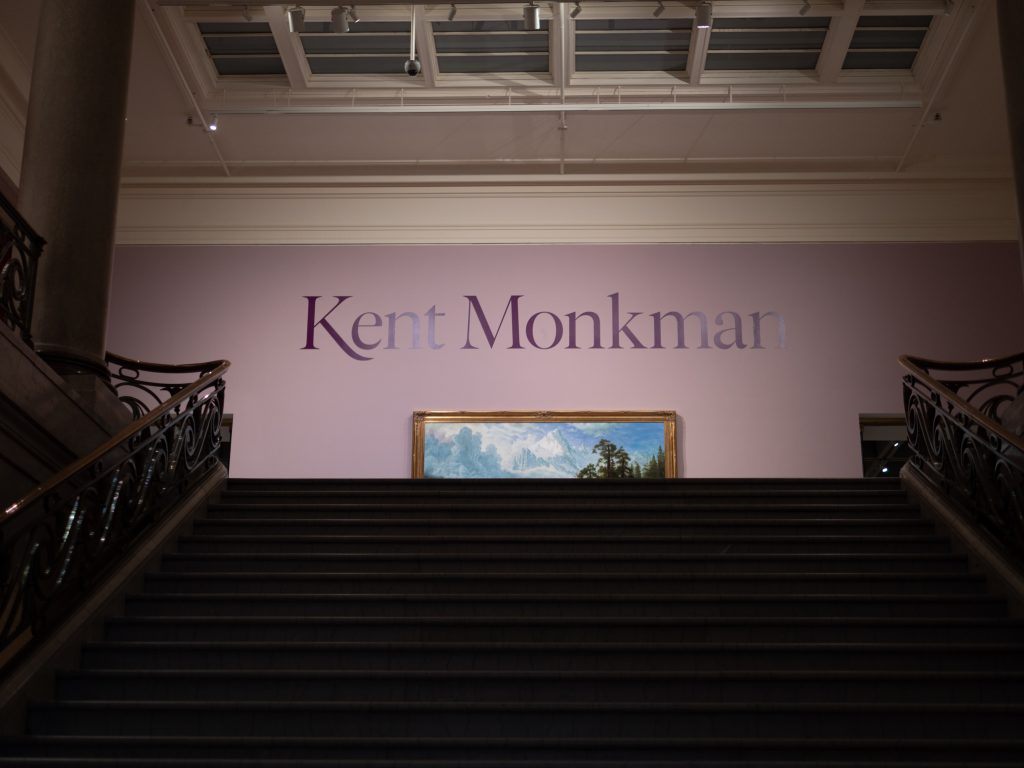
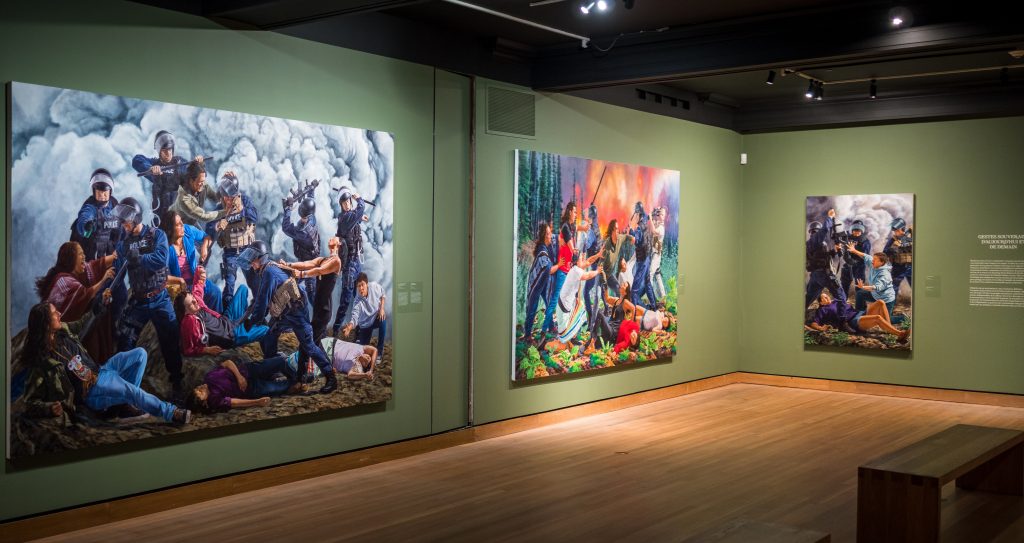
I had just come out of Kent Monkman’s exhibition at the Musée des Beaux Arts de Montréal when it became clear that what distinguishes this work is not critique alone nor reversal but a rare capacity to move fluently across multiple visual cultures and visual civilizations without collapsing them into metaphor. Monkman does not simply cite Western art history and Indigenous visual cultures side by side; he works from within both, mobilizing their internal logics, their modes of authority, and their techniques of address. The result is not hybridity in the decorative sense but a form of visual sovereignty exercised through mastery.

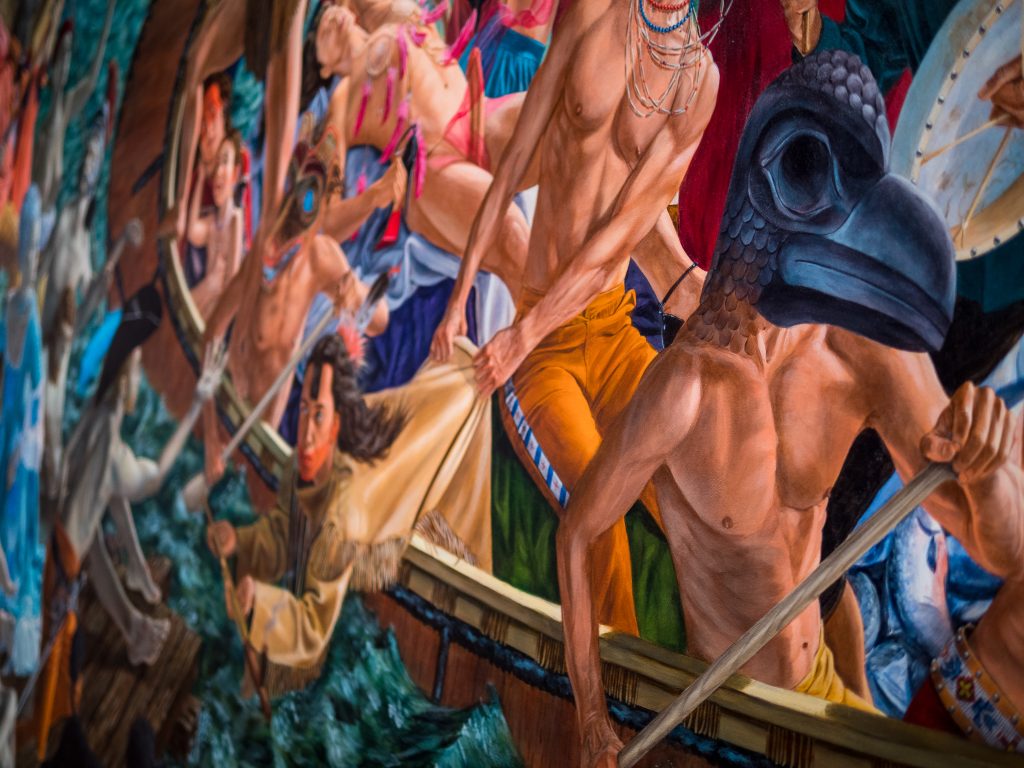
A useful thesis emerges here; Monkman’s paintings function as acts of historical repossession enacted at the level of visual grammar rather than iconography. In other words, his work repossesses history by reconfiguring the rules of representation, not just by changing what is represented. He does not argue against the canon from the outside; he inhabits its most prestigious forms, history painting, baroque theatricality, academic figuration, and dramatic realism, and then reprograms them using Indigenous epistemologies of land, body, and relationality. Indigenous visual traditions are not reduced to symbolic counterweights; they operate as structuring forces that reshape how narrative, space, and temporality behave within the frame.

Monkman’s work is best understood through the idea of medium as a site of governance; the canvas, the museum, the conventions of perspective and realism function as technologies of power, regimes of legibility and perception. These are systems that organize what is visible, what can be apprehended, and what is socially permissible to imagine. Monkman’s intervention is therefore infrastructural; he repurposes the medium itself, demonstrating how forms that once served colonial authority remain operative and can be redeployed to articulate Indigenous sovereignty.

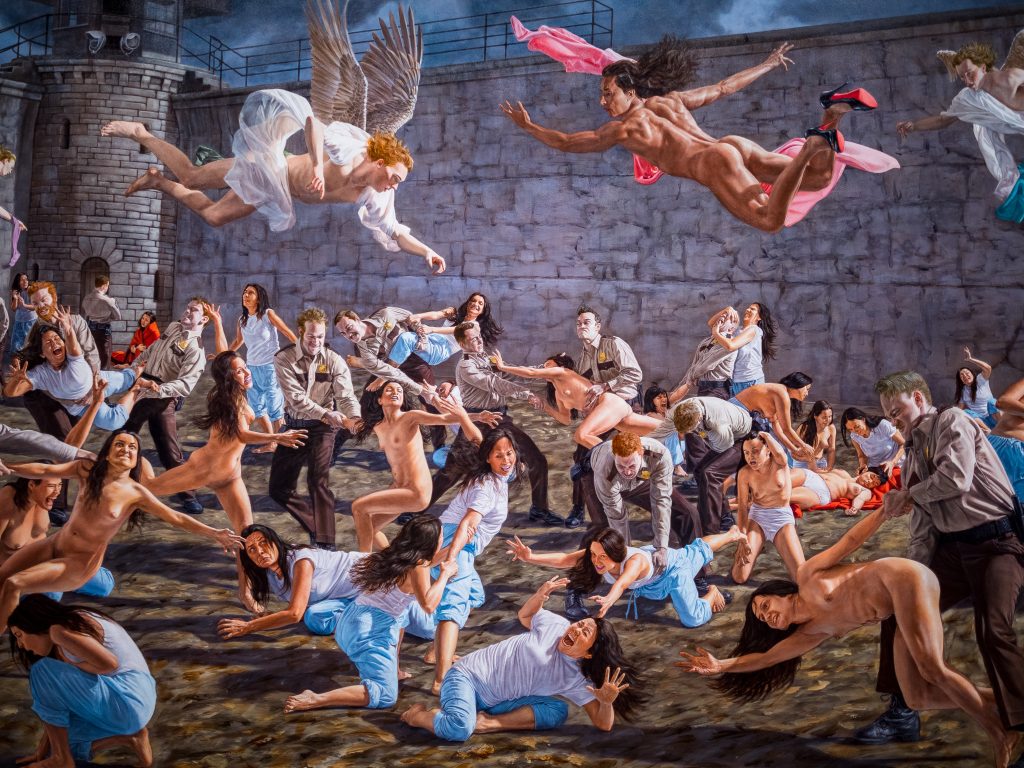
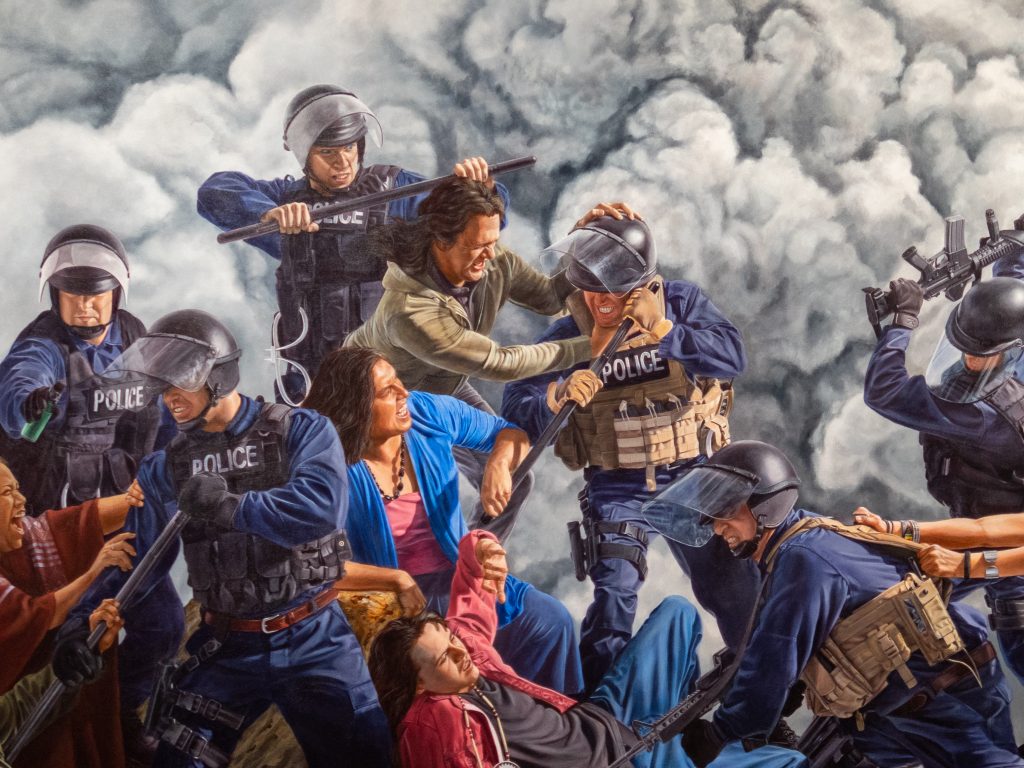
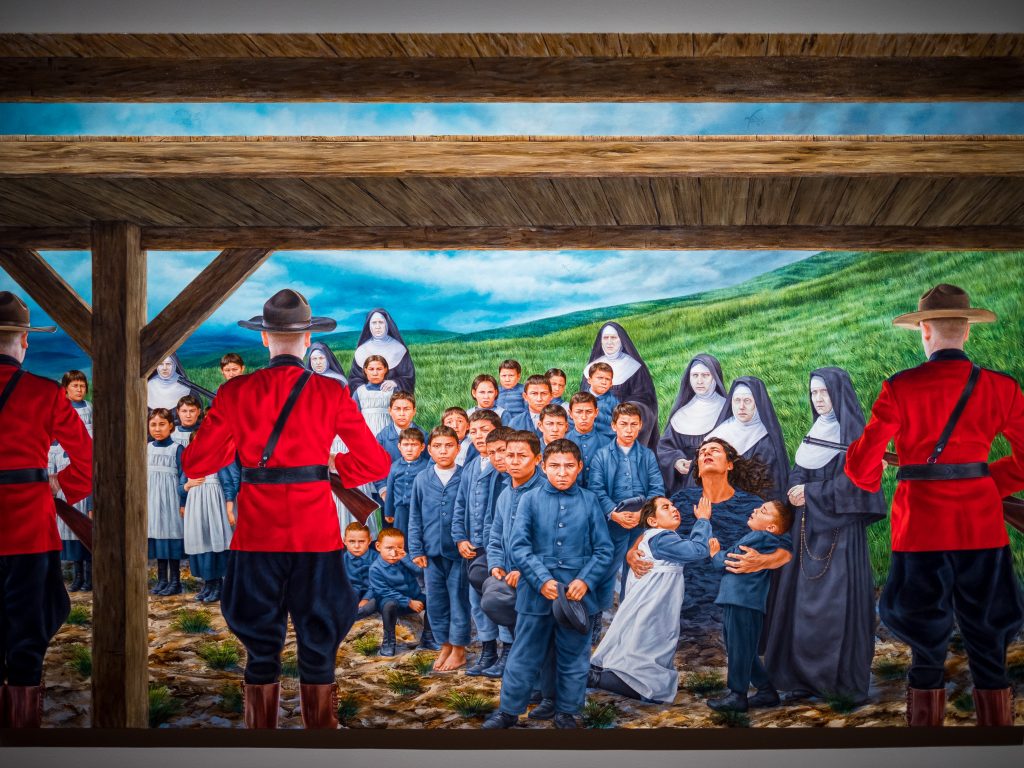
This operation unfolds across multiple scales of attention. In the body, hands and posture carry juridical weight, registering power and consent in ways that recall Caravaggio. Gesture precedes speech, and power is first registered anatomically. A hand resting possessively on a shoulder, a wrist twisted in restraint, a body leaning too far forward or collapsing under its own imbalance; these are not expressive flourishes but signs of command, consent, and coercion. Yet Monkman’s attentiveness extends beyond the gestural into the minutiae of each scene, recalling the densely populated moral ecology of a painter such as Bruegel or Bosch. Small interactions, subtle facial glances, objects in the background, and almost incidental gestures accumulate to form a network of interdependent actions. The paintings do not present a single, legible narrative; they present a field of social relations, a dispersed archive of micro-events.

Landscape functions as a key vector in this operation. The sweeping skies, distant mountains, and panoramic compositions evoke the sublime of Albert Bierstadt and the Hudson River School, yet Monkman retools this language so that land itself becomes legible as contested infrastructure. The horizon is not neutral; it is a site of occupation and resistance. The sublime becomes a device for exposing dispossession rather than producing aesthetic transcendence. In parallel, moments of collective human drama, the twisting, desperate bodies on rafts and in floodwaters, recall early nineteenth-century historical painting. Catastrophe is staged as spectacle, but the audience is made to understand that the spectacle emerges from structural violence rather than narrative fiction.

Monkman’s work registers catastrophe in a way that evokes Géricault’s Raft of the Medusa. The raft is not merely a historical reference; it is a pictorial logic of catastrophe as spectacle, a form of mass suffering staged for the gaze. Monkman appropriates this logic but redirects its vector. The suffering is not only a human tragedy but a structural consequence of colonial regimes. Bodies collapse, reach, recoil, and are propelled through space in ways that dramatize structural inequality without reducing the narrative to melodrama. The spectacle remains, but the audience is forced to recognise that the spectacle is not separate from the structure that produces it.

Miss Chief Eagle Testickle moves through these scenes not as a symbol but as a mobile intelligence; her posture is elastic, theatrical, and strategically excessive. She does not correct history; she exposes how history was staged to begin with. In doing so, Monkman reveals the continuity between techniques of Western visual authority and the colonial administration of bodies and land. Indigenous visual traditions intervene not as opposition but as alternative grammars of space, relationality, and temporality, producing a radically polyphonic field of sight.

Seen in Montreal, this matters; the city’s visual inheritance is saturated with Catholic baroque, imperial pageantry, and liberal narratives of tolerance. Monkman’s paintings do not reject this inheritance; they turn it inside out, showing how its techniques remain operative and how easily they can be reactivated. In doing so, the work also reaches back toward the twentieth century, where the surrealist project sought to reveal the unconscious structures that govern perception and desire. Like surrealism, Monkman deploys the logic of the uncanny, but he does so not to escape history or to dissolve the social world into dream, but to expose the way colonial power already contains the irrational, the obscene, and the absurd.

The excess does not produce humour; it produces absurdity, a structural mismatch that refuses relief. The paintings have the precision of historical illusion yet the logic of the dream image, so that the viewer experiences a dissonance between what is visible and what is permissible to see. The viewer is not permitted to laugh and move on; the scene is too precise, too intentional, too materially invested in the power it depicts. The absurdity is not an escape hatch; it is a diagnostic tool that reveals how the colonial order depends on spectacle, fantasy, and the staging of bodies as objects of both desire and control.

This exhibition makes a quiet but forceful claim; that the future of history painting does not lie in moral instruction or archival correction but in the strategic reoccupation of visual systems that once claimed universality. Monkman demonstrates that these systems were never neutral and that they are still available to those who understand them well enough to bend them. By drawing on gesture, minutiae, landscape, and catastrophe alike, he produces a visual language that is both encyclopedic and insubordinate; a sovereign grammar capable of registering the full weight of colonial and Indigenous histories simultaneously while insisting that vision itself is a terrain of power and negotiation.

The Architectonics of Power The Carbonstate, the Electrostate, and the New Strategic Order – Adam Tooze’s 2025 LRB Autumn Lecture 

Adam Tooze’s 2025 London Review of Books Autumn Lecture offers a diagnosis of a world whose organizing principles can no longer be captured by moral narratives or inherited geopolitical categories. The lecture is not concerned with adjudicating virtue or blame, but with understanding how power is materially organized, reproduced, and defended under contemporary conditions. What emerges is a picture of a global order under strain, not for lack of agency, but because it is saturated with it.

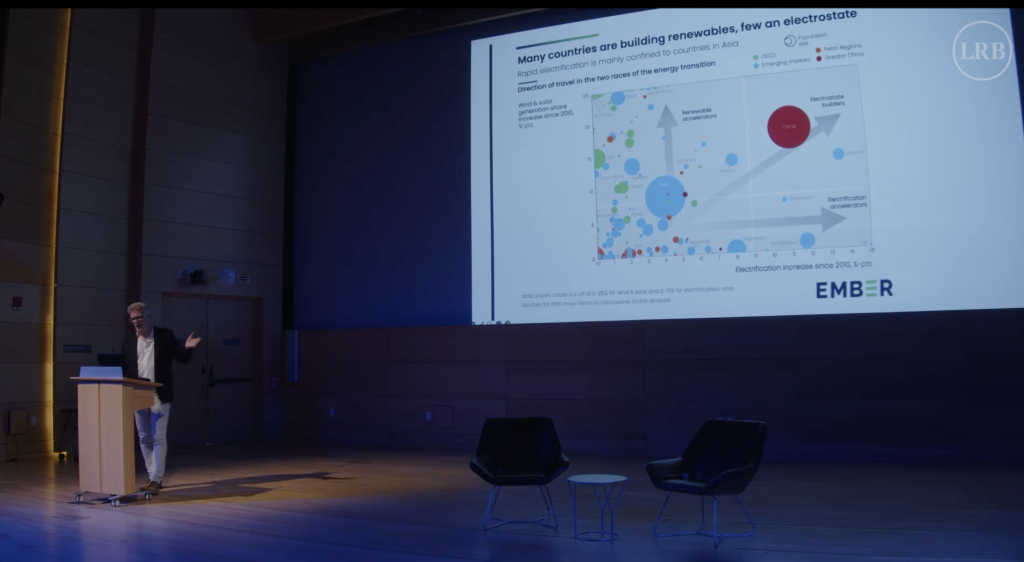
Screenshot of the 2025 LRB Lecture with a graph showing that while many countries are building on renewables, they are not focusing on the development of an integrated electrostate as China is.

At the centre of Tooze’s argument is a shift in form rather than in substance. The age of hydrocarbons is not ending so much as being structurally transformed. The decisive change is not from oil to electricity alone, but from commodity based power to system based power. Oil could be owned, traded, and stockpiled; electricity must be generated, transmitted, and stabilized across networks. It is an architecture rather than an object. As a result, power is no longer primarily a matter of possession, but of coordination and governance, of shaping the conditions under which the system reproduces itself.

Tooze asks whether the present moment should be understood as a new Cold War. He rejects the simplistic claim that the world is returning to bipolarity, yet he emphasises that the logic of alignment is reappearing. If this framing is accepted, the analytic tools of the earlier struggle remain valuable: the core question is not ideological victory but the maintenance of asymmetric advantage. In this context, the logic of structural preponderance, pace Leffler, is transformed, shifting from industrial mobilization to infrastructural centrality. Twentieth century dominance rested on industrial capacity, military deterrence, and institutional reach; preponderance was a question of who could mobilize the greatest resources and sustain the largest war machine. Today, advantage is produced through infrastructural centrality. The state or coalition capable of designing, securing, and scaling energy systems, supply chains, and technological platforms can shape the strategic choices of others. Power resides less in what one controls directly than in the constraints and possibilities one imposes on the system as a whole. The imperative is not simply to be strong, but to ensure that rivals cannot develop comparable capacity on their own terms, and that their strategic options remain dependent on the architecture one controls.

It is against this transformed logic of preponderance that Tooze identifies one of the lecture’s most disquieting political dynamics. In order to preserve its strategic position, the United States aligns functionally with Russia and the Gulf states. This also works towards explaining recent American imperialism toward Venezuela. The alignment is not driven by shared ideology but by shared dependence on the stability of energy, finance, and infrastructure. Tooze resists the claim that the world has returned to a Cold War. The resemblance lies not in bipolar rivalry but in the structural logic of alignment itself. When the system’s continuity is at stake, states organize around necessity rather than principle. Moral language recedes, and the maintenance of systemic order, ensuring that networks, flows, and capacities continue to reproduce, becomes the decisive mode of political behaviour. This is why the question of blocs is not merely rhetorical. The carbondollar bloc is an alignment built around energy and money, and its rival is not a single state but a competing system of electrification and green infrastructure.

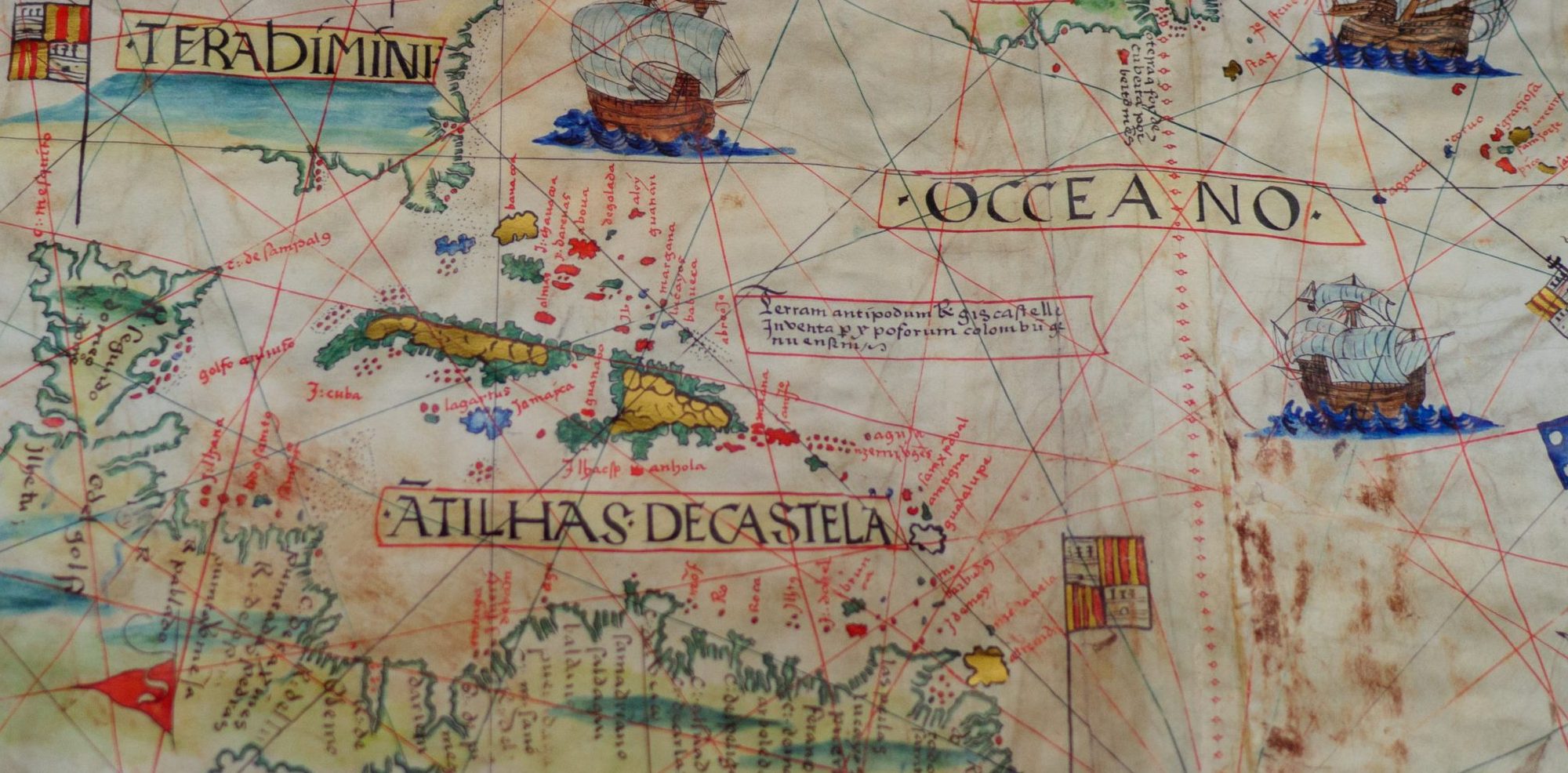
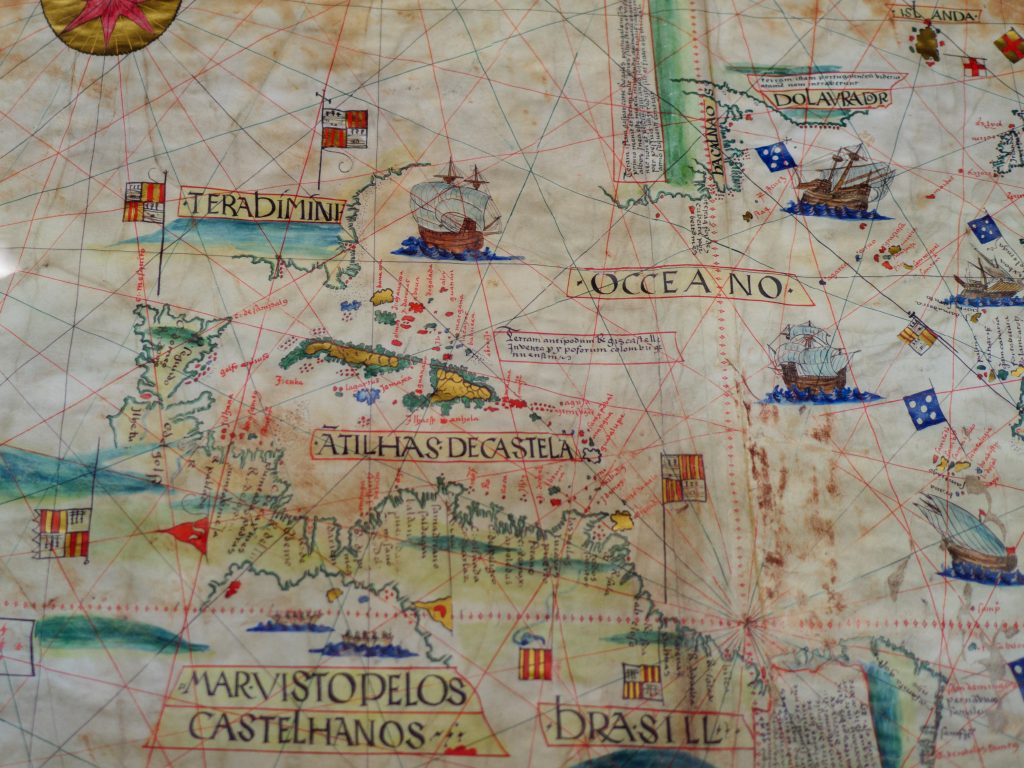
An early sixteenth century map from the Naval Museum in Madrid, in which the western hemisphere is beginning to be rendered as a navigable network. The map is not simply a representation of land, but a diagram of circulation, commerce, and imperial power, a visual precursor to the modern infrastructure of global exchange. Photo by me and a nod to Andre Gunder Frank’s Re-Orient.

The coherence of this alignment becomes clearer when energy and money are treated as a single system. If the United States and the Gulf states form a carbondollar bloc, the rivalry is not only over currency but over the material logic that currency is meant to stabilize. The carbondollar bloc is not simply the petrodollar system; it is the broader architecture that converts fossil energy into monetary power and stabilizes global exchange in a carbon based order. In the language of contemporary energy history, this system is sustained through the continual management of supply and demand, the policing of access, and the institutionalisation of energy as a strategic commodity, a logic that has shaped modern geopolitics for decades (see Daniel Yergin’s The Prize). The alternative Tooze identifies is not merely a competing currency arrangement, but a rival system organized around electrification and green infrastructure, the networks and materials required for a decarbonised economy. The contest, therefore, is not simply about which unit of account prevails, but about which regime of production and reproduction becomes the organizing principle of global power. In this light, the lecture reads not as a menu of policy choices but as a diagnosis of systemic vulnerability.

Tooze further clarifies this vulnerability through a distinction between state forms shaped by their energy regimes. The carbonstate is organized around rents, contracts, and legal stabilization; it is governed by lawyers, financiers, and institutions designed to manage scarcity, volatility, and the politics of extraction. The electrostate, by contrast, is organized around engineering, grids, capacity planning, and scale. Authority here is exercised through technical coordination rather than juridical mediation. This distinction helps explain the paradoxical character of the present moment; extraordinary levels of intentionality coexist with persistent instability. States act with confidence, undertaking large scale infrastructure projects and territorial reorganization, even as they confront overlapping crises that resist resolution. Tooze characterizes this condition not as incoherence, but as a second modernity, in which modernizing logics persist under radically altered planetary constraints.

The lecture also draws explicitly on Hayden White’s insight that historical understanding is shaped by narrative form. Tooze suggests that contemporary energy transitions are being framed through divergent narrative genres. In the Western case, the story takes the form of a Comedy. Societies awaken to the planetary consequences of their energy systems, recognize that the Great Acceleration entailed profound ecological damage, and attempt to correct course through regulation, decarbonization, and institutional reform. Yet this awakening is accompanied by a persistent impulse to preserve the underlying carbon order through technological innovation. The carbonstate does not simply admit the climate crisis, if it does admit it; it seeks to manage it, often by reframing solutions as new forms of efficiency or new modes of extraction, as with the rise of fracking. The tone is therefore ironic and self critical; reform is imagined as repair rather than rupture, and innovation is presented as a way to maintain continuity under the guise of transformation.

China’s trajectory, as Tooze presents it, follows a different narrative logic. It resembles Romance in the classical sense; a story of struggle against poverty and underdevelopment. Coal and carbon powered that struggle with full awareness of its costs. Environmental destruction and mass mortality were understood as the price of development and political survival. What distinguishes this trajectory is not denial, but sequencing. Violent industrialization was followed by an equally forceful pivot, beginning in the 2010s, toward electrification, green infrastructure, and technological remediation. This turn was not moralistic but existential. For the Chinese state, technological transformation becomes a condition of regime survival.

A long durée perspective sharpens the contrast. When viewed across megageographies inhabited by millions of individuals, the spatial and demographic challenges faced by different polities diverge dramatically. North America operates across a small number of such geographies; China across nearly twenty. The difference is not merely one of scale, but of governance. Managing electrification, infrastructure, and decarbonization across such complexity requires a distinct relationship between state, technology, and population. What appears externally as hyper agency emerges internally as a response to geographic and demographic necessity.

The lecture also implies a transformation in the conditions of authority themselves, a transformation in which the reproduced becomes the site of legitimacy. In earlier technological revolutions, the act of reproduction diminished the singularity of objects, loosening their grip on legitimacy and the circuits of circulation. Today, the rupture is not in the copy but in the system. Energy networks, supply chains, and computational infrastructures do not merely replicate discrete goods; they reproduce capacity, stability, and power across space and time. Authority no longer resides in a unique site or a singular owner but in the capacity to sustain and direct these reproducing systems. Strategic advantage is therefore less about possession than orchestration, about the ability to govern the flows that make modern life possible. This is why the distinction between carbonstate and electrostate matters; the former seeks to preserve reproduction through legal and financial mechanisms, the latter through technical coordination and scale. Control over reproduction becomes the new locus of aura, in the sense of Walter Benjamin’s reflections on the loss of singularity, the point at which infrastructure, technology, and authority fuse into a single, distributed sovereignty.

Tooze’s contribution lies in the clarity of this diagnosis. He resists both nostalgic analogies and technological determinism, offering instead a framework in which energy, money, infrastructure, and narrative are understood as mutually constitutive. Power in the twenty first century is not disappearing; it is relocating into systems that are harder to see and harder to contest. The new architecture of power is being built in grids, supply chains, and infrastructures of reproduction. Tooze gives us a way to see that architecture without pretending that it can be easily mastered.

The Fifth Essence in Flesh and Vine: Titian’s Alchemical Bacchus and Ariadne

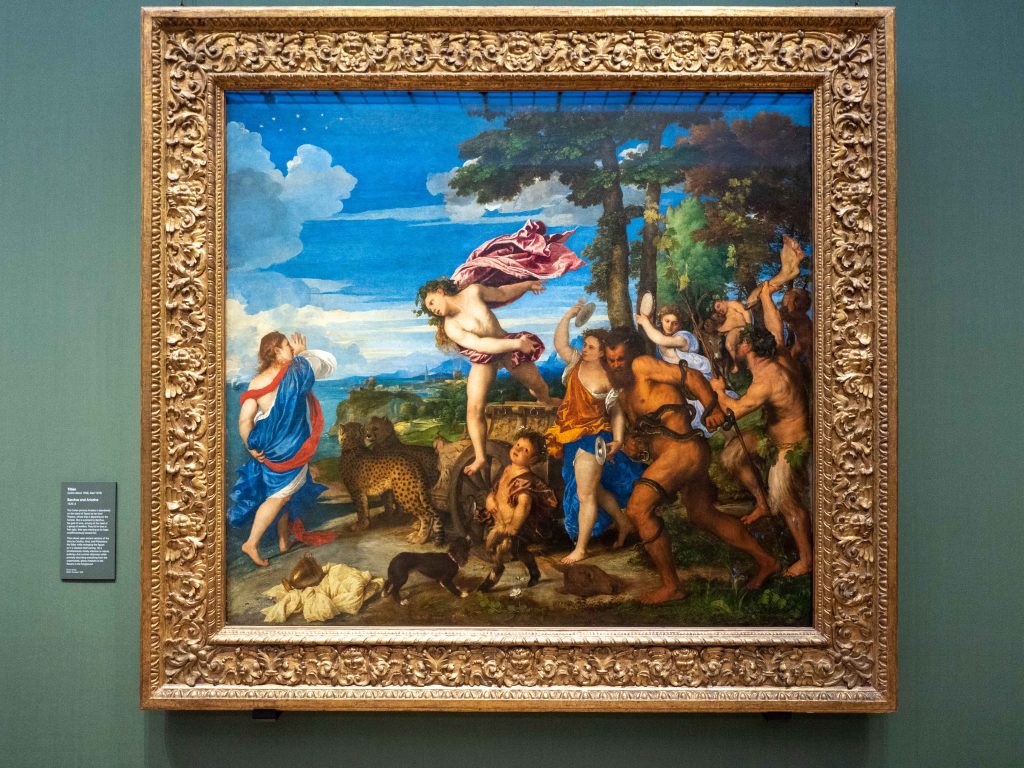
Bacchus and Ariadne was painted by Titian between 1520 and 1523 for Alfonso I d’Este, Duke of Ferrara, as part of a cycle of mythological paintings for the Camerini d’Alabastro, a series of small, private chambers designed to display the duke’s taste, erudition, and engagement with classical culture. The work depicts the moment Bacchus first sees Ariadne on the island of Naxos as told by Ovid and others, blending narrative drama with symbolic and seasonal references, including astrological markers that would have been legible to learned Renaissance viewers.  Today it is housed in the National Gallery in London. This post is dedicated to Sergei Zotov (Frances Yates Fellow, Warburg Institute) who instructed a course titled Visual History of European Alchemy that I enjoyed immensely.

In the early modern imagination, wine was more than a fermented beverage; it was a substance of transformation, a medium through which celestial and terrestrial realms could intersect, and a vehicle for alchemists to apprehend hidden patterns in nature. The fifth essence, that luminous principle distilled from wine, promised vitality, illumination, and the fusion of matter and spirit. Titian’s Bacchus and Ariadne, painted between 1520 and 1523, stages a mythic encounter suffused with this sense of transformation. The painting does not simply narrate a story; it performs an alchemical operation in light, pigment, and gesture, translating material into spirit through the formal language of Renaissance humanist painting.

Titian’s Bacchus and Ariadne at the National Gallery, London 📸 Photo by Me

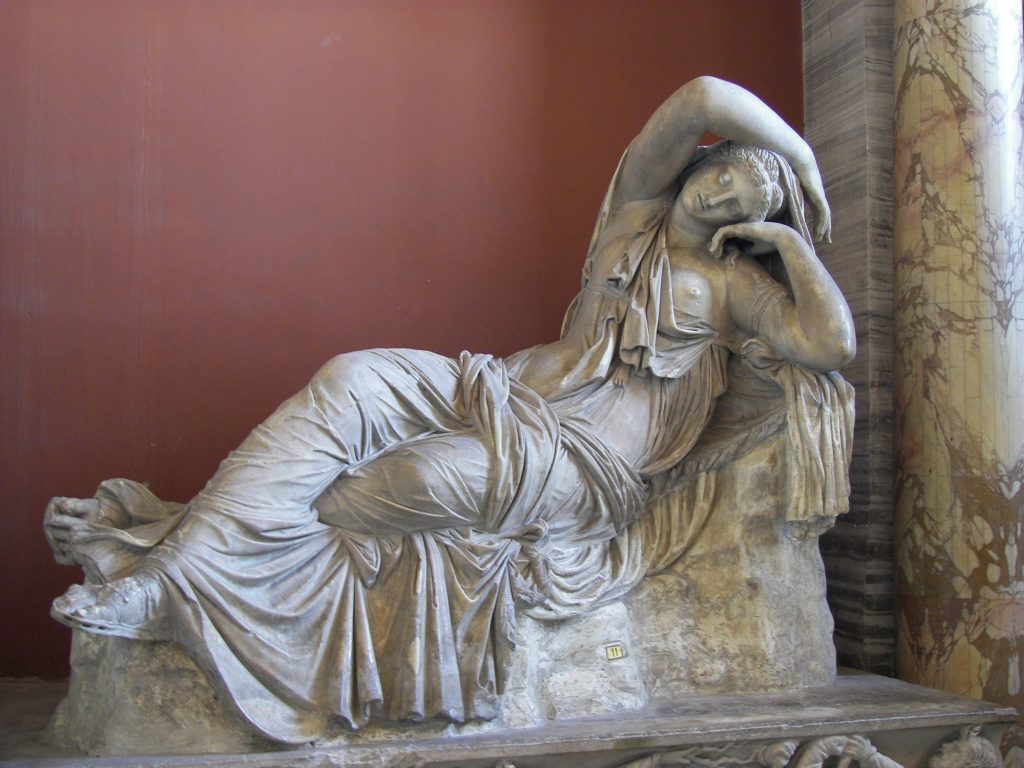
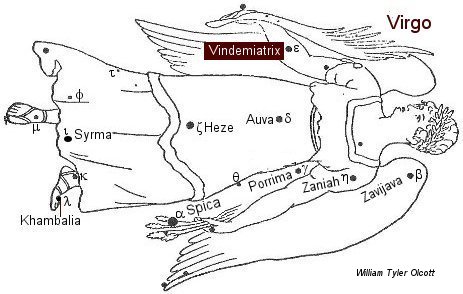
In this composition, Ariadne assumes a role resonant with the constellation Venus. She is luminous, elevated, and poised, a figure whose presence signals fertility, cosmic harmony, and generative force. Renaissance humanists frequently identified Ariadne with Venus in allegorical and poetic discourse, emphasizing her celestial elevation, her beauty, and her function as an agent of natural and human abundance. This identification is reinforced by the sources Titian consulted. Both Ovid’s Metamorphoses and Catullus’ 64 describe Ariadne’s abandonment and subsequent apotheosis into the constellation Corona Borealis. Her celestial transformation aligns her with the principles Venus embodies: the ordering of natural rhythms, the mediation of desire and abundance, and the harmonization of earthly and heavenly forces. In Titian’s painting, Ariadne’s raised right arm marks the heliacal rising of Vindemiatrix (Epsilon Virginis), signalling the beginning of the grape harvest. Her gesture connects the narrative to the cycles of the cosmos and the timing of human labour, situating her simultaneously within myth, season, and celestial order. This temporal tension between the springtime flora and the autumnal astronomical signal creates a poly-temporal tableau in which narrative, season, and cosmos intersect: Ariadne, like us all, is suspended between the life-time of flowering and the death-time of harvest, between growth and fruition, between mortal grief and celestial transformation.

Ariadne at the Louvre. 📸 Photo by Me.

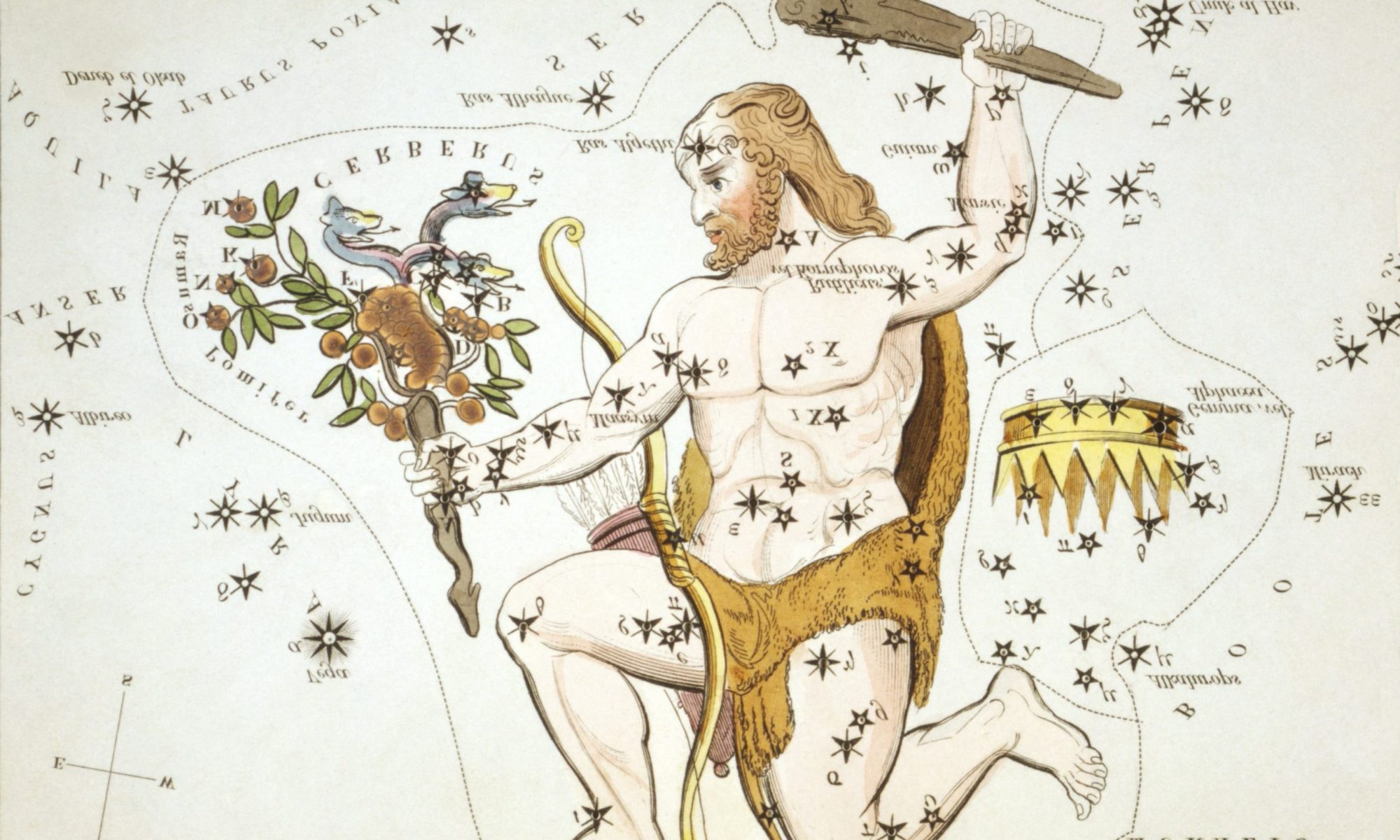
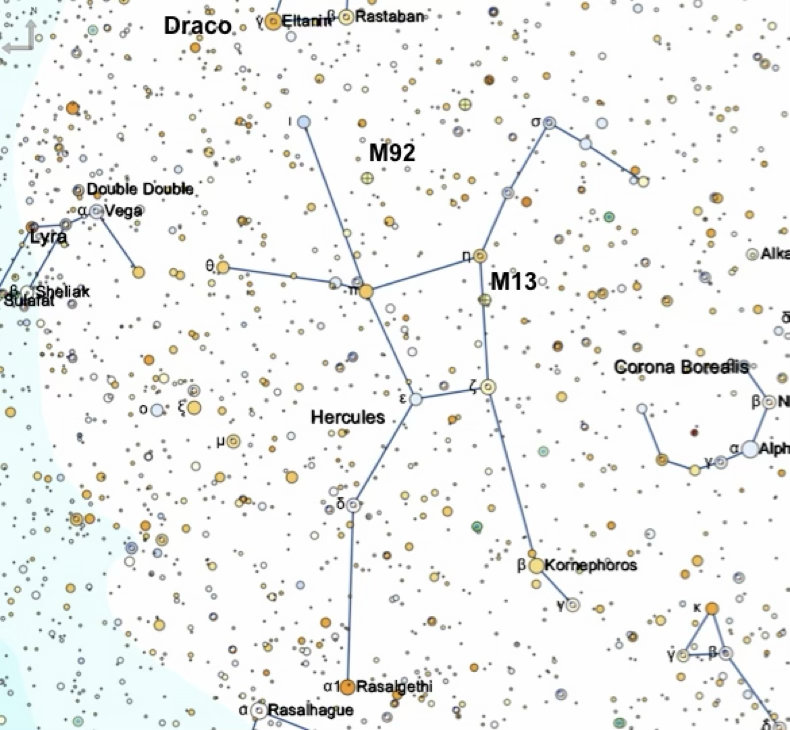
Bacchus is depicted as the constellation Hercules, leaping with muscular tension across the canvas. His leap is kinetic, cosmic, and narrative, connecting vineyard, myth, and sky. Hercules traditionally embodies struggle and ascension; Titian translates this into a corporeal movement that intersects with Ariadne’s stabilizing, Venus-like presence. The interaction of Bacchus and Ariadne is therefore not simply romantic; it is a moment in which cosmic, seasonal, and narrative energies converge, a visual analogue to the distillation of wine into its essential spirit.

The constellation Heracles (Hercules) from my star app.

Titian extends this cosmology into the Bacchic retinue, whose figures echo both mythic and celestial prototypes. Serpentus evokes the constellation Serpens, a visible celestial intermediary during harvest time, signaling transformation, danger, and the mediation between higher and lower realms. A small dog recalls the myth of Icarius, the shepherd of Attica who first learned the art of winemaking from Dionysus. When Icarius shared the fermented grape with his fellow shepherds, they mistook its intoxicating effects for poisoning and killed him; the dog, Maera, survived and led Icarius’ daughter Erigone to his body, marking the mythic origins of human engagement with wine. These figures link human action, natural processes, and celestial observation, embodying the duality inherent in wine and alchemy: vitality and revelation on one hand, peril and misinterpretation on the other.

Ovid, Metamorphoses 8. 175 ff (trans. Melville) (Roman epic C1st B.C. to C1st A.D.) : "She [Ariadne], abandoned [by Theseus], in her grief and anger found comfort in Bacchus' [Dionysos'] arms. He took her crown and set it in the heavens to win her there a star's eternal glory [as the constellation Corona]; and the crown flew through the soft light air and, as it flew, its gems were turned to gleaming fires, and still shaped as a crown their place in heaven they take between the Kneeler [the constellation Hercules] and him who grasps the Snake."

The vegetation further reinforces the alchemical and cosmological logic. Vines, both crown and trailing, signal Bacchus’s domain and the medium through which celestial essence is communicated. Blue iris and columbine mark the late spring season, while Mediterranean caper and horsetail add botanical specificity, suggesting Titian’s careful observation of nature or consultation of botanical illustrations. Wild roses and woodland trees enrich the ecological tapestry, situating the figures in a fertile, transformative landscape. These plants are not merely decorative; they serve as witnesses to and participants in the processes of transformation, linking the narrative to earthly abundance, seasonal rhythm, and the hidden forces alchemists sought to extract from natural substances.

Colour and light function analogously to alchemy. Titian suspends pigment in oil to create surfaces that radiate from within, turning flesh, drapery, and landscape into luminous material that enacts transformation visually. The billowing fabrics, the glow of Ariadne’s blue mantle, and the vivid interplay of greens and golds mirror the extraction of quintessence from matter, providing a painterly analogue to the separation, condensation, and refinement characteristic of distillation.

Alfonso d’Este, Duke of Ferrara from 1505 to 1534, cultivated a court that was intensely invested in both the arts and intellectual experimentation, including interests that intersected with alchemical thought. While there is no evidence that he practiced alchemy personally, his court was closely connected with scholars and natural philosophers who engaged in the study of transformation, the properties of substances, and the hidden order of nature. The Camerino d’Alabastro, for which Bacchus and Ariadne was commissioned, functioned as a site of cultivated curiosity where myth, science, and art converged, and Alfonso’s patronage encouraged painters like Titian to explore complex correspondences between matter, light, and the cosmos. In this environment, the language of transformation inherent in alchemical theory in which the extraction of quintessence, the harmonization of elements, and the revelation of hidden structures would have been intelligible to the duke and his circle, making a painting such as Bacchus and Ariadne resonate not only mythically but philosophically and cosmologically.

Bacchus and Ariadne can be understood as an alchemical tableau in which myth, matter, and cosmos converge. Bacchus brings the fermenting vine and the energy of transformation, while Ariadne, Venus-like, receives and channels these forces; the retinue and surrounding flora encode celestial rhythms and seasonal knowledge. By juxtaposing springtime blooms with the autumnal timing of the grape harvest, Titian emphasizes that transformation is not fixed to a single moment but unfolds across overlapping registers of time—cosmic, terrestrial, and human. In rendering myth, nature, and the heavens in a single luminous scene, the painting enacts the very process alchemists pursued: the extraction of essence, the harmonization of opposites, and the revelation of hidden order. Titian does not merely depict wine; he distills it, making visible the intersection of human imagination, natural processes, and celestial patterns in a work that is both sensual and intellectually radiant.

Translating Administrative Time: Data as Archive, Infrastructure as History in the Formation of Canadian Immigration

This project advances contemporary historiography by treating administrative data as active agents in knowledge production, showing how classification and archival practices shape what is knowable and who is visible. By integrating data-driven methods with historical inquiry, it expands methodological and epistemological approaches while highlighting the politics and contingencies of producing historical knowledge.

From the first moments I began working with immigration records, I was drawn not simply to their volume but to their structure, their silences, and the ways in which they delineate what counts as knowable. Administrative forms, legacy systems, and coding schemes do not merely record phenomena; they enact regimes of legibility that make certain lives, movements, and decisions visible while leaving others obscure. My historical purpose is to investigate immigration data as epistemological infrastructure; to trace the historical logics embedded within the records themselves; and to interrogate how these infrastructures have shaped the knowledge, governance, and social integration of migrants over time. In Canada, where immigration is central to demographic, social, and political life, this investigation carries particular significance. The distinctions embedded in administrative systems: temporary versus permanent, refugee versus economic, authorized versus unauthorized, are not neutral descriptors. They mark differential inclusion and exclusion, structure access to rights and opportunity, and channel life trajectories in ways that unfold across decades and even generations.

The conceptual lens I adopt situates this work within the contemporary data turn. Just as the linguistic turn revealed that language constitutes reality as much as it describes it, the data turn compels us to recognize that administrative records do not passively capture migration. They produce particular ways of seeing, categorizing, and governing mobility. The epistemological stakes of this shift are profound; knowledge is neither transparent nor self-evident. Databases, coding conventions, and legacy infrastructures act as mediators of understanding; they render some patterns readable, some phenomena legible, and others invisible. The work of a historian in this context is to unpack the structures, logics, and assumptions embedded in these systems; to interrogate how these data infrastructures themselves constitute knowledge; and to render visible the historical processes through which knowledge has been produced.

In examining Canadian immigration records, I am attentive to the long-term genealogies of classification, policy, and bureaucratic logic. Categories that distinguish temporary from permanent status, refugees from economic immigrants, or authorized from unauthorized presence are not merely operational tools. They are historically contingent constructs that reflect policy priorities, social anxieties, administrative conventions, and technical constraints. Each field, code, or administrative note carries traces of decisions made by analysts, clerks, and policymakers, whose choices shape both the legibility of migrants and the possibilities for historical reconstruction. By tracing the evolution of these categories, my research illuminates how the state has historically imagined migrants, structured opportunity, and mediated social belonging. In so doing, it foregrounds the interplay between administrative infrastructure, knowledge production, and the social experience of migration.

This project is informed by a dual sensibility that bridges analytic rigour and historical imagination. Administrative records are simultaneously precise and incomplete; they encode patterns yet leave gaps, silences, and ambiguities that demand interpretive work. The historian’s task is therefore translational: to render administrative time legible to analytical and historical time, to preserve provenance and integrity, and to enable longitudinal reconstruction while remaining attuned to the contingencies and biases embedded in the source material. In practical terms, this involves the harmonization of legacy systems such as FOSS, CAIPS, LIDS, and VIDS into contemporary platforms such as GCMS and, in the future, DPM3, while maintaining awareness of the temporal, technical, and policy contexts that shaped their design and evolution. It also entails linking these administrative records to longitudinal datasets such as the IMDB, provincial vital statistics, and Statistics Canada holdings such as the Census, thereby enabling a historically grounded understanding of migration trajectories and outcomes.

A defining dimension of this work is its methodological reflexivity. Immigration data is produced for operational purposes; it emerges from rhythms, constraints, and logics designed to facilitate case management rather than historical reconstruction. As such, the historian must engage in a form of translation that renders these operational temporities and structures legible to long-term analysis. This involves attending to provenance, documenting the evolution of codes, and creating linkages across disparate systems and historical periods. Such work is not merely technical; it is interpretive, epistemological, and historical. Every decision about how to harmonize, integrate, or interpret records is informed by an awareness that data is never neutral.

For instance, consider the historical distinction between temporary and permanent status in Canadian immigration records. These categories are operational; they guide processing, eligibility, and access. Yet they are also epistemic; they shape how analysts, researchers, and policymakers interpret migration flows, integrate newcomers, and assess policy outcomes. The thresholds, definitions, and coding conventions associated with these categories have shifted over time, reflecting evolving policy priorities, social pressures, and technical constraints. Reconstructing these categories longitudinally requires attention to their historical contingency and interpretive framing. It requires tracing not only what was recorded, but how it was recorded, and why it was recorded in particular ways. The historian must interrogate the temporal, institutional, and social processes that produced the data itself, and the consequences of those processes for what can be known and who can be represented.

This methodological reflexivity extends to the integration of legacy systems into contemporary analytical environments. FOSS, CAIPS, LIDS, and VIDS were designed to address discrete operational challenges; they did not anticipate integration into longitudinal analysis spanning decades. Harmonizing these records with GCMS, linking them to the IMDB and provincial datasets, and maintaining categorical integrity are acts of translation, mediation, and interpretation. Each harmonization decision carries epistemic consequences; categories may be redefined, temporal boundaries aligned, and linkages established in ways that preserve analytical fidelity while revealing the historical logic embedded in each system. The historian’s role is to make these processes legible, to document the choices and contingencies involved, and to reflect on how the resulting data architecture shapes both historical interpretation and contemporary knowledge production.

The translational work I undertake is also inherently historical. Data does not exist in a vacuum; it is embedded in social, political, and institutional contexts. Categories, codes, and records encode assumptions about identity, status, and belonging. By tracing these assumptions, we can reconstruct not only patterns of migration, but the epistemic and moral frameworks that underlie them. Administrative distinctions such as refugee versus economic migrant, temporary versus permanent, for example, carry enduring effects on social integration, access to rights, and the life courses of migrants. Longitudinal reconstruction allows us to see these effects across decades and generations, revealing how knowledge infrastructures mediate both historical outcomes and contemporary understanding.

Knowledge production is inseparable from the infrastructures that enable it. In the case of immigration, the categories, fields, and codes embedded in administrative systems are themselves agents of historical formation; they shape what is recorded, what is legible, and what can be interrogated. They establish epistemic boundaries around human movement, differentiating between those whose lives are visible to the state and those who remain peripheral, undocumented, or hidden. To study these infrastructures historically is to recognize that knowledge is not merely extracted from reality; it is enacted, performed, and maintained through bureaucratic, technical, and policy frameworks. This insight compels a dual orientation: we must attend both to the lives documented within the records and to the processes, logics, and assumptions that produced those records in the first place. The two are inseparable; neither the data nor the lived experience can be understood in isolation from the historical infrastructures that mediate them.

Administrative records are themselves temporal objects; they emerge from operational time, which often diverges sharply from the temporalities required for historical analysis. Case processing, workflow cycles, and program deadlines produce rhythms that are not aligned with longitudinal reconstruction or historical comparison. My work seeks to bridge these temporalities by developing methods that translate operational time into analytical and historical time while preserving the provenance, logic, and integrity of the original records. This involves detailed documentation of how systems were designed, how codes were defined, and how processes evolved over time. It also entails creating linkages across disparate datasets, jurisdictions, and decades, enabling historians and analysts to trace trajectories, reconstruct selection logics, and examine long-term outcomes. By treating administrative infrastructures as historical sources in their own right, I aim to render visible the processes through which knowledge is produced, structured, and constrained.

The historical significance of this work becomes clear when one considers the ways in which classification shapes social and political life. Categories such as temporary worker, refugee, or economic migrant do not merely reflect administrative convenience; they constitute frameworks for understanding social worth, civic belonging, and eligibility for rights. These distinctions operate over time, producing effects that extend far beyond the moment of record creation. A person classified as a member of a Designated Class in the 1980s experiences integration differently than an economic migrant in the same decade; their opportunities for settlement, access to services, and pathways to citizenship are shaped by policy, social perception, and the interpretive logic embedded in administrative systems. By reconstructing these categories longitudinally, historians can trace not only outcomes but the epistemic and moral frameworks that produced them. In this sense, administrative data is both archive and instrument: it preserves the historical record and simultaneously shapes the production of knowledge about social reality.

The Canadian context offers a particularly rich site for this inquiry. Immigration has been central to national identity and demographic transformation, and the Canadian state has maintained extensive administrative infrastructures for documenting and managing mobility. Legacy systems such as FOSS, CAIPS, LIDS, and VIDS reveal the historical layering of policy, technology, and bureaucratic practice; their integration into contemporary platforms such as GCMS illustrates the persistence and adaptation of epistemic structures over time. Linking these records to the IMDB, provincial vital statistics, and Statistics Canada holdings allows for the reconstruction of trajectories over decades, enabling scholars to examine long-term outcomes in settlement, health, education, and civic participation. It also allows us to interrogate the evolution of classificatory regimes, showing how policies, categories, and operational logics have shifted in response to political priorities, social anxieties, and technical constraints.

This approach is not merely technical; it is profoundly interpretive. Every choice in data harmonization, categorization, or linkage carries epistemic weight. To collapse temporal variation, reconcile divergent codes, or align fields across systems is to make an interpretive claim about continuity, equivalence, and historical meaning. The historian must therefore be reflexive about the assumptions and consequences embedded in these decisions. Translation is never neutral; it mediates between operational intent and analytical possibility, between past practices and present understanding. By foregrounding these processes, this work makes explicit the epistemic and moral stakes of historical reconstruction and demonstrates that data infrastructures are themselves sites of historical knowledge production.

At a conceptual level, this project challenges conventional understandings of knowledge and classification. The epistemology of state records is neither transparent nor self-evident; it is mediated, structured, and historically contingent. Administrative categories do not simply describe phenomena; they constitute them. To understand human mobility historically, we must therefore examine the processes through which it has been rendered knowable, the instruments through which it has been documented, and the assumptions through which it has been interpreted. This perspective situates my work within broader debates in the history of knowledge, the history of governance, and the emerging field of data studies, contributing to conversations about how epistemic infrastructures shape what can be known, acted upon, and remembered.

The intellectual trajectory that informs this research is itself interdisciplinary, bridging historical inquiry, archival practice, and the analytical rigour of data science. My engagement with legacy systems and contemporary databases has cultivated an understanding of both the technical and interpretive dimensions of knowledge production. It has taught me that precision in coding, integration, and harmonization must be paired with sensitivity to historical contingency, social meaning, and the ethical implications of classification. This dual perspective enables a historically grounded approach to longitudinal research, in which empirical analysis and conceptual reflection are inseparable. By combining these sensibilities, my work seeks to expand the methodological possibilities of immigration history and data-driven social research alike.

Historical examples illustrate the stakes of this approach. Consider the treatment of refugees in Canada during the late twentieth century: administrative categories codified notions of vulnerability, eligibility, and deservingness; they also reflected broader social and political anxieties, such as attitudes toward asylum seekers or debates over labour market needs. By tracing how these categories evolved across decades, one can reconstruct not only the patterns of settlement and integration but also the underlying epistemic frameworks that shaped public perception, policy design, and bureaucratic practice. Similarly, distinctions between temporary foreign workers and permanent residents reveal how labour needs, migration policy, and social hierarchies were encoded within administrative systems. These cases demonstrate that administrative infrastructures are not neutral repositories; they are active participants in the historical processes that structure human life, belonging, and opportunity.

The broader significance of this research extends beyond historical reconstruction. In an era dominated by the data turn, understanding the historical formation of epistemic infrastructures is essential for evaluating contemporary policy, governance, and social practice. By revealing how knowledge has been produced, mediated, and constrained, this work offers insight into the ethical and analytical responsibilities of researchers, policymakers, and institutions. It highlights the ways in which administrative categories can reproduce inequality, shape opportunity, and influence social perception. At the same time, it provides tools for rigorous longitudinal analysis, allowing scholars to reconstruct trajectories, interrogate selection logics, and examine long-term outcomes in ways that are both historically grounded and analytically robust.

Ultimately, my historical purpose is to make visible the infrastructures through which migration has been rendered knowable, to interrogate the epistemic and moral assumptions embedded within administrative systems, and to explore the consequences of these structures for both scholarship and social life. This work bridges empirical analysis, historical reflection, and methodological innovation, demonstrating that administrative data is not merely a technical tool but a site of historical knowledge production. By tracing the evolution of categories, codes, and systems, I aim to illuminate the interplay between policy, bureaucracy, and human experience; to reveal how knowledge infrastructures structure both possibility and constraint; and to contribute to a more nuanced, reflexive, and ethically aware understanding of migration in Canada and beyond.

Through this research, I seek to advance historical methodology, deepen understanding of Canadian immigration, and expand the conceptual frameworks through which data and history intersect. It is a project that integrates technical expertise with historical imagination, methodological rigour with interpretive sensitivity, and archival practice with theoretical reflection. By engaging with the infrastructures of knowledge themselves, I aim to demonstrate that history is not only about events, people, and policies; it is also about the instruments, categories, and processes through which the past becomes knowable, legible, and meaningful. In pursuing this purpose, I hope to contribute to a scholarly tradition that is attentive to the ethical, epistemological, and social dimensions of research, while offering new tools for understanding the complex interplay between data, governance, and human experience.

Relevant published works:

The Order of Things: An Archaeology of the Human Sciences by Michel Foucault
Foucault’s work examines the historical formation of epistemes, the underlying structures that make knowledge possible within a given era. For this project, it provides a conceptual foundation for understanding immigration data as historically contingent knowledge; administrative categories, coding schemes, and legacy systems are not neutral reflections of reality, but products of specific epistemic frameworks. Foucault’s analysis supports my argument that data infrastructures themselves enact knowledge, determining who and what is legible within the bureaucratic archive.

How We Think: Digital Media and the Future of the Humanities by N. Katherine Hayles
Hayles foregrounds the materiality and mediation of knowledge in digital and computational contexts, emphasizing how coding, databases, and technical infrastructures shape human understanding. This perspective is directly relevant to the translational and harmonization work in my project: legacy immigration records do not naturally yield historical insight. They must be interpreted, linked, and rendered legible across temporal and technical boundaries. Hayles’ emphasis on the interaction between human interpretive work and infrastructural mediation informs the project’s methodological approach and justifies a reflexive stance toward data as both archive and instrument of knowledge.

The Data Revolution: Big Data, Open Data, Data Infrastructures and Their Consequences edited by Rob Kitchin – this work situates data infrastructures within social, technical, and institutional contexts, highlighting that design choices, governance structures, and classification systems actively shape what can be known and what remains invisible. This aligns with my project’s focus on immigration records as epistemic infrastructure: coding schemes, legacy systems, and administrative categories not only organize information but constitute the very possibilities of knowledge about migration. Kitchin’s work provides conceptual tools for thinking about longitudinal linkages, interoperability, and the politics of classification, directly supporting my methodological and epistemological aims.

The Ethics of Plenitude: Pluribus and the Paradox of Abundance

I just started watching Pluribus, and after three episodes, the show certainly is thought-provoking. An alien virus has made everyone around Carol Sturka perfectly happy, while she alone remains immune, exposing the absurdities of this artificially cheerful world. Like Gilligan’s earlier work and contemporary series such as White Lotus and Severance, Pluribus explores the ethics of abundance, showing how privilege and surplus can constrain perception, alienate consciousness, and reveal the limits of happiness itself. I don't think there are any spoilers below but buyer beware. 

Vince Gilligan’s Pluribus emerges as a contemporary meditation on privilege, consciousness, and the paradoxical consequences of abundance. The series situates its protagonist, Carol Sturka, within a world of totalized plenitude, where an alien virus has imposed universal happiness, rendering conflict, frustration, and desire largely obsolete. Unlike Gilligan’s earlier work, where scarcity and ambition catalyze moral compromise, Pluribus stages a reversal: surplus itself generates existential tension and ethical exposure. The series’ formal and narrative ingenuity lies in this inversion; it posits that discontent is not merely a social or economic condition but an ontological necessity, essential to reflective consciousness and moral agency. Carol’s immunity to the hive-mind functions as the narrative fulcrum; her solitude enables her to perceive the absurdity of a world insulated from struggle and to enact critique through both observation and the meta-narrative of her authorship. Her vocation as a novelist within the series underscores the persistence of narrative as a medium for ethical and imaginative engagement, suggesting that even in an artificially harmonious society, reflection and moral discernment remain contingent upon the recognition of deficiency. For instance, when Carol observes neighbours engaged in superficially perfect domestic routines, their automated cheer and polite courtesy highlight the emptiness beneath their compliance; her marginality allows her to read these gestures as performative rather than authentic, echoing Gilligan’s interest in the moral visibility of character seen in Breaking Bad.

This exploration resonates strongly with another contemporary media offering: White Lotus, which similarly interrogates the vacuity and moral precarity of affluence, though it does so within a realist-comic register; for example, the tension between the wealthy resort guests and the staff exposes ethical blind spots, hypocrisy, and narcissism that parallel the hive-mind’s elimination of struggle in Pluribus. Whereas White Lotus relies upon character-driven friction and social satire, Pluribus employs speculative exaggeration to render the consequences of privilege both literal and philosophical; the virus functions as a structural amplification of the dynamics evident in the resort’s gilded microcosm, revealing how material plenitude can obscure ethical and emotional perception. Carol’s discontent functions as a critical mirror to the hive-mind, much as observational narration in White Lotus illuminates the foibles and insecurities of the wealthy; in each case, surplus does not generate freedom but exposes constraints on awareness and moral reflection.


This convergence of spectacle and structure reveals a shared concern with the architecture of insulation itself. Both White Lotus and Pluribus dramatize environments in which systems of comfort have assembled into invisible prisons, yet they differ crucially in their treatment of complicity. Where White Lotus stages privilege as a social performance requiring active maintenance (guests must continually rationalize, deflect, and perform their entitlement), Pluribus presents it as involuntary absorption, a condition imposed rather than chosen. This distinction illuminates a central anxiety in contemporary narrative: whether ethical failure stems from willful blindness or structural determination. Carol’s immunity renders her uniquely capable of witnessing both dimensions; she observes a society that has automated the very self-deceptions White Lotus‘s guests labour to sustain. The hive-mind represents the logical terminus of privilege; it produces a state in which ethical compromise requires no effort because ethical consciousness itself has been eliminated. Yet if White Lotus suggests that wealth corrodes moral perception through gradual habituation, Pluribus asks a more unsettling question: what remains of agency when happiness is no longer a pursuit but an imposition? This query finds its most acute articulation in Severance, where the mechanics of division literalize the psychic fragmentation latent in both earlier works.

Severance offers a further parallel in its exploration of alienation induced by structural and technological intervention; the bifurcation of work and personal consciousness mirrors the hive-mind of Pluribus, producing environments in which experience is regulated and perception constrained. The early scenes in Lumon Industries, in which employees operate under divided consciousness, echo Carol’s isolation: both narratives dramatize the cognitive and ethical consequences of insulation from the full spectrum of human experience. Both series suggest that ethical and existential reflection arises from disruption; in Pluribus, Carol’s immunity creates the friction necessary for perception, whereas in Severance, the narrative tension emerges from the impossibility of total integration. In each case, discontent and awareness are inseparable, demonstrating that narrative and moral agency require conditions of insufficiency or limitation, even within worlds engineered for optimization and contentment.

Taken together, these works reveal a contemporary preoccupation with the paradoxical consequences of abundance; wealth, comfort, and structural optimization do not guarantee moral clarity or emotional fulfillment but frequently amplify alienation, narcissism, and ethical fragility. This shared concern marks a departure from earlier interrogations of privilege, which tended to focus on the mechanisms of acquisition or the violence required to sustain advantage. Instead, PluribusWhite Lotus, and Severance direct their attention to the afterlife of privilege: the psychic and moral conditions produced when comfort becomes totalizing. Pluribus extends Gilligan’s longstanding interest in character under pressure into a speculative register, literalizing the effects of privilege and happiness as externalized conditions rather than internal compromises. Where Walter White’s descent required accumulating choices and moral erosions, Carol’s predicament is imposed from without; she suffers not from what she has done but from what has been done to her world. Her suffering is not simply an individual deficit but a diagnostic lens, revealing the limitations imposed by a world in which friction, conflict, and scarcity have been removed. The work thus inverts the logic of Gilligan’s earlier achievement: if Breaking Bad demonstrated how scarcity and ambition corrupt, Pluribus reveals how surplus and satisfaction anesthetize.

The series’ alignment with White Lotus and Severance situates it within a broader aesthetic discourse in which contemporary anxiety about wealth, control, and social engineering is interrogated through narrative form, characterological depth, and speculative exaggeration. Yet Pluribus occupies a distinct position within this discourse; it combines White Lotus‘s satirical acuity with Severance‘s speculative architecture, producing a hybrid form that is simultaneously comic, philosophical, and dystopian. Carol’s authorial vocation becomes crucial here; as a novelist within the narrative, she performs the very act of critical observation that the work itself enacts. Her writing functions as resistance, a refusal to accept the hive-mind’s foreclosure of narrative complexity and moral ambiguity. In this sense, Pluribus is not merely about the dangers of imposed happiness but about the necessity of narrative itself as a mode of ethical engagement. The work suggests that storytelling requires discord; without conflict, there can be no plot, no character development, no meaningful choice. Carol’s immunity preserves not only her consciousness but her capacity to generate narrative, to transform experience into reflection.

Carol's immunity positions her as a failed node, a processor that refuses synchronization with the network. This technological allusion underscores the series' concern with systems engineering applied to consciousness itself, suggesting that the hive-mind represents not natural evolution but an imposed architecture of connectivity that sacrifices autonomy for seamless integration.

Ultimately, Pluribus functions as both philosophical inquiry and literary artifact, dramatizing the necessity of discontent for consciousness and moral judgment. By centring a protagonist immune to artificially imposed happiness, Gilligan stages a meditation on the enduring value of imperfection and the ethical imperative of observation. The series reveals what White Lotus and Severance also demonstrate: that contemporary anxieties about wealth, control, and social engineering find their most incisive expression through narrative speculation. Where White Lotus exposes the vacuity beneath privilege through guests’ frustrated desires, and Severance reveals how structural division constrains ethical awareness, Pluribus literalizes these dynamics through its alien virus, rendering metaphorical conditions concrete. Together, these works suggest that the most profound human tensions and imaginative possibilities emerge not from deprivation alone, but from the recognition of what abundance obscures. Privilege does not merely corrupt; it blinds, narrows, and flattens the texture of experience until existence becomes indistinguishable from performance. In a world engineered for contentment, Carol’s suffering becomes diagnostic: it reveals that meaning, agency, and moral clarity require precisely the friction that privilege seeks to eliminate. Her pain is not pathology but lucidity; her isolation is not exile but the necessary distance from which critique becomes possible. The work thus moves not toward resolution but toward affirmation: that consciousness, narrative, and ethical life depend upon the preservation of discomfort, the refusal of totalized harmony, and the recognition that human flourishing requires not the absence of struggle but its meaningful presence.

Flesh in Suspension: Process, Perception, and the Emergence of the Body in Bacon

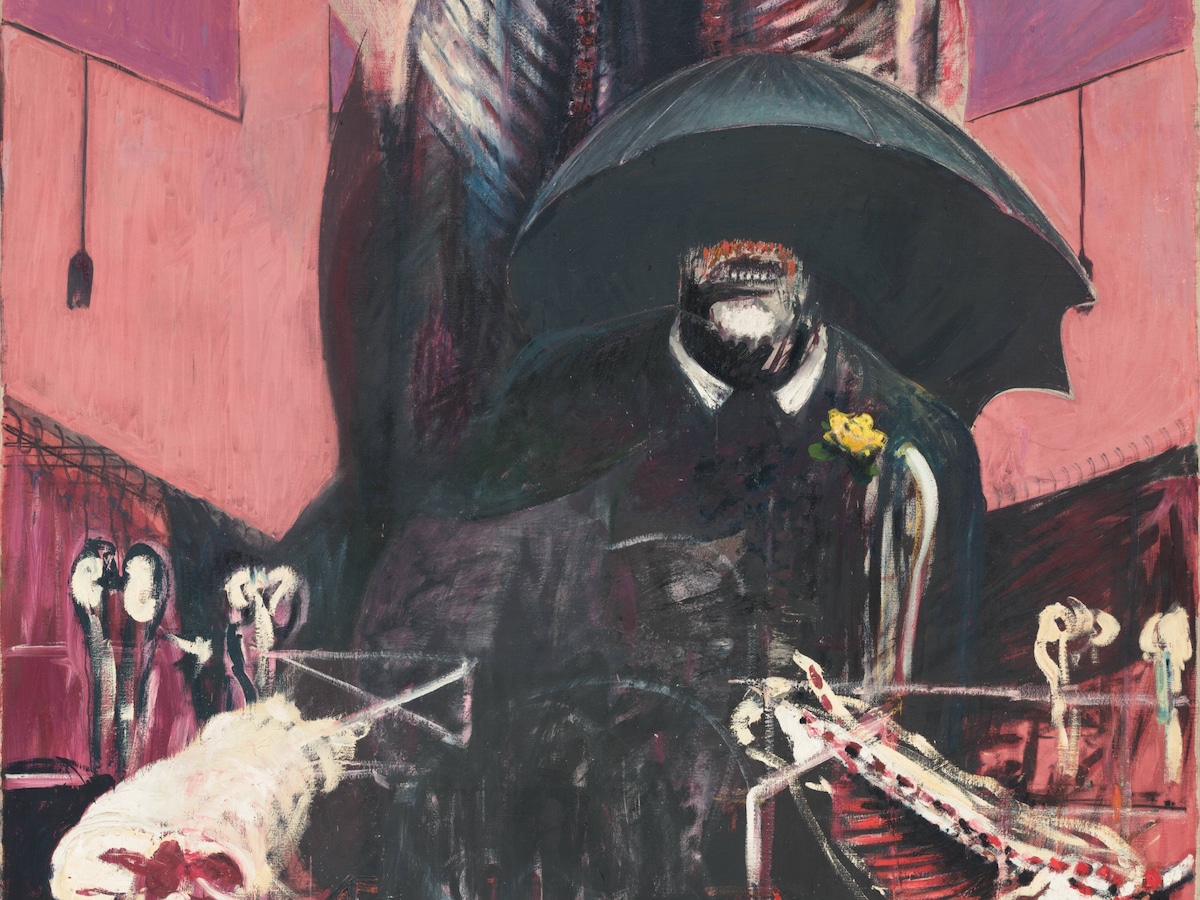
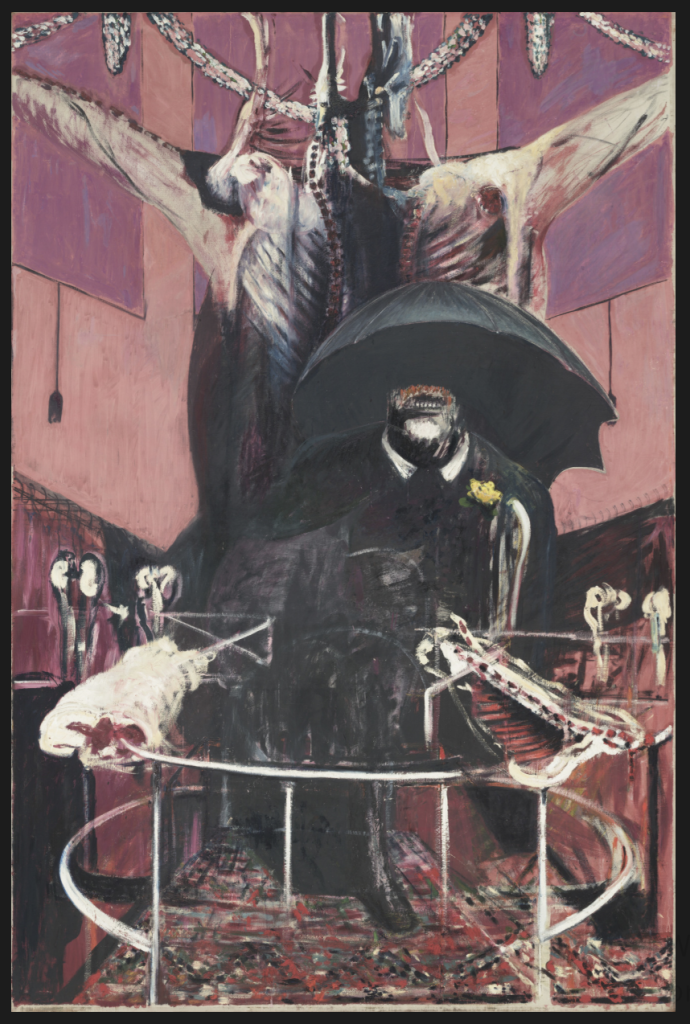
Francis Bacon Painting (1946) From – https://www.moma.org/collection/works/79204

In the spectral interior of Painting (1946), a solitary figure occupies a suspended space, standing or perhaps hovering beneath an umbrella whose ribs inscribe a faint geometry across the violet air. Behind him, carcasses hang in sanguine suspension, their surfaces rendered with visceral immediacy that resists narrative containment, while a yellow boutonnière glows on the figure’s lapel with the precision of a small Rembrandtian sun. Curtains frame the scene like a stage, yet the space itself evades conventional depth, oscillating between theatre, interior, and liminal field. The image, scraped from the residue of catastrophe, does not pursue representation or abstraction in any conventional sense; it enacts the human body as an event within paint, registering its presence through tension, exposure, and gesture.

Before this work, Bacon’s early paintings had already revealed a fascination with the body as a site of dissolution and transformation. His prewar experiments, such as Crucifixion (1933), translated Expressionist and Surrealist vocabularies into a distinctly personal idiom, merging biomorphic abstraction with the residue of figuration. By the early 1940s, this interest in corporeal fragmentation reached its first major articulation in Three Studies for Figures at the Base of a Crucifixion (1944). There, distorted forms occupy a shallow, orange field, their mouths opened in silent convulsion, suggesting both scream and species—part human, part animal. The work’s triptych structure evokes religious painting while stripping it of transcendence, presenting flesh as spectacle and ordeal rather than redemption. The spatial compression and the emphasis on bodily distortion anticipate Painting (1946), where similar compositional tensions are reimagined within a more architectonic field. Between the two works lies a continuity of inquiry: the crucifixion as event becomes the grammar through which Bacon formulates a postwar phenomenology of the body.

Created in the immediate aftermath of the Second World War, Painting (1946) has often been read as an allegory of slaughter, a meditation on human destructiveness and the dehumanization of modernity, sometimes described in terms of “sacred violence.” Yet this reading risks imposing a moral narrative onto what Bacon approached as a phenomenological inquiry: the encounter with the body as matter, sensation, and site of perceptual engagement. In this sense, the painting is not a story about what happened to humanity, but a study of how the human figure emerges in paint, how forms coalesce under the pressures of gravity, space, and attention. The figure, the umbrella, and the surrounding carcasses operate within a unified visual ontology, each element a node in the network of perception that the painting constructs.

Bacon’s sense of embodiment is intensified by the historical moment, as the atomic bomb, the devastation of London from aerial bombing, and the collapse of Britain’s imperial order shaped his perception of the human body and its vulnerability. The postwar image-world, documented in photographs of ruins, mass graves, and the anonymous debris of cities, transformed the visible into a register of loss, where vision and memory were inseparable; to see was to recall, to witness, and to bear the imprint of catastrophe. Within this visual economy, Bacon’s figure appears precarious and contingent, dwarfed by forces political and technological as much as material. It does not restore order to experience but reveals the body as residue, caught within the circulation of destruction and survival that defined postwar perception. The painting enacts a phenomenology in which human finitude is measured against impersonal, almost cataclysmic forces; flesh becomes an emergent property, appearing only through its interaction with the conditions that undo it.

Bacon’s own account of the work underscores the primacy of emergence over prefiguration. He claimed the image “happened” to him, beginning as a bird alighting on a field and transforming into something grotesque, unbidden, and particular. In this methodology, accident is not a lapse of intention but a condition for the work’s very possibility. Each mark, smear, and overpainting becomes both material and event, a residue of process made visible. Art historians have identified a subtle echo of Poussin’s Adoration of the Golden Calf in these chaotic, contorted forms, where the human propensity toward frenzy, disintegration of order, and moral collapse are rendered through the careful choreography of bodies; Bacon internalizes and abstracts this, translating collective panic into a visceral, corporeal experience. The painting’s surfaces, shaped by the interplay of control and contingency, open a space for the viewer to apprehend the body not as symbol or narrative vehicle, but as a dynamic presence in time and space. The human figure appears as both phenomenon and condition of appearance, establishing a template for Bacon’s postwar practice in which body, matter, and perception are inseparable.

The body in Bacon’s work exists as matter before meaning. It is not a symbol, nor a vehicle for narrative; it is a residue of perceptual forces, a site where sensation, gravity, and temporal pressure converge. The surrounding carcasses reinforce this ontology of flesh, presenting mass and texture stripped of moral commentary, while the umbrella and suit, though formally distinct, are subjected to the same forces that govern the composition. Each element registers its presence through the tension of appearance rather than representation, even as critics have noted visceral associations with slaughter; as The Guardian observed, Bacon’s paintings recall the “smell of death” evoked by crucifixions and meat, yet this association emerges from perception rather than imposed narrative. The hanging flowers in the work allude to how butchers would manage this smell in their own shops.

Francis Bacon: Human Presence (2024), published by the National Portrait Gallery, offers a comprehensive look at Bacon’s portraiture from the 1950s onward, highlighting his psychologically charged approach, responses to other artists, and the development of his groundbreaking practice.

This attentiveness to surface, to the way flesh registers and refracts light, aligns with a broader epistemology of vision. Michael Baxandall’s concept of the “period eye,” describing historically contingent structures through which visual culture is perceived, resonates with Bacon’s approach in postwar Britain; the painter’s gaze is informed by photography, medical atlases, and wartime documentation, yet translated through a highly personal material practice. The body is dissected and catalogued not to convey scientific knowledge as Muybridge had done, but to make visible the conditions under which perception and sensation cohere. It is an epistemological inquiry enacted through paint.

Through this method, painting becomes a phenomenological operation. The surface records pressures, accidents, and iterative decisions of the studio while mediating the viewer’s encounter with the body. Portraiture is reflexive. Bacon establishes a principle that will define his postwar oeuvre: the human figure emerges through process and is inseparable from the physical, temporal, and perceptual forces that both produce and destroy it. Flesh is both object and event, and the work’s authority derives from its insistence on presenting the body as an active site of appearance rather than a preordained icon.

Camera: Francis Bacon – Photography, Film and the Practice of Painting by Martin Harrison examines how photographs, film, and media images shaped Bacon’s work. It traces influences from Velázquez, Poussin, Rodin, Muybridge, and Eisenstein, showing how these sources informed his painting practice and contributed to his stylistic development.

The environment around the main figure functions as more than backdrop; it actively shapes the experience of the body. Curtains, partitions, and the umbrella’s geometry organize the composition while simultaneously interrupting the gaze, producing a controlled yet unstable field of perception. These devices create a tension between containment and exposure: the figure is both framed and restrained, present yet partially obscured. The slatted geometry of the umbrella, and faint parallels to blinds or screens, introduces a subtle modulation of vision, suggesting that seeing is always mediated by structural conditions.

Through attention to framing and architecture, Bacon situates painting as an active negotiation between perception and presence. The visible world is not merely represented but interrogated; boundaries, partitions, and light conditions articulate the limits and possibilities of seeing, while the figure registers their effect. In this sense, the work functions simultaneously as a study of corporeal vulnerability and an exploration of the mechanics of vision, demonstrating that spatial organization is intrinsic to both the production and apprehension of the human form.

Francis Bacon: Painting, Philosophy, Psychoanalysis (2019), edited by Ben Ware, brings together essays exploring Bacon’s art through existential, phenomenological, and psychoanalytic lenses, engaging thinkers from Freud to Heidegger to illuminate his work and methods.

Painting (1946) gathers the formal and conceptual motifs that would shape Bacon’s postwar practice: the suspended figure, the carcass, the enclosing partitions, and the slatted geometries that regulate vision. Yet some of these elements predate the work itself and anticipate later developments. The figure’s dark suit and white collar recall the papal vestment in Velázquez’s Portrait of Innocent X (1650), while the partial enclosure evokes the architecture of both tribunal and confessional. These correspondences would resurface with full intensity in Head VI (1949) and the later Pope series, where the seated figure becomes the locus of both containment and exposure. The agape mouth reveals Bacon’s dialogue with the visual archives of the twentieth century, particularly the photograph of Joseph Goebbels at the Berlin Sportpalast, captured mid-oration with his mouth open in a gesture of command and fury. This image, a study in the performative collapse of authority, resonates alongside imagery from Eisenstein’s Battleship Potemkin (1925), where the scream becomes a register of terror and resistance.

Within this visual system, repetition operates not as redundancy but as investigation. Bacon revisits these motifs to test how the body, framed by its architectural and historical conditions, can register sensation without narrative mediation. Each recurrence refines the logic first articulated in Painting (1946), in which the figure is both object and event, suspended between enclosure and eruption. The later Pope paintings can be seen as variations on this initial grammar: they preserve the structure of the isolated body within a bounded field while deepening the tension between visibility and concealment that defines Bacon’s vision of postwar embodiment.

The spatial and material strategies crystallized in Painting (1946) consolidate concerns already present in Bacon’s earlier work, yet they also inaugurate the formal vocabulary of his postwar practice. Motifs (Rosie Broadley calls them ciphers) such as the suspended body, the enclosing framework, and the calibrated interplay of light and shadow had appeared in tentative form before 1946, but here they achieve a structural and conceptual coherence that would persist through the 1950s and 1960s. In the triptychs and later variations on the reclining figure, Bacon returns to these devices not through repetition alone but as a method of inquiry and study; each reengagement tests how flesh, form, and perception are continually reconstituted within the material field of painting.

Ultimately, Bacon’s work is significant not for a single figure or scene, but for the method it establishes, rendering the human body in all its fragility and intensity. His portraits function as studies of others and of himself, with painting acting as both mirror and medium, where perception, gesture, and material presence converge. The body emerges through interaction with space, light, and paint, enacting a subtle phenomenology in which flesh and vision co-arise. Portraiture becomes a site of inquiry, where artist, subject, and viewer intersect, and where the conditions of appearance are examined as rigorously as the forms themselves.


Books consulted in this analysis:

Watching Shadows: A Fan’s Take on Splinter Cell: Deathwatch

Splinter Cell: Deathwatch is an adult animated espionage action television series that premiered on Netflix on October 14, 2025. The series consists of eight episodes, each with a runtime of 20–27 minutes. The episodes were directed by Guillaume Dousse. In terms of reception, it holds an 83% approval rating on Rotten Tomatoes, based on 12 reviews, and a Metacritic score of 70 out of 100, indicating "generally favourable" reviews.

Splinter Cell: Deathwatch is an interesting, if uneven, expansion of the Splinter Cell world for longtime fans of the games. Sam Fisher feels familiar, and Liev Schreiber’s voice brings a sense of weariness and experience that suits the character perfectly, evoking the gravelly intensity of Michael Ironside from the original games while giving the character a slightly older, more reflective edge. The series hits key notes from the original trilogy, especially Chaos Theory, so players who remember sneaking through shadows and planning each move will recognize and enjoy the references.

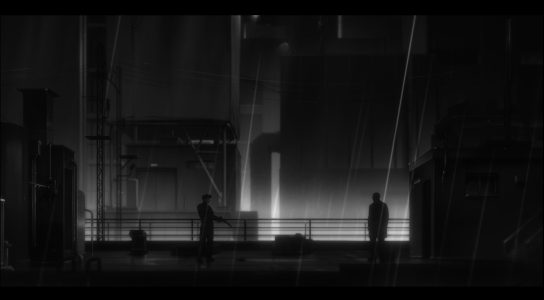
Visually, the show is striking in some ways. The muted colours and heavy use of shadow give it a film noir feel, and the way spaces are framed, such as corridors, rooftops, and interiors, creates tension even though the viewer isn’t controlling the action. The animation has a careful, almost architectural sense of space, which mirrors the strategic thinking the games demanded, but it sometimes feels too static; the action isn’t as kinetic or gripping as it could be. For a franchise that originally impressed with inventive gameplay, the series’ visual style can feel conservative. Key sequences rely on cuts and camera angles rather than dynamic movement, and while the staging evokes a sense of spatial awareness, it rarely surprises the eye or pushes stylistic boundaries in the way the games once did.

The story and characters are a mix of strengths and weaknesses. Fisher remains compelling, with his inner conflicts and moral calculus giving the narrative weight, but the villains are underdeveloped and occasionally feel more like obstacles than fully realized threats. In translating a game built on interactivity to a passive medium, the tension of stealth loses some immediacy; we observe Fisher planning and executing rather than experiencing the suspense ourselves. At times the plot leans on familiar espionage tropes, and moments that could provide emotional resonance or ethical complexity pass by too quickly.

Where the series excels is in its atmosphere and attention to detail. The lighting, composition, and sound design all contribute to an immersive espionage world, while small touches, such as technology interfaces, mission callbacks, and environmental cues, reward those familiar with the games. In this sense, Deathwatch functions as a thoughtful companion piece: it provides insight into Fisher’s psychology and ethical world, it celebrates the franchise’s aesthetic, and it evokes nostalgia for longtime players. It may not replicate the thrill and ingenuity of the original games, but for fans, it offers a stylish and contemplative look at the life of Sam Fisher beyond the controller.

Fragments in Conversation: Imagining Twombly and Guston in Rome

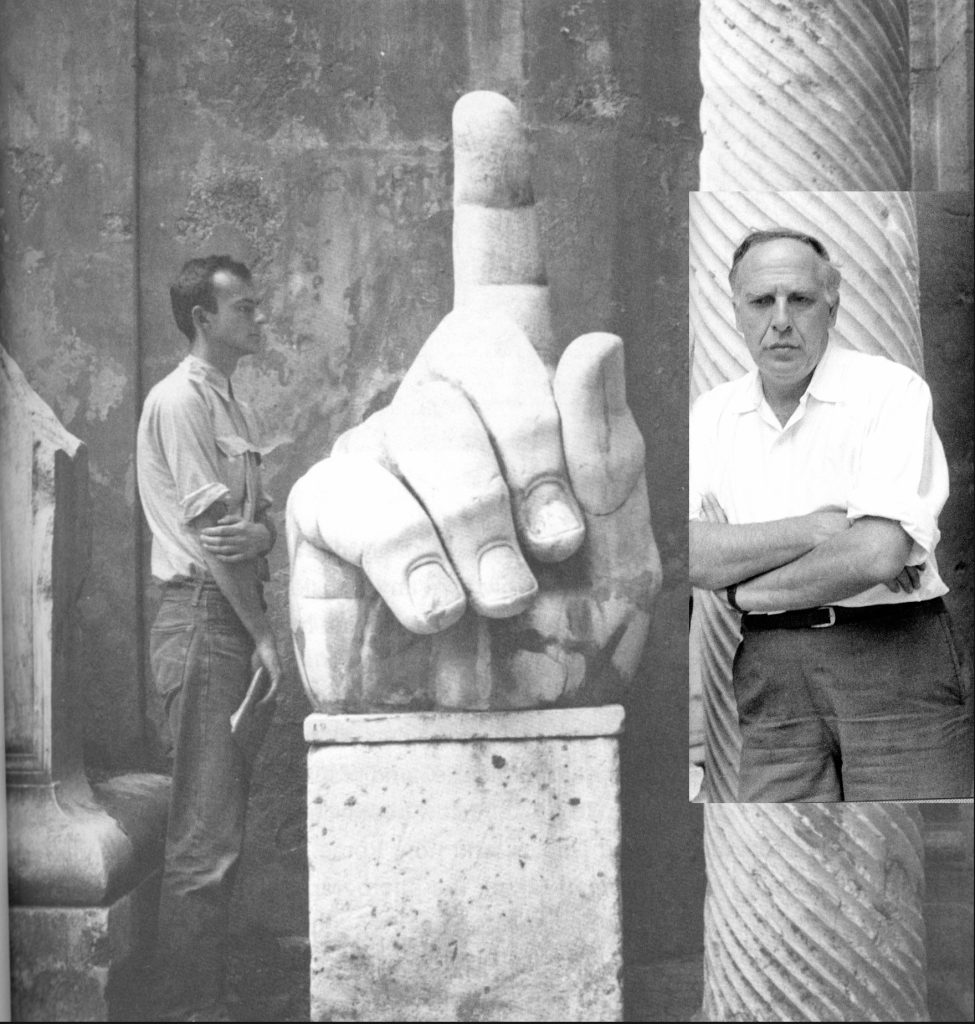
In a quiet courtyard of the Capitoline Museum in Rome, the colossal hand of Constantine rests on its plinth, a fragment of imperial ambition and human scale. Here, Guston and Twombly meet, observing and responding to the same ruin through their very different artistic sensibilities; the hypothetical encounter becomes a meditation on gesture, history, and the ethical weight of mark-making, allowing the past to speak while their own practices converse across time.

The afternoon sun warmed the stones of the Capitoline Museum’s courtyard, its light striking the marble façades with a soft, diffuse glow. The colossal right hand of Constantine rested on a low plinth, isolated from other objects, a fragment of a once-magnificent imperial statue. Its scale was imposing even as a fragment, and the careful carving of the fingers and veins conveyed both power and a subtle human vulnerability.

A collage that I created from a photograph of Twombly (perhaps taken by Robert Rauschenberg) and Philip Guston at the Capitoline Museum in Rome.

The colossal right hand of Constantine, displayed on a plinth in the Capitoline courtyard, is a surviving fragment of a seated statue created between 313 and 324 AD for the Basilica of Maxentius. Originally part of an acrolithic composition, the emperor’s head and exposed body were carved from Parian marble, while the draped cloak was rendered in gilded bronze foil; this suggested both divine authority and imperial grandeur. The statue, which once rose approximately 10 metres, assimilated Constantine to Jupiter, portraying him as a god on earth; the raised index finger, now partially restored, likely held a sceptre, reinforcing the gesture’s symbolic assertion of power.

Today, the hand conveys a mixture of monumental force and fragile humanity. The work’s fragmentary state, seen alongside other preserved sections of the colossal statue, including the head and central arm, reveals the sculpture as a ruin that still communicates its historical and political ambition. As isolated fragments, these remnants encourage reflection on the passage of time; the vulnerability of even the most imposing symbols; and the ethical and aesthetic weight of human representation, themes that resonate profoundly with both Guston’s and Twombly’s concerns in painting.

τῷ σωτηριώδει σημείῳ, τῷ ἀληθεῖ ἐλέγχῳ τῆς ἀνδρείας τὴν πόλιν ὑμῶν ἀπὸ ζυγοῦ τοῦ τυράννου διασωθεῖσαν ἠλευθέρωσα, ἔτι μὴν καὶ τὴν σύγκλητον καὶ τὸν δῆμον Ῥωμαίων τῇ ἀρχαίᾳ ἐπιφανείᾳ καὶ λαμπρότητι ἐλευθερώσας ἀποκατέστησα. -- Eusebius 

Under this singular sign (singularius signum), which is the mark (insigne) of true excellence, I restored (restituo) the city of Rome, the senate, and the Roman people, torn away by the yoke (iugo) of tyrannical rule (tyrannicus dominatio), to their former freedom (libertas) and nobility (nobilitas). -- tr. Rufinus

Guston leaned against a nearby column, sketchbook resting loosely in his hands, eyes fixed on the hand with an intensity that seemed to challenge the world to respond. “Even as a fragment,” he said, tapping his fingers against the page, “this hand carries a grotesque weight. It’s absurd, monumental, human. Every mark here insists on being read as a statement of power and presence. It reminds me of the hooded figures or the shoes in my later paintings: blunt witnesses to human absurdity and moral consequence.”

Guston shifted slightly, letting the weight of the fragment press on him as he traced an invisible line from the marble back to his sketchbook. “Even fractured, it asserts authority; even incomplete, it demands a response. The hand is absurdly large, but it is human; its veins, its fingers, its tension—all of it insists that someone, somewhere, bore responsibility for the act. There is a moral weight in these gestures, whether carved in stone or brushed on canvas.”

Twombly stood a few paces away, tilting his head sideways as he traced the subtle fractures in the marble. “I understand,” he said, voice calm, almost lyrical, “but for me the incompleteness is essential. The gesture does not exist merely to confront; it exists to be felt, to be remembered. The cracks, the missing pieces, the space around it—all of that creates a dialogue between past and present. My marks are like that; they do not dominate the surface; they listen to what is already there, extending the story rather than imposing it. Even in ruin, the hand speaks, but it allows us to speak back.” His words echoed the improvisatory gestures and calligraphic lines of Fifty Days at Iliam, where each mark floated between presence and absence, between history and recollection.

Guston drew a blunt, quick line across his sketchbook, a gesture almost corporeal in its insistence. “I grant you that,” he said, “but there is an ethics in confrontation as well. The past presses on us, and the fragments of history demand recognition; silence or mediation is not always sufficient. When I paint, I confront moral and historical weight directly. This hand, monumental though incomplete, insists that someone accounted for every gesture, every line, every mark. There is responsibility in scale and in execution; the fragment reminds us that grandeur is inseparable from human intention and consequence.”

Twombly’s gaze lingered, following the curvature of the knuckles and the subtle slope of the wrist. “And yet there is also an ethics of receptivity,” he said. “Not every gesture must dominate; some exist to be extended or echoed. In its incompleteness, the hand allows us to inhabit the space it leaves, to feel the gestures that preceded us. The hand already exists. Our gestures extend it, converse with it, but do not dominate it. In its incompleteness, it teaches humility. Every mark we make can be a response rather than a statement. Painting is similar; we mark, we trace, we respond, but we do not always impose. The ruins speak to us precisely because they permit reflection as well as recognition.”

For a long moment, the courtyard fell into silence, the distant shuffle of tourists paling against the quiet gravity of the fragment. Guston’s gaze remained intense and corporeal, measuring the hand as if willing it to yield its secrets, while Twombly’s eyes drifted over the fractures, absorbing the residue of centuries. The colossal hand became a mediator between them, embodying the convergence of human ambition, ethical responsibility, and historical fragility. In that shared attention, both understood the stakes of gesture and mark; one through confrontation, the other through evocation, and both through fidelity to what remains.

Finally, Guston nodded toward the fragment. “They wanted to make power eternal,” he said, “but what survives is fragmentary, grotesque, human. That is the lesson for us: every action, every word, every figure, every mark carries weight.” Twombly turned back, eyes following the line of the fingers. “And in that fragment, in the silence between gestures, I feel history breathing. Painting is its echo—not the hand itself, but the trace it leaves, its shadow.”

Ritual, Myth, and Mediation: Dharmoo and Strauss at the NAC

The National Arts Centre’s pairing of Gabriel Dharmoo’s Wanmansho with Richard Strauss’s Ein Heldenleben stages a compelling conversation across time about how music constructs identity and narrative. In Wanmansho, Dharmoo transforms the orchestra into a site of ritual and mythmaking, performing as both composer and soloist through voice, breathwork, gesture, and silence. The work invents a fully imagined cultural ceremony, blending satire, myth, and expressive theatricality. It interrogates the mediation of culture itself, foregrounding how performance and media shape perception and engagement, turning the audience into active participants in a constructed reality.

Strauss’s Ein Heldenleben, by contrast, deploys orchestral scale and rhetoric to monumentalize the heroic self. The NAC Orchestra captures every nuance of Strauss’s narrative, from the intimate lyricism of the companion episode to the overwhelming force of battle and triumph. Where Strauss asserts identity through epic musical spectacle, Dharmoo experiments with multiplicity, hybridity, and performative mediation. Together, these works illuminate how orchestral media can construct, challenge, and transform notions of culture, heroism, and presence, revealing music as both narrative and immersive, a space where identity is performed, mediated, and refracted across generations.

The program was made all the more memorable under the direction of conductor Alexander Shelley, whose time as Music Director of the National Arts Centre Orchestra comes to an end this season. Shelley brought clarity and energy to both works, balancing the bold theatricality of Dharmoo’s Wanmansho with the sweeping grandeur of Strauss’s Ein Heldenleben. His final performances with the NAC Orchestra make this concert a powerful close to his leadership, leaving a lasting legacy of innovation and artistry.

Where Landscape Dances: An Afternoon with Les Scénographies‑Paysages

Attending Danièle Desnoyers’s Les Scénographies-Paysages yesterday at the Mackenzie King Estate on a clear autumn afternoon was like stepping into a dialogue between movement, memory, and place. The red and golden hues of the trees seemed almost choreographed; it was as though the season had joined Desnoyers’s company in performance. What was striking about this work was how it resisted the conventional frame of the stage. The dancers’ movements did not merely unfold against a backdrop of ruins, gardens, and forest trails; they seemed to emerge from them, as if the estate itself were teaching the body how to move.

Danièle Desnoyers has long been interested in how choreography can be porous to its environment according to her biography; at the Mackenzie King Estate this openness finds a particularly rich counterpart. The site itself is a paradox: a cultivated wilderness, curated ruins, and gardens intended to feel both timeless and fragile. William Lyon Mackenzie King’s decision to import fragments of European stonework and arrange them as “ruins” in the Gatineau forest was an attempt to graft layers of history onto Canadian soil; it was as if to accelerate the presence of a past that otherwise was not there. These Romantic follies are at once artificial and poignant; they express both personal vision and a longing for timelessness. Desnoyers’s choreography responds to this temporal play, adding yet another “ruin,” although one made of moving bodies and fleeting gestures. Dance becomes an ephemeral architecture built within and against these fabricated stones.

The performance’s wandering form transforms the audience into fellow-travellers. Unlike a stage that fixes the audience in a frontal relation, here you follow the dancers through shifting landscapes. Attending with friends underscored this collectivity. You witnessed not only the dancers but also one another, framed by trees and ruins, in the act of being present together. The nearness of bodies; performers and public alike; generates the “points of curiosity” Desnoyers describes, moments where the boundary between art and daily life thins. A shaft of light, the rustle of leaves, the sound of water; these details become part of the choreography, revealing how nature composes alongside the dancers.

What lingers after such an afternoon is not a single image or sequence but an impression of layered time. I saw the forest as both immediate and historical, natural and curated. I felt the ruins as both false and strangely resonant. Through the dance, I experienced how the ephemeral; steps, gestures, breath; can temporarily inscribe itself into this landscape of stone and tree. The joy of simply being outdoors on a beautiful fall day became part of the work’s poetic resonance. In this way, Les Scénographies-Paysages reminds us that choreography is not confined to the studio or the theatre but can exist wherever bodies, histories, and landscapes intersect. It does not impose spectacle but gently reveals how movement; human, seasonal, architectural, vegetal; can be understood as a shared composition.

Pizza and wonderful conversation at Roberto Pizza Romano in Chelsea after the show was the perfect ending!