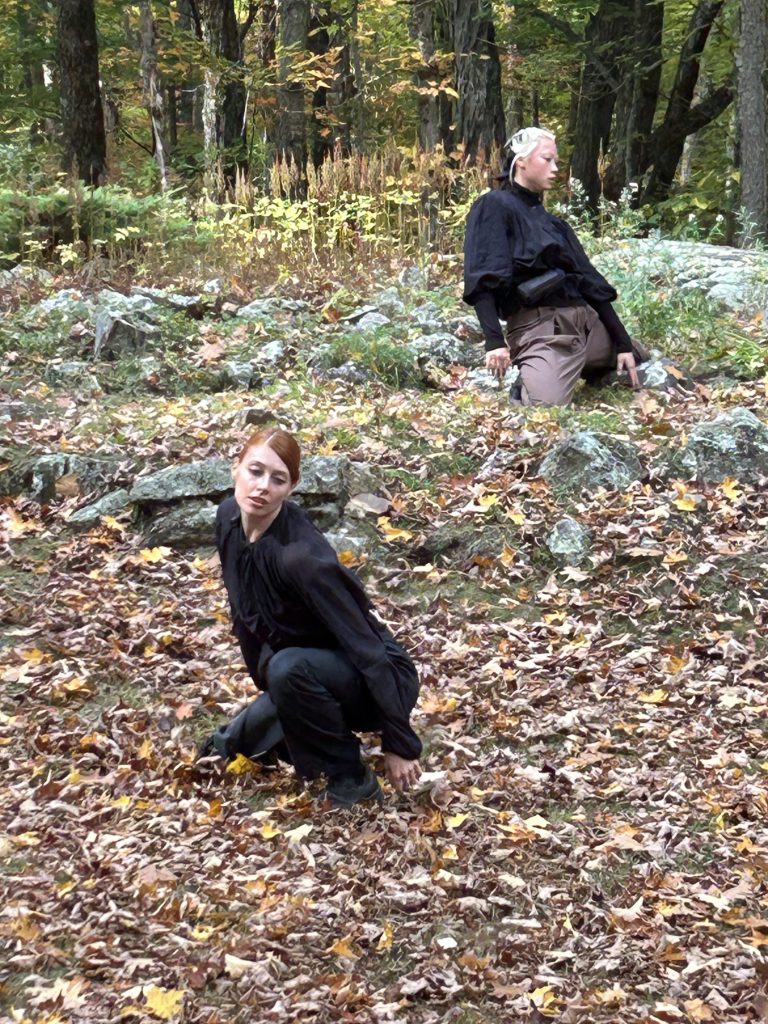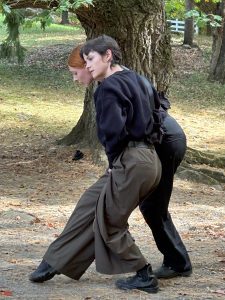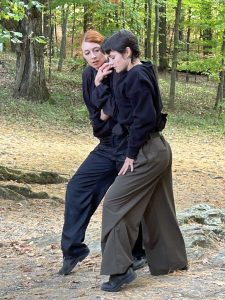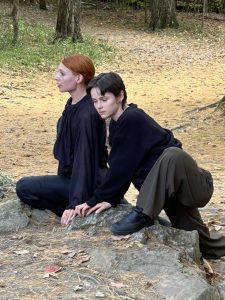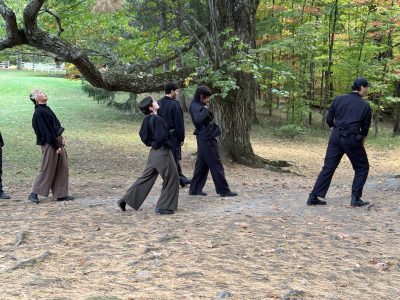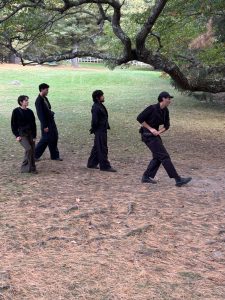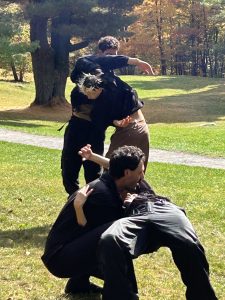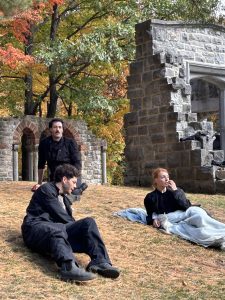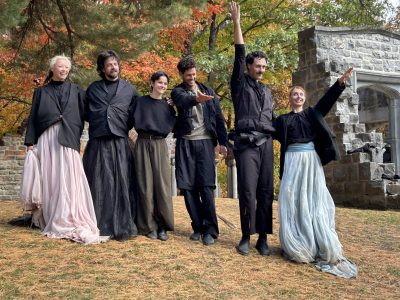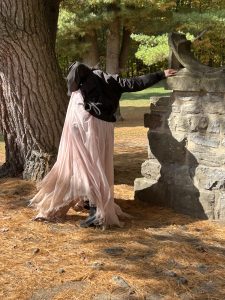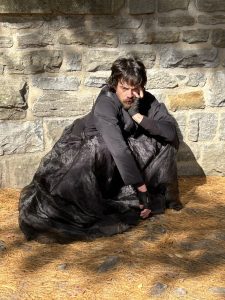


Côté’s production of Hamlet at the National Art Centre frames the entire experience through the logic of the theatrical event itself. The line the play is the thing operates not only as a quotation but also as a guiding principle that shapes the performance from first to last. The adaptation does not rely on spoken dialogue to carry Shakespeare’s narrative. Meaning is constructed through movement, light, shadow, reflection, and the choreography of bodies. The story unfolds as an inquiry into how performance produces knowledge and how attention completes what is staged. Theatre becomes both subject and instrument, and dance becomes the language through which the drama articulates its tensions. In this sense, the production invites a parallel with the argument that narrative is never a neutral container for events but a formal act that constitutes meaning: that the shape given to a story is itself an interpretive choice with ethical and epistemological consequences.

Shadow functions as a central dramaturgical force. The scene in which the murder of Hamlet’s father is rendered behind a curtain through silhouette replaces literal visibility with outline. The audience does not witness the act directly; what appears is its contour, traced in darkness. Ballet and contemporary dance intersect here, as classical lines convey formality and ceremonial control, while modern gestures communicate secrecy, rupture, and emotional volatility. Meaning emerges from what is withheld as much as from what is shown. The shadow does not obscure the event; it stages interpretation. This is precisely the condition that narrative theory identifies at the heart of all emplotment ( to borrow a structural term from Ricœur): the “real” event remains inaccessible, and what circulates in its place is a formal rendering: a shape cast by choices about what to foreground, what to withhold, and what mode of telling to inhabit. Light shapes the form, darkness intensifies it, and movement becomes both narrative and affective vector, recalling the way Renaissance painters used chiaroscuro to guide the viewer’s perception and ethical response.

Reflection plays an equally significant role in this adaptation, particularly in the scenes with Ophelia. Mirrors multiply her presence and destabilize spatial certainty. Her body appears refracted across surfaces, creating a sense of doubling that echoes her psychological disorientation. Dance amplifies this effect: fluid contemporary movement expresses fragility and inner turmoil, while balletic lines maintain compositional clarity. The mirrored field alters perception; the audience sees Ophelia seeing and being seen. Identity becomes contingent, produced through both movement and reflection. There is something here that resonates with the understanding that subjects are themselves constructed through narrative framing — that selfhood, like historical agency, is not given in advance but takes shape through the modes in which it is represented and received. In these moments, the production recalls art historical strategies in which surfaces and reflections extend narrative space and implicate the observer in the construction of meaning.

Shadow and reflection establish a visual and kinetic grammar that defines the performance. The stage becomes an environment where visibility and motion are constantly negotiated. Darkness frames action, mirrors extend bodies, and light directs attention. Ballet articulates hierarchy, restraint, and ritual, while contemporary movement conveys hesitation, grief, and affective complexity. Together, they allow the story to resonate without words. The choreography operates as a media system in miniature: bodies, light, shadow, and reflective surfaces are channels through which narrative and myth circulate. The mode of telling, be it tragic, fragmented, or spatially dispersed, is not incidental to the story but constitutive of it. The audience participates actively, offering attention that completes the circuit of performance and sustains the story’s symbolic force.


In this adaptation, Hamlet functions less as a text to be illustrated than as a structure to be inhabited through movement. Dance becomes the primary vehicle of meaning, with ballet’s formal clarity and historical discipline intersecting with the grounded immediacy of contemporary choreography. Their interaction produces a field in which tension, hesitation, and violence are expressed spatially and temporally rather than verbally. Narrative emerges through embodied relation, through shifts in weight, proximity, rhythm, and duration, allowing the tragedy to be experienced as choreography of thought rather than recitation of plot. The emplotment is kinetic rather than verbal — but it is emplotment nonetheless, a formal imposition of shape upon event that determines what the story means and how it is felt.
Within this system, light, image, and staging operate as conditions of perception rather than decorative devices. They shape how action becomes visible and how attention is organized, and, importantly, this has always been true. The technologies through which bodies, shadows, and reflections have been arranged for collective attention, from the chandelier and the mirror to the frame and the lens, are not neutral instruments but formal systems with their own conventions of visibility, their own ways of directing the eye and organizing what is seen. Hamlet is a play that has always known this. It stages the act of looking, implicates its characters in acts of observation and misreading, and turns the court into a field of competing interpretations. This production inherits that preoccupation and extends it into the visual and kinetic register, treating the choreography of light and shadow, body and reflection, as the medium through which the drama’s central questions are posed. To attend to that form, to ask how light falls, how a body is framed, how shadow defines rather than obscures, is to recognize that the conditions of seeing are themselves a kind of argument. What endures is not textual fidelity but the activation of performance as a living process, where a story as resistant and generative as this one remains viable because it is continually re-encountered in new formal conditions. The production does not interpret Hamlet so much as it enacts the interpretive process itself, staging the operations through which any event becomes legible, any tragedy becomes intelligible, any myth retains its claim on the present. In this sense, the play is the thing, not as quotation, but as proposition about performance itself and about the formal traditions through which performance has always made the past available to sight.