Anton Jäger’s Hyperpolitics is an innovative and stimulating work, particularly in its synthesis of temporality, media, attention, and political action. Yet, for me, many of its underlying concerns have been explored elsewhere and some of the arguments assume facts not entirely agreed upon. Its originality lies less in identifying an entirely new condition than in offering a compelling temporal framework for understanding it.
The unit that increasingly matters in contemporary political life is no longer primarily the institution, the policy, or the program. It is attention: what can be seized, held, reactivated, and converted into action. As attention becomes scarce and contested, politics takes the form of a recurrent present: an endless sequence of now-moments in which history remains informationally available but temporally inert. The problem is not that people have forgotten the past, but that the past no longer binds the future in durable ways. Each new cycle demands renewed justification; each response competes with the last for attention and dominance. Under these conditions, collective political life begins to resemble less a project unfolding over time than a loop that repeatedly restarts itself.
Jäger’s Hyperpolitics helps name the outcome. The diagnosis is not merely that politics is intense or ubiquitous, but that politics becomes extreme while political consequences fail to accumulate. That is, politicization spreads; moral contestation, identity conflict, scandal, protest, and spectacle proliferate; yet the public sphere does not produce stable conversions of anger into lasting leverage. Hyperpolitics is characterized by visibility without consolidation: people remain highly engaged, but engagement is routed into forms that rarely harden into durable power. This is why the phenomenon feels simultaneously omnipresent and strangely ineffective. The political consequences are not neutral: when demands for change must repeatedly begin again, existing structures of power retain the advantage. In this sense, a politics of perpetual disruption can produce a radically conservative outcome.
To see why attention generates this pattern, it helps to consider the political work of calculation. Calculation is often treated as a technocratic virtue, an impartial method for making the world legible. But calculation has always been a governmental art. A modius of annona, an old grain-measure, is not a neutral thermometer as I have written about Solvej Balle’s fictional On The Calculation of Volume. It transforms abundance into a quantity that can be inventoried, transferred, taxed, rationed, and compared. Measurement makes resources governable; it converts living variability into a grid or into data that institutions can act upon. “Empire,” on this view, is not only conquest. It is the capacity to render the world enumerable so that control can travel through numbers. Calculation thus creates a political order by turning experience into administrable units.
Yet calculation-by-measure is only one temporality. It addresses what the world is made of: grain, land, labour, output, risk. Hyperpolitics adds a different mechanism: it re-organizes when political life happens. Attention economies do not simply deliver information; they impose a rhythm. Feeds and notifications deliver politics as an ongoing queue of present-tense stimuli. The past can be “known” in clips and summaries, but it functions more like background texture than like historical constraint. What matters is not the narrative that accumulates but the update that breaks through. The present is recurrent not because the world repeats, but because attention is engineered to re-select the newest emergency. History becomes a warehouse of content rather than a force with temporal authority.
This temporal regime produces a distinct kind of mass politics, one that resembles action while undermining its consolidation. Collectives require time to become collectives: time for trust, for organizational learning, for deliberation, for negotiating internal differences, for maintaining commitments that outlast the immediate outrage. When attention is constantly pulled away, collective life cannot thicken. Participation becomes easier than persistence. It becomes abundant in expression and poor in carryover. Hyperpolitics therefore yields exactly Jäger’s paradox: extreme politicization without political consequences, because the conditions that normally allow consequences to accumulate, such as continuity, institutional reproduction, and shared orientation toward a future, are weakened.
The recurrent day is a political form of time. It is the experience of living inside a loop where each moment claims total relevance. Such loops do not abolish time; they hollow it. They keep politics perpetually at the point of recommencement, so that the costs of organization never get amortized across a genuine future. The day is replayed, and therefore the future is perpetually postponed. Postponed, not by censorship, but by tempo. Even memory is converted into a new present: past events are resurfaced, but they do not bind action in the way history binds reform, strategy, and policy.
Joyce’s relation to this problem clarifies what is at stake. James Joyce‘s Ulysses can be read as staging a world in a day: the whole universe compressed into measured form. But the day in Joyce is not merely a loop; it is a constructed totality, thick with recurrence that carries meaning rather than simply refreshing itself. Joyce’s measured “modern” present demonstrates how a bounded duration can be made world-making. In his work, recurrence is not necessarily the negation of history; it is a technique for assembling experience so that it coheres. Where hyperpolitics tends to convert recurrence into churn, Joyce converts recurrence into structure. One can feel the universe in a day because form knits the day into a meaningful pattern; one can feel the universe as a perpetual now because the attention economy keeps re-initiating the day without allowing durable synthesis.
Hyperpolitics can therefore be understood as an aesthetic and administrative failure to turn attention into form. Calculation gives the world a grid through which it can be governed; hyperpolitics gives the public sphere an endless feed through which it can be endlessly reacted to. In both cases, time is disciplined, but differently: calculation organizes the world into units, while hyperpolitics organizes the subject into cycles of activation. The result is a political field saturated with conflict but institutionally thin, where genuine moral intensity fragments into episodic performance rather than accumulating into durable power. People are not absent; their time is.
Political effectiveness, then, cannot be secured through persuasion or better arguments alone. It depends upon the temporal conditions through which collective life can endure: forms capable of preserving memory, sustaining commitments, and converting attention into persistence. Joyce shows how recurrence can accumulate through memory, history, and anticipation; Balle asks what remains possible when repetition no longer carries experience forward. Hyperpolitics suggests, pace Fukuyama, a different end of history: not the resolution of political conflict, but its endless recurrence; not the disappearance of politics, but the present’s inability to consolidate into a durable future. It also demands an impossible political subject: a citizen-self continually called upon to attend, respond, judge, and mobilize, despite the finite demands of work, care, family, and ordinary life.
The problem, then, is not simply that attention is captured, but that it is continually recaptured, repeatedly returning politics to an intensified present while leaving the work of world-building unfinished. The endless self is an impossible political subject. The political challenge is therefore to create forms of continuity capable of making the present consequential: institutions, memories, and commitments through which collective action can outlast the cycle that produced it. This is not an escape from the present, but a refusal to be perpetually confined to it. Without such structures, the storm continues. With them, repetition might become something more than recurrence, and politics something more than the endless experience of beginning again.
As the Immigration Act of 1976 approaches its fiftieth anniversary, it invites renewed examination through historical approaches that have expanded considerably since the time of its passage. For many years, scholars have interpreted the Act as a major turning point in the modernization of Canadian immigration policy. This body of work emphasizes the introduction of formal planning mechanisms, the articulation of national immigration objectives, and the consolidation of a shift toward selection practices that were presented as non discriminatory. Within this traditional historiography, the Act appears as a rational and technocratic reform that professionalized immigration governance and aligned Canada with emerging humanitarian norms.1
1. See Ninette Kelley and Michael Trebilcock, The Making of the Mosaic: A History of Canadian Immigration Policy (Toronto: University of Toronto Press, 1998); Freda Hawkins, Canada and Immigration: Public Policy and Public Concern (Montreal & Kingston: McGill‑Queen’s University Press, 1988); Valerie Knowles, Strangers at Our Gates: Canadian Immigration and Immigration Policy, 1540–2007 (Toronto: Dundurn, 2007); Gerald E. Dirks, Canada’s Refugee Policy: Indifference or Opportunism? (Montreal: McGill‑Queen’s University Press, 1977); Triadafilos Triadafilopoulos, Becoming Multicultural: Immigration and the Politics of Membership in Canada and Germany (Vancouver: UBC Press, 2012).
This article proposes a different interpretive frame. Drawing on insights from visual history, particularly Martha Langford’s argument that photographic practices shape cultural memory and that images are never neutral (see A History of Photography in Canada (McGill‑Queen’s University Press, 2025)), it suggests that immigration law can be understood as a representational system that operates in ways similar to visual media. Langford’s work demonstrates that images are produced through choices about what to record, how to frame it, and how to circulate it. These decisions do not simply document reality. They construct it. This insight offers a productive analogue for examining the tools, categories, and classificatory practices that structure immigration legislation, including the specific administrative and data infrastructures, including redesigned application forms, centralized registries, personal information banks, sponsorship records, and statutory reporting practices that accompanied its modernization such as new data systems, registries, and reporting practices. Like photographic technologies, these systems determine what information is captured, how it is organized, and how it is made legible to the state. This analogy underscores how immigration law, like photographic practice, produces legibility through selective capture, structured framing, and controlled circulation.
Applying this perspective to the Immigration Act of 1976 shifts attention from administrative modernization to the representational work performed by the state. The Act did more than reorganize bureaucratic procedures or codify policy objectives, it made certain values and categories legible in law. Through the criteria it established, the categories it formalized, the data infrastructures it relied upon, and the forms of belonging it legitimized, the Act participated in the construction of an official image of the Canadian nation. It defined who could and who could not enter the national frame and on what terms, shaping the contours of national membership with the same deliberation that a photographer brings to the composition of an image. These representational choices circulated through annual plans, parliamentary debates, public statistics, and international commitments, giving the Act’s image of Canada a durable public presence.
Reconsidering the Act through this lens underscores its role as an instrument of national self definition. Rather than treating the legislation as a neutral administrative response to demographic or economic pressures, this approach highlights the ways in which immigration policy functions as a representational technology that selects, frames, and circulates particular visions of the national community. This perspective opens new avenues for understanding the evolution of Canadian immigration policy in the late twentieth century and invites further engagement with methodological approaches that foreground the cultural, epistemic, and visual dimensions of statecraft.
Immigration officials had already begun this representational work a decade earlier with the introduction of the 1967 points system, itself an outgrowth of the White Paper on Immigration that Minister Marchand tabled in Parliament the year before and the Immigration Regulations, Order-in-Council PC 1962-86 that eliminated overt racial discrimination from Canadian immigration policy. Designed to replace long‑standing racial preferences with a formalized and ostensibly neutral method of selection, the points system (see Immigration Regulations, Order-in Council PC 1967-1616) marked a significant shift in how the state imagined and organized potential membership. It translated the idea of the desirable immigrant into data by reducing it to measurable attributes such as education, occupation, language ability, and adaptability. This translation depended on new administrative capacities and emerging data‑collection systems that enabled officials to quantify personal characteristics, standardize assessments, and track both sponsorship and applicants across categories in ways earlier regimes could not. These systems did more than streamline processing. By determining what information and data mattered, how it was categorized, how it was reported, and how it circulated within the bureaucracy, they shaped the very terms through which immigrant desirability could be imagined.2
2. From Report of the Interdepartmental Committee on Computer-Assisted Immigration Processing System Appendix 3, May 16, 1983: The system must capture all overseas immigrant, visitor, and returning‑resident cases; store all case‑processing data in an electronic file accessible to authorized post staff; and make all program‑analysis data elements available online to NCR users, including any additional elements shown to be necessary.
Although presented as an administrative improvement, the points system functioned as a representational tool in its own right. It signalled a move toward a universalist and technocratic vision of belonging, one that sought legitimacy through transparency and objectivity while still reflecting the priorities and assumptions of its designers. These developments laid the conceptual and infrastructural groundwork for the Immigration Act of 1976, which would expand and codify this representational logic within a comprehensive statutory framework.
The broader intellectual and policy climate of the period reinforces this shift. As Northern Sparks: Innovation, Technology Policy, and the Arts in Canada (MIT Press, 2022) demonstrates, the years following Canada’s Centennial and Expo 67 in Montreal were marked by a national preoccupation with technological modernity, state‑supported innovation, and new modes of cultural self‑representation. Governments experimented with planning tools, information infrastructures, and cultural programs as ways of articulating a modern Canadian identity. This environment shaped immigration policy as well. Officials operated within a political culture that increasingly valued technocratic solutions, measurable outcomes, and the capacity to project a coherent image of Canada to both domestic and international audiences. The points system and the statutory framework that followed emerged from this moment, one in which technology, policy, and national self‑imagination were understood as mutually reinforcing.
The Immigration Act of 1976 should be understood as part of this same national project. It extended the technocratic, future‑oriented ethos that characterized Canada’s post‑Expo 67 moment and embedded it within a comprehensive statutory framework. By formalizing systems of selection, planning, and long‑term demographic management, the Act positioned immigration as a central instrument through which the state could articulate and project an image of Canada’s future. Its emphasis on objectives, categories, data, and coordinated planning reflected a broader belief that national identity could be shaped through administrative design and supported by emerging data infrastructures. In this sense, the Act functioned not only as legislation but as a representational statement about the kind of country Canada intended to become.
For immigrants to Canada prior to 1967 it was the “admissible” class that defined the selection criteria. The three admissible classes were the Ethnic Preference Class, the Relative Class, and Independents, workers in occupations for which they were selected. The first group included British, French, United States and Commonwealth citizens from self governing dominions. These immigrants faced no barrier to entry save sufficient funds. The second group was relatives and included brothers and sisters and “immediate family” such as children and parents. There were no restrictions on this class until 1967 save for health and character requirements. The third group, workers, were selected by immigration officers for work in primary industry and many were chosen in consultation with the Colonization Division of the Canadian National and Canadian Pacific Railways just as workers were brought to Canada in earlier years by other corporate entities to exploit Canadian resources and build infrastructure projects. The 1962 Immigration Act did outline certain guidelines for the immigration of this third group of migrants. These included age, language proficiency, means of support, job prospects, and personal qualities such as suitability and resourcefulness. These were, however, factors that bore on the selection decision rather than selection standards.
The 1966 White Paper on Immigration, tabled in October of that year, was the first step toward the “points system”. The White Paper asked the question: “what measure of selection and control are required to distinguish between the two categories [Independent economic immigrants and relatives] fairly and effectively?”3 The issue for the government of the day was how to effectively maximize the qualitative aspects of the immigration flow noting that the sponsored immigration led to the entry of many persons without the characteristics desired by the state.4 The White Paper continued that unsponsored immigrants should be admitted on the basis of education or occupational qualifications, personal history, and their employment record. The White Paper also acknowledged that the definition of “dependents” and “extended family” were necessary but suggested that those members of the extended family should have to meet minimal selection standards.
3 White Paper on Immigration, 1966. Page 6.

4 “One skilled immigrant comes to Canada and quickly establishes himself. Very soon, he can sponsor the immigration of his brothers and sisters and his wife’s brother and sisters. They do not have to meet any standards of education or skills. They bring their wives and husbands… and so on… All this movement can take place without being related in ay way to the qualifications that the people concerned are going to need in order to hold a steady and productive place in the labour force of the future Canadian economy.”
The 1967 points system marked a profound reorientation in how Canada approached the selection of newcomers.5 It replaced a regime built on racial preference and discretionary judgment with a model that claimed to operate through universal criteria. Instead of asking who applicants were in cultural or civilizational terms, officials now evaluated what applicants could offer according to a set of measurable attributes. Education, occupation, language ability, and adaptability became quantifiable indicators that could be compared across individuals who might otherwise have been treated as fundamentally different. This shift introduced a new logic of classification, one that treated migration as a problem of sorting, weighting, and ranking rather than one of preserving a particular national character.
5 See McCormick, Michael, unpublished internal CIC documentation Operational Documentation: A Review of the CAIPS System, 2015.
The points system remained an administrative innovation without a legislative philosophy to sustain it. It operated as a modern classificatory tool layered onto a legal framework built for an earlier, discretionary era of immigration governance. Its universalist aspirations lacked statutory grounding: nothing in law explained why its criteria mattered, how they should be interpreted, or what broader vision of society they served. As a result, the system introduced a new way of imagining prospective members but without the conceptual or legislative foundation needed to stabilize or evolve that vision.
Its emergence was also a response to mounting pressures that made the discretionary regime increasingly untenable. Critics highlighted opaque and inconsistent decision making, and early administrative appeals revealed starkly divergent outcomes for similar applicants with little justification. These discrepancies exposed the fragility of a system dependent on broad, largely un-reviewable discretion and underscored the need for a more coherent, legally anchored approach to selection.
International human rights norms were shifting in ways that made racial preference increasingly indefensible. Canada’s commitments under emerging conventions, and its desire to present itself as a modern rights‑respecting state, placed growing pressure on policymakers to abandon selection practices that could not withstand legal or diplomatic scrutiny. The points system offered a temporary reconciliation: by formalizing criteria and presenting them as neutral and universal, officials sought to insulate decisions from charges of arbitrariness while aligning Canadian practices with evolving expectations at home and abroad.
Its introduction, however, immediately exposed a deeper tension within immigration law. The points system promised consistency and transparency, yet it operated within a statute that still granted officers broad discretionary authority. Undefined notions of suitability, character, or national interest continued to shape decisions, allowing subjective judgments to override the very criteria the system was designed to standardize. The result was a regime in which modern classificatory techniques coexisted uneasily with an older discretionary logic.
Beginning in 1952, immigration administration adopted new coding practices that translated applicants into standardized administrative representations, establishing the classificatory logic that later data systems would amplify. The Department of Citizenship and Immigration created the first automated record system with the coding strip along the bottom of the Landing Record (IMM1000) that recorded limited tombstone information and the details of the landing. A copy of that form was then microfilmed and the data from the coding strip was stored on punch cards. An alphabetical name index was produced on microfilm so that images of the landing documents could be reported on and retrieved. This punch card system was in place until 1967 when new Regulations were proclaimed and a new Landed Immigrant Data System(LIDS) was installed. Two years later the Non-Immigration Data System (NIDS) was deployed to produce a “Lookout Book” for use both overseas and a Canadian ports of entry.
By 1972 there were multiple computerized systems in place. The Immigrant Data System Overseas (IDSO) and the Immigrant Data System Canada (IDSC) were in place to monitor trends in migration to Canada and from around the world. In 1976, when a new Immigration Act was written for proclamation in 1978, these four batch systems were re-designed to support the new Act and its Regulations. These systems were installed in April, 1978 along with a re-designed Enforcement Information Index to replace the old Lookout System. And while the RCMP re-activated the Computerized On-Line Immigration Lookout System (COILS) for the Edmonton Commonwealth Games, it was clear that by 1979 new data systems were required. The Enforcement Data System (EDS) and the Field Operating Support system (FOSS I)6 were installed. The final “piece of the puzzle” was put in place in 1983 with the introduction of theComputer-Assisted Immigration Processing System (CAIPS)7 overseas module, which coordinated and integrated the computerization initiatives then underway in Employment and Immigration Canada and External Affairs to support the management and delivery of Canada’s immigration program abroad.8
6 FOSS was a consolidation of all names and identifying data fed weekly by the following systems: Enforcement Information Index (EII) to quickly identify inadmissible persons ; Enforcement Data System (EDS) for those within the Enforcement process and all persons deported since 1973 ; Landing Records in LIDS from 1973 ; and VIDS for Visitor’s Records for all persons with valid status within the past 120 days including permit holders.

7 Internal program documentation described the system as an online environment designed to store all data elements required for routine case processing and for program monitoring within the National Capital Region. It specified that electronic case files should contain every data element needed by officers at posts, that these same elements should be accessible online to users in Ottawa for analysis, and that additional elements not required for case processing could be included when justified by program needs. Appendix C, CAIPS: A Conceptual Model, Report of the Interdepartmental Committee on a Computer-Assisted Immigration Processing System. May 16, 1983.

8 “The first substantive result of the CAIPS process was the identification of the major goals and objectives of both Departments in the development of a computer-assisted processing system.” Ibid. pg.5.
Data is produced through deliberate acts of selection and definition. Each variable represents a decision about how to divide the world into units that can be recorded and processed, turning complex human attributes into stable, repeatable categories. These definitions do not simply describe reality; they shape it by determining what can be captured, retrieved, and analyzed. Once established, variables become durable components of administrative and scientific systems, carrying forward the assumptions and priorities embedded at the moment of their creation. Early coding practices made these dynamics visible by revealing both the power and the limits of administrative representation, exposing structural tensions that later data systems would amplify.
This logical mismatch produced a hybrid system: applicants could be ranked with apparent precision using data variables, but officers retained the power to admit or exclude for reasons outside the measurable attributes the system privileged. Selection was caught between two philosophies (i.e. technocratic rationality and discretionary authority) making clear that administrative tools alone could not transform the regime. A statutory foundation was required if the new logic of classification was to function as more than an overlay on an unreformed legal structure.
Political pressures reinforced the need for a fundamental shift in immigration governance. Under Prime Minister Lester B. Pearson and later Prime Minister Pierre Trudeau, Canada increasingly sought to present itself as a modern, rights‑respecting state. Selection practices that lacked transparency or produced unequal outcomes became difficult to defend, especially as international human rights instruments and the expectations of newly independent states placed Canada under scrutiny. Immigration Minister Jean Marchand, who had already initiated reforms through the 1966 White Paper, recognized that racial preference was no longer legally or diplomatically tenable. The points system offered a temporary administrative solution, but it could not resolve the deeper contradiction between a technocratic approach to selection and a legal framework rooted in an earlier discretionary era.
Demographic demands, geopolitical shifts, and evolving normative expectations made clear that incremental adjustments were insufficient. Postwar labour shortages turned immigration into a central instrument of economic planning, and decolonization reshaped global migration flows in ways the old regime could not accommodate. Senior officials within the Department of Manpower and Immigration, responding to both domestic criticism and international pressure, concluded that a comprehensive statutory overhaul was necessary to align Canada’s immigration system with its economic needs, its international commitments, and its emerging self‑image as a pluralist, rights‑based society.
Official multiculturalism, announced by Prime Minister Trudeau in 1971, anticipated many of the principles that Section 3 of the Immigration Act, 1976 would later articulate. It presented Canada as a plural, rights-respecting, and future-oriented society, but remained a policy declaration rather than a statutory commitment. The Immigration Act, 1976 gave legislative expression to this evolving vision by establishing explicit objectives for immigration policy, including economic development, demographic growth, family reunification, and humanitarian protection.9 In doing so, Section 3 did more than affirm Canada’s changing national identity: it provided the legal framework through which these objectives could be translated into administrative practice. By making the purposes of immigration explicit, the Act also made them increasingly measurable, laying the foundation for governing immigration through planning, categorization, and, ultimately, data.
9 Canada, Immigration Act, 1976, S.C. 1976–77, c. 52, s. 3: set out the statutory objectives of Canadian immigration policy, marking the first time immigration was governed through an explicit statement of legislative purposes. Section 3 identified multiple, co-existing aims, including demographic and economic development, family reunification, and humanitarian protection of refugees and persons in need of resettlement. It also required that immigration be administered in a manner consistent with Canadian social and cultural values, and that selection and admission decisions be guided by these stated objectives. In doing so, it provided the legal framework through which immigration could be planned, evaluated, and justified as a measurable coherent national policy rather than a series of discrete admission decisions.
The articulation of immigration objectives in Section 3 completed the representational shift initiated by the points system. Where the points system converted desirable immigrant qualities into measurable attributes, Section 3 converted the state’s assumptions about membership into explicit statutory purposes. It elevated norms such as merit, universality, humanitarian responsibility, and family obligation from implicit administrative practice to formal statements of national intent. In doing so, it made visible the representational work immigration governance had always performed: defining not only who could enter but the values through which the national community understood itself.
The Act extended the representational logic first articulated by the points system by embedding distinct immigrant classes directly into statute. Whereas the points system translated desirability into measurable economic attributes, the Trudeau government’s 1976 framework, introduced by Immigration Minister Bud Cullen, organized admission through legally recognized categories including economic, family, and refugee classes. These statutory categories became the foundation of an expanding statistical infrastructure.
The creation of a refugee class gave legal expression to a humanitarian identity the points system could not capture. Claims rooted in persecution or urgent protection needs cannot be reduced to points for education or language. By recognizing refugees10 as a distinct category, the Act acknowledged that some admissions arise from moral and legal duties rather than assessments of economic utility. This signalled that Canada accepted responsibilities under international protection norms and that humanitarian commitments formed part of its national self presentation.
10 In 1969 Canada acceded to both the 1951 Convention Relating to the Status of Refugees and the 1967 Protocol Relating to the Status of Refugees.
The Act reinforced its humanitarian commitments through the Designated Classes11, which allowed Canada to admit groups facing collective danger including war, civil conflict, or mass displacement even when individuals could not meet the evidentiary standards of Convention refugee status. These classes enabled rapid responses to global crises and recognized forms of vulnerability that did not fit individualized legal definitions. They projected an image of Canada as a state willing to act flexibly and generously when international events demanded it.
11 Canada, Immigration Regulations under the Immigration Act, 1976 s. 6(2), provided for humanitarian “designated classes” later including the Indochinese Designated Class (1978) (covering persons who left Vietnam, Laos, or Cambodia after 30 April 1975), the Latin American Political Prisoners and Oppressed PersonsDesignated Class (1978), and the Eastern European Self-Exiled Persons Designated Class (1978). These classes were introduced as part of the regulatory package implementing the Act under Minister Bud Cullen and were designed to facilitate resettlement without requiring individual Convention refugee determinations.
The elevation of family reunification moderated the narrowly economic logic of the points system. Where the latter reduced desirability to measurable human capital, the family class reasserted kinship and social bonds as legitimate grounds for admission. By making family reunification a statutory objective, the Act signalled that membership could not be defined solely in terms of market utility, recognizing kinship, dependency, and social reproduction as ends in themselves and marking a normative shift in the immigration apparatus.
As a central policy aim, family reunification projected a vision of Canada as a socially cohesive, settlement-oriented polity. Family ties were framed as investments in stability, community formation, and intergenerational continuity rather than incidental outcomes of migration. In practice, this privileged admissions associated with durable attachments to place and the reproduction of domestic life. The representational effect was to recast immigration not as a mechanism for short-term labour supply but as a process of long-term social incorporation.
Taken together, these classes defined both the boundaries and the character of the national community. Economic rules projected a vision of Canada as strategically selective and economically oriented. Family rules projected a vision of Canada as socially cohesive and committed to domestic stability. Refugee rules projected a vision of Canada as a rights respecting and humanitarian actor. The statutory coexistence of these visions produced a composite image of membership that was more complex and more explicitly normative than the pre 1967 regime.
Finally, by naming and organizing these categories in law, the Act made the values governing inclusion legible to both the public and the bureaucracy. The expansion of selection logic into multiple admission classes did not merely diversify pathways to entry; it institutionalized competing rationalities within the immigration apparatus and reshaped how the state classified and represented prospective immigrants. Once these categories were established in law and administrative practice, they also became increasingly amenable to statistical observation and longitudinal analysis. The legal architecture of immigration thus laid the foundation for a growing infrastructure of administrative and survey data through which immigrant populations could be measured, compared, and evaluated over time.
Mandatory annual immigration planning extended the predictive logic of the points system from individual selection to population management. Planning translated micro-level assessments into national targets, requiring officials to forecast demographic needs, allocate admissions across classes, and treat immigration as a variable to be modelled, anticipated, and adjusted. In doing so, it scaled the technocratic logic of selection to the level of the nation.
📸 Photo by Me of the Peace Tower and the East Block of Parliament
Planning was also a representational practice. Annual immigration levels projected an image of Canada’s future population, labour force, and settlement patterns. By assigning numerical priorities across categories, planners effectively composed a vision of the nation to come, balancing economic demand, family formation, and humanitarian commitments within an idealized demographic model. Technocratic confidence in the 1970s federal state fuelled expanded data collection, refined classifications, and mandatory planning cycles. These tools strengthened immigration policy’s representational power: planning meant defining the nation’s desired future and mobilizing the Federal bureaucracy to achieve it.
Mandatory planning and annual levels completed the 1967 system’s evolution by embedding immigration within the federal planning apparatus. Selection was no longer limited to evaluating individual applicants; it also involved setting numerical targets that sought to align immigration with projected demographic and labour market needs. The 1976 Act transformed the 1967 experiment into a coherent national project. By codifying objectives, classes, planning requirements, and procedural safeguards, it projected Canada as humanitarian, planned, multicultural, and rights‑oriented. Its representational commitments were quickly enacted through the large‑scale resettlement of Southeast Asian refugees.
The Act converted administrative practice into statutory identity. It articulated national purposes, defined refugees as a distinct class, and institutionalized planning and reporting requirements that rendered immigration legible as public policy. Section 3 anchored selection instruments in declared measurable objectives, completing the shift from ad hoc innovation to a national governance framework. Its enduring significance lies in its representational capacity. By naming objectives, enumerating classes, and formalizing planning procedures, the Act produced a stable image of Canada as economically prudent, family-centred, humanitarian, and legally fair. This framework shaped both political discourse and policy practice, including refugee resettlement initiatives that demonstrated how legal recognition and administrative capacity could translate national self-description into material action.
The legacy of the 1976 Act endures because it transformed how immigration could be represented and governed. Through new statutory categories, administrative procedures, and information infrastructures, it made immigrant populations increasingly legible to the state. Like photographic practice, these systems did not simply record reality; they selected, framed, and organized it. The Southeast Asian resettlement program demonstrated how this new representational framework could align administrative capacity with humanitarian ambition, projecting Canada as a modern, compassionate nation and an active participant on the world stage.
📸 Photo by Me – The main hall of the Museum of History in Gatineau, QC.
A stumble is not simply a disruption of movement through space. More fundamentally, it is a disruption of movement through time. Every step contains an assumption about the future. The body anticipates where the ground will be, and when that anticipation fails, balance is lost. The significance of the stumble lies not in the fall itself but in the sudden revelation that the next moment was not what we expected. For most people such moments are brief. The interruption passes, balance returns, and time resumes its ordinary course. Solvej Balle’s On the Calculation of Volume asks what happens when that recovery never arrives. By the fourth volume of the series, Tara Selter’s recurring November 18 has become something more than a narrative premise or philosophical puzzle. It has become a sustained investigation into how human beings construct knowledge, meaning, and ethical responsibility when the future ceases to function as expected.
What distinguishes Volume IV from the earlier books (Volumes I & II) is the increasing importance of collective inquiry. The novel is no longer primarily concerned with the subjective experience of temporal displacement. Instead, it becomes concerned with the effort to explain that displacement. Throughout the volume, conversations unfold among those who inhabit the recurring day. Observations are exchanged, hypotheses proposed, assumptions challenged, and explanations tested. The discussions move across disciplinary boundaries with remarkable ease. At various moments they resemble scientific investigation, historical interpretation, philosophical speculation, systems theory, and even theology. What emerges is not a single explanation but a portrait of explanation itself. The novel becomes interested in what people do when confronted with a reality that exceeds the categories available to them.
This shift gives the book an unexpectedly contemporary quality. Much of modern intellectual life has been shaped by the belief that sufficient information will eventually produce understanding and that understanding will eventually produce mastery. Volume IV repeatedly questions this assumption. Knowledge accumulates throughout the novel. Observations become increasingly sophisticated. Patterns emerge. Yet understanding does not restore the future. The participants become better theorists of their condition without becoming its masters. Their discussions therefore illuminate a distinctly twenty-first-century predicament: how to think under conditions where information grows continuously but certainty remains elusive.
The dominant metaphor for time in Western thought has traditionally been the river. From Heraclitus onward, temporality has been imagined as flow. Rivers possess direction. They move from source to destination. They imply continuity, development, and movement toward an end. Modernity embraced this image enthusiastically. Historical time became a river carrying societies toward progress. Scientific advancement, technological innovation, economic growth, and political reform all reinforced the sense that history moved forward along an identifiable course. Even when the destination remained uncertain, movement itself seemed undeniable.
The literary imagination of modernism often reflected this confidence. James Joyce’s Ulysses, published in 1922, is perhaps the supreme example. The novel compresses an entire world into a single day, yet that day overflows with motion. Consciousness moves continuously through memory, sensation, language, myth, and observation. The famous stream-of-consciousness technique is already hydrological in its assumptions. The reader is carried by currents of thought. Although Joyce’s world contains uncertainty and fragmentation, it remains animated by movement. The future appears open, and consciousness expands to meet it.
Balle’s temporal imagination feels fundamentally different. The recurring November 18 is not best understood as a river but as an ocean. Oceans possess currents, but they do not necessarily possess destinations. Their movements are cyclical, recursive, and often invisible from the surface. Tides return. Waves repeat. Vast transformations occur beneath apparently stable conditions. This metaphor captures something essential about Volume IV. The date itself remains fixed, yet understanding continues to evolve. Memory accumulates. Relationships deepen. Theories emerge, compete, and dissolve. The participants inhabit a world in which chronology has stalled while interpretation remains in motion. The discussions that occupy so much of the novel become a kind of intellectual current flowing beneath the static surface of the calendar.
This distinction has important consequences for how we understand change. Modernity often assumed that change was primarily chronological. Time moved forward and societies changed with it. Volume IV suggests a different possibility. Meaning does not arise automatically from succession. A calendar can remain frozen while profound transformations occur within consciousness. The recurring day therefore becomes a laboratory for examining forms of change that are not dependent upon historical progress. What develops is not chronology but understanding.
The contrast with Joyce becomes particularly revealing when viewed from a historical perspective. Ulysses appeared near the beginning of the century that would define itself through acceleration. The decades that followed witnessed unprecedented technological development, expanding communication networks, mass consumer culture, and extraordinary economic growth. Whatever reservations modernists may have expressed, they wrote within a world increasingly oriented toward the future. Balle writes from a different historical horizon. The twenty-first century remains technologically dynamic, yet many people experience a growing sense of repetition. Political crises recur. Information cycles repeat themselves endlessly. Economic insecurities persist across generations. Digital systems generate constant activity while often producing the impression that nothing fundamental changes. The future remains imaginable, but it no longer feels guaranteed.
In this context, the recurring November 18 begins to look less like a speculative fiction device and more like a cultural metaphor. The inhabitants of the day experience a condition that increasingly resembles contemporary historical consciousness. They possess abundant information but limited certainty. They generate explanations without reaching consensus. They continue moving intellectually while remaining trapped within structures they cannot escape. Their situation reflects a broader shift in the relationship between knowledge and power. Modernity often assumed that explanation would eventually lead to control. To understand a system was, sooner or later, to intervene successfully within it. Volume IV repeatedly undermines this expectation. The participants learn a great deal about their condition, but their growing knowledge does not restore the future. Understanding becomes valuable in its own right rather than as a pathway to mastery.
This transformation is especially significant because it changes the meaning of ethical action. Much ethical reasoning depends upon assumptions about the future. Sacrifices are justified because they will produce benefits later. Difficult choices acquire significance because they contribute to long-term outcomes. Political projects, educational systems, and personal ambitions all depend upon confidence that tomorrow will differ meaningfully from today. The recurring November 18 places these assumptions under pressure. Yet rather than eliminating ethical responsibility, the novel clarifies it. The participants continue choosing, cooperating, disagreeing, and caring for one another despite the absence of ordinary temporal incentives. Indeed, the discussions themselves become ethical practices. They are not merely exchanges of information. They are efforts to sustain a shared world under conditions where the future can no longer be relied upon to perform that function automatically.
Taken together, these references illuminate a way of reading Balle's project: Joyce on the emergence of modern consciousness at the dawn of a century of progress, Foucault on the collective construction of knowledge, Postone on the historical organization of time and the promise of the future, and Camus on ethical action within conditions that cannot be overcome. Balle's achievement is to bring these concerns together within a recurring day that becomes a laboratory for thinking about what remains when modernity's faith in renewal, progress, and an open future begins to waver.
The most important assumption embedded in the AI boom is not that intelligence demand will grow. It is that intelligence will remain centralized. This assumption is rarely examined because it has been inherited from the economics of fossil fuels and cloud computing. Yet the rise of local models raises the possibility that intelligence may increasingly resemble renewable energy: abundant, distributed, and locally generated. If so, the consequences extend far beyond technology markets. They would reshape the geography of power itself.
The artificial intelligence boom rests on a surprisingly narrow assumption. Across financial markets, technology firms, governments, and the media, there is broad agreement that demand for computation will continue rising for years, perhaps decades. This expectation underpins hundreds of billions of dollars in investment in data centres, power generation, semiconductor fabrication, and the infrastructure required to support them. Every new hyperscale facility is celebrated as evidence of an inevitable future.
Yet the AI boom assumes more than rising demand. It assumes that intelligence itself will remain centralized.
History suggests this distinction matters. The most consequential technologies are often remembered not for what they did, but for how they were organized. Coal transformed the nineteenth century because it created new relationships between capital, labour, and the state. Oil reshaped the twentieth because its production favoured scale, concentration, and control over strategic resources. The internet altered communication because it reorganized the architecture through which information flowed. Infrastructure, not technology alone, determines who holds power and who depends on whom.
This perspective echoes a broader insight found in the work of Adam Tooze (see my review of his LRB speech from last year) and earlier scholars such as Lewis Mumford and Thomas P. Hughes. Modern power is exercised through infrastructure. Energy systems, financial networks, logistics chains, communications platforms, and technical standards shape economic and political outcomes as surely as governments or markets. The central question is not who possesses resources, but who controls the systems upon which others depend.
Viewed this way, artificial intelligence appears less as a technological breakthrough than as the latest chapter in a much older story. The critical issue is not whether AI becomes more capable. It is whether AI reinforces an existing logic of concentration or introduces a new logic of distribution.
Technological revolutions are often portrayed as disruptions that overturn existing hierarchies. More often, they reinforce them. The industrial revolution concentrated production in factories. Electrification produced centralized grids. The oil economy elevated a small number of producers, refiners, and states to strategic importance. In each case, the enduring consequences flowed from the infrastructure surrounding the technology rather than the technology itself.
Artificial intelligence may prove no different. Today’s debate is dominated by benchmarks, reasoning capabilities, and the race toward increasingly powerful models. Future historians may care less about which model first surpassed a particular threshold than about who owned the computational infrastructure, who controlled access to intelligence, and who captured the resulting economic rents.
The current trajectory clearly favours concentration. Frontier AI models require enormous amounts of capital, energy, specialized hardware, and technical expertise. These requirements create formidable barriers to entry and strengthen the position of a small number of firms whose advantages compound over time. More compute produces better models; better models attract more users and investment; investment finances still larger infrastructure. Scale begets scale.
The pattern closely resembles the political economy of fossil fuels. Oil production rewarded concentration because extraction, refining, and distribution required large-scale infrastructure. The result was not merely economic power but geopolitical influence. Control over energy became a source of leverage; access became a strategic concern. Contemporary discussions of AI increasingly adopt the same language. Semiconductors are treated as strategic assets. Data centers are becoming critical infrastructure. Electricity generation is framed as a prerequisite for national competitiveness.
Yet there is another possibility. While investment flows toward larger centralized systems, local AI models are improving at extraordinary speed. Tasks that recently required cloud-scale resources can increasingly be performed on consumer hardware. More efficient models, better chips, and advances in compression are steadily reducing computational requirements.
This raises a question largely absent from current forecasts: what if intelligence follows a trajectory closer to renewable energy than fossil fuels?
A photo of the hydro generation near IJmuiden aan Zee in the Netherlands.
The comparison is ultimately about power. Oil is concentrated; solar is distributed. Oil creates dependency because production is controlled by a relatively small number of actors. Solar reduces dependency by allowing energy to be generated where it is consumed. The transition from fossil fuels to renewables is therefore not merely an energy transition; it is a transformation in the architecture of power.
A similar distinction may emerge in AI. Frontier models resemble large power stations, requiring immense capital and centralized infrastructure. Local models resemble distributed generation. They may not match frontier performance, but they offer advantages in autonomy, resilience, privacy, and cost.
The conventional response is that efficiency increases demand. Following Jevons (Jevon’s Paradox), many argue that cheaper AI will simply generate more AI usage, just as cheaper storage produced more data and cheaper computation produced more software. This is likely correct. But it misses the crucial point. Efficiency can increase demand while simultaneously changing where that demand is satisfied.
The rise of personal computers increased demand for computation without requiring all computation to remain centralized. Smartphones expanded computing while placing substantial capability directly into users’ hands. Growth and distribution are not mutually exclusive.
The key question, therefore, is not whether demand for intelligence will grow. It almost certainly will. The more important question is whether that demand requires centralized infrastructure. Most users do not need frontier performance; they need systems that are good enough. If local models satisfy most everyday tasks, intelligence may become increasingly distributed even as overall demand continues to rise.
The implications extend far beyond technology markets. Infrastructure shapes political and economic power. A world dominated by centralized AI would deepen dependence on a small number of firms and states. A world of widely distributed intelligence would produce a different balance between autonomy and dependency, concentration and diffusion.
The most important assumption embedded in the AI boom is not that demand for intelligence will continue growing. It is that intelligence will remain centralized. If that assumption proves wrong, the consequences will extend far beyond technology. They will reshape the political economy of computation and, potentially, the geography of power itself.
This argument builds most directly on the work of Lewis Mumford and Thomas P. Hughes. In Technics and Civilization (1934), Mumford argued that technologies are never merely technical; they embody social and political choices, often reinforcing either centralized or decentralized forms of power. Hughes, in Networks of Power: Electrification in Western Society, 1880–1930 (1983), shifted attention from individual inventions to the large technological systems that emerge around them, showing how infrastructure, institutions, capital, and governance become inseparable. Together, they suggest that the key question about AI is not how intelligent it becomes, but what kind of system it creates. This perspective has been extended by Alfred Chandler (The Visible Hand, 1977), Manuel Castells (The Rise of the Network Society, 1996), James C. Scott (Seeing Like a State, 1998), Timothy Mitchell (Carbon Democracy, 2011), David Edgerton (The Shock of the Old, 2006), and more recently Adam Tooze, all of whom examine how infrastructure shapes economic, political, and social power.
Perfect Books in Ottawa has quickly become my favourite bookshop along with the bookstore at the National Art Gallery; I love its carefully curated selection, the welcoming atmosphere, and the staff who make discovering new reads such a pleasure. David Harvey, 2026. Verso Books. ISBN: 9781836742111
David Harvey’s The Story of Capital insists that capital is never a fixed object but a process whose reality emerges only through enactment, measurement, and trust. It exists not in commodities or money alone but in sequences of production, exchange, and accumulation that transform potential into realized effect. As capital moves across space and time it simultaneously shapes social, political, and ecological worlds. Crises are neither aberrations nor failures of oversight but structural consequences of circulation encountering limits in production, profitability, debt, and geography, resolving through technological adaptation, financial expansion, and spatial reorganization. Every act of exchange, every measure of labour, every investment participates in sustaining a system whose power depends upon collective enactment.
Reading Harvey with attention to this procedural nature reveals dimensions often overlooked. Value exists as much in the social and performative domain as in the material, requiring belief, coordination, and repeated enactment that collapse multiplicities into actionable certainty. As I noted in my review of Solvej Balle’s On the Calculation of Volume, the Roman Annona and the modius demonstrate how standardized measures in antiquity rendered ambiguous quantities distributable, transforming natural abundance and social expectation into legible, governable forms; a parallel that illuminates Harvey’s argument that capital, too, depends on instruments of measure and trust to render the invisible visible and the uncertain stable. Contemporary financial instruments formalize claims on as-yet unrealized labour in much the same way. Capital circulates through urban grids, transportation networks, ports, and infrastructure that make distant production exchangeable and administrable. The city functions as both container and instrument, streets, factories, and markets operating as nodes in a network that coordinates value while continuously reproducing the material architecture through which circulation persists.
The spatial dimension of capital unfolds through urbanization (a core element of what we know of as “modernity”) as a mechanism of accumulation. Harvey’s example of Haussmann’s Paris shows how redevelopment reordered circulation, facilitated movement, controlled populations, and enabled investment. Walter Benjamin understood the same streets and arcades as a constellation; a configuration in which disparate elements such as the boulevard, the shopfront, the crowd, and the commodity are held in tension, illuminating one another without resolving into a single narrative. Baudelaire’s flâneur, drifting through this constellation, is the figure who inhabits its choreography, attuned to its spectacle yet estranged from its logic. Harvey recovers the political economy beneath that estrangement, showing how the same spatial forms that produce aesthetic experience also direct the movement of value, concentrate power, and generate crises when flows are obstructed. The city, read this way, is not a backdrop but a living constellation of circulation, perception, and accumulation; a laboratory where the procedural logic of capital is enacted, tested, and recalibrated, exemplifying Henri Lefebvre’s insight that space is itself continuously produced through economic and political processes.
Simultaneously, the planetary dimension emerges. Accumulation is inseparable from power: states, empires, and governance networks stabilize and extend circulation, translating crises into opportunities for expansion. Transport corridors, energy grids, financial centres, and ports mirror the logic of urban networks at global scale. Sites of geopolitical, economic, and historic importance such as Versailles or Potsdam assemble and materialize state authority, staging control in ways that structure perception and project hegemonic order. As Adam Tooze observes in his London Review of Books 2025 lecture, contemporary blocs emerge from the deliberate orchestration of infrastructure, finance, and energy networks, producing global conditions that enable local enactments and revealing capital as infrastructural, ecological, and political.
The ecological dimension is inseparable from these processes. As production expands, resources are consumed, landscapes transformed, and urban and rural space restructured. Crises of overproduction, environmental degradation, or resource scarcity are structural, addressed not through equilibrium but through displacement, technological adaptation, or territorial reorganization. This is what Harvey describes as the “metabolic” interrelation of capital’s contextual conditions, in which social, economic, and ecological processes are continuously entwined. Measurement, accounting, and trust stabilize complexity and translate it into actionable forms, even as material and sensory richness resists capture, flows always exceeding control. Capital incorporates ecological and social realities into its movement while transforming landscapes, labour, and life into networks of dependency and managed uncertainty.
The performative logic of capital resonates across social systems. Value, labour, and commodities exist not as objective facts but as enacted realities dependent upon repeated procedures, codified standards, and shared recognition. Financial instruments, contracts, property titles, and labour metrics stabilize uncertainty, rendering flows legible and actionable, forming a constellation that spans city, nation, ocean, finance, ecology, and infrastructure. Financial, spatial, and ecological crises (examples of Timothy Morton’s Hyper-objects) are simultaneously local and global, material and symbolic, revealing the necessity of continuous enactment, measurement, and coordination. One gap worth noting is that Harvey’s spatial framework, so powerful when applied to cities, infrastructure, and territorial expansion, is less equipped to account for platform and digital capital, where accumulation increasingly operates without the material nodes and corridors his analysis depends upon. This is not so much a weakness as an opening; a terrain his framework invites but does not yet fully occupy.
The Story of Capital operates as more than economic analysis, and it reads as such. It is philosophy, anthropology, history, and much more. Harvey, who celebrates his ninetieth birthday this year, writes with the rare quality of a thinker who has lived with these ideas long enough to render them both demanding and intuitive; the complexity is real, but so is the clarity and resolution. It is a lens through which to apprehend the procedural, performative, and relational architecture of contemporary life, demonstrating that flows of value are inseparable from the organization of space, the structuring of power, and the orchestration of ecological and infrastructural systems. Crises are inherent and embedded rather than accidental, and capital is always in motion, relational, and contingent upon collective recognition as much as material production. What lingers is not merely the analytical framework but its insistence; capital is not a system that happens to us but one that we collectively enact, and understanding it as process, circulation, and contingent recognition is not an intellectual exercise but a precondition for any serious engagement with the crises, inequalities, and ecological entanglements that define the present moment.
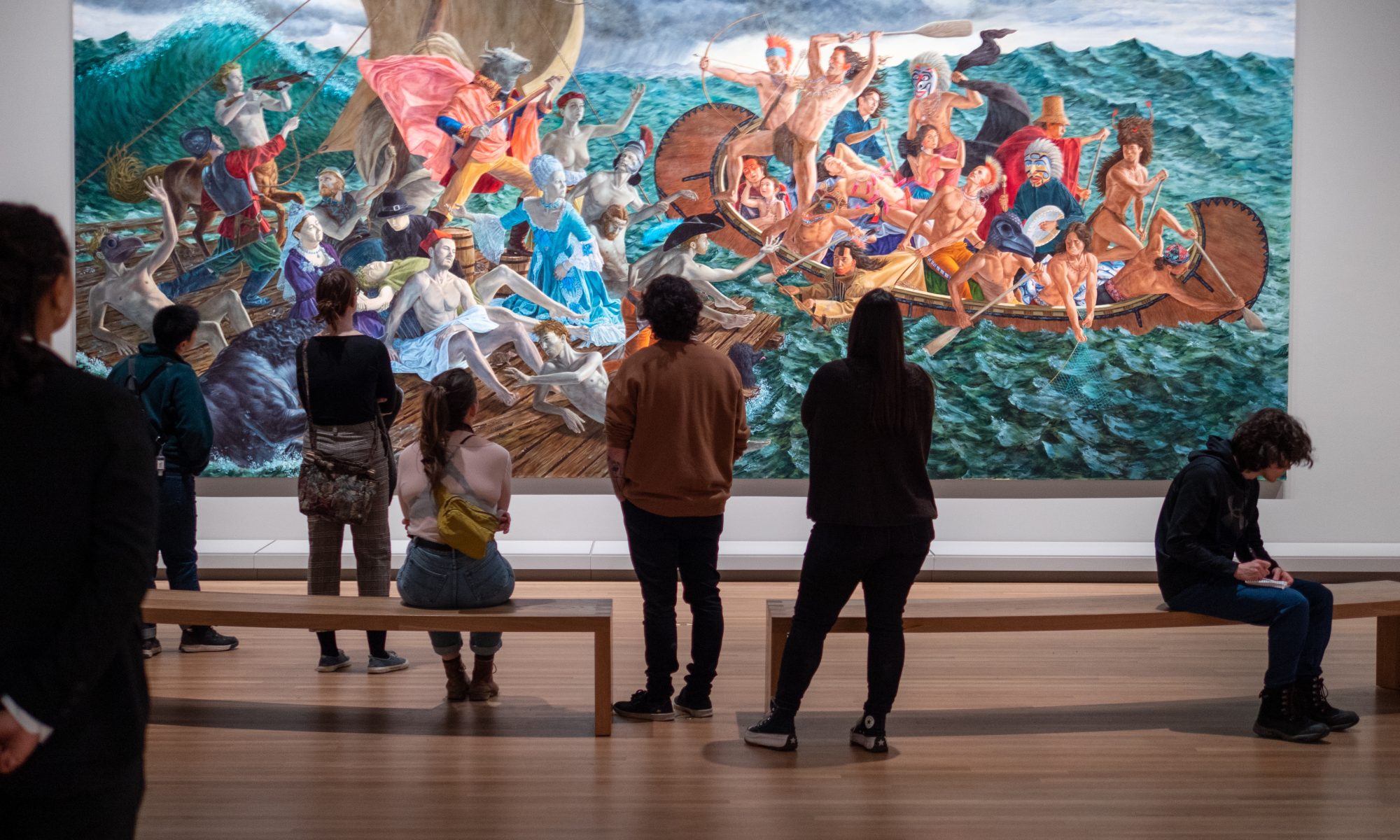
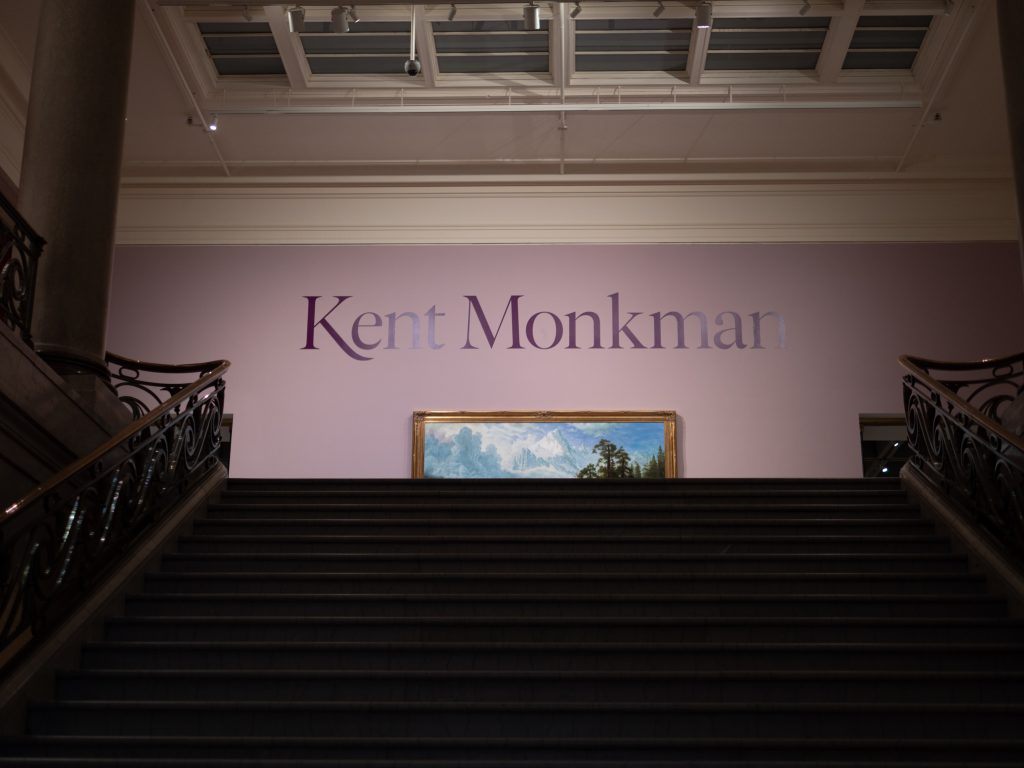
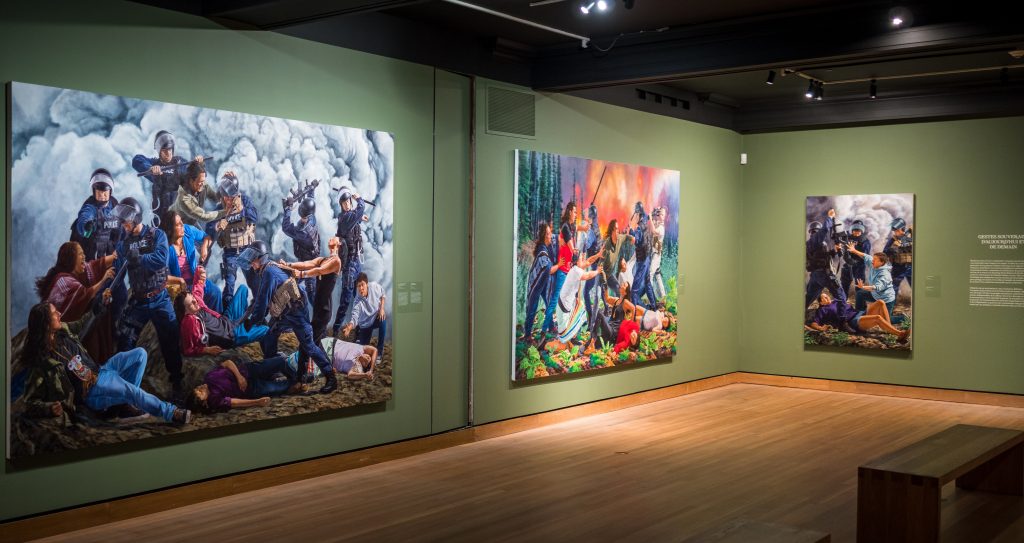
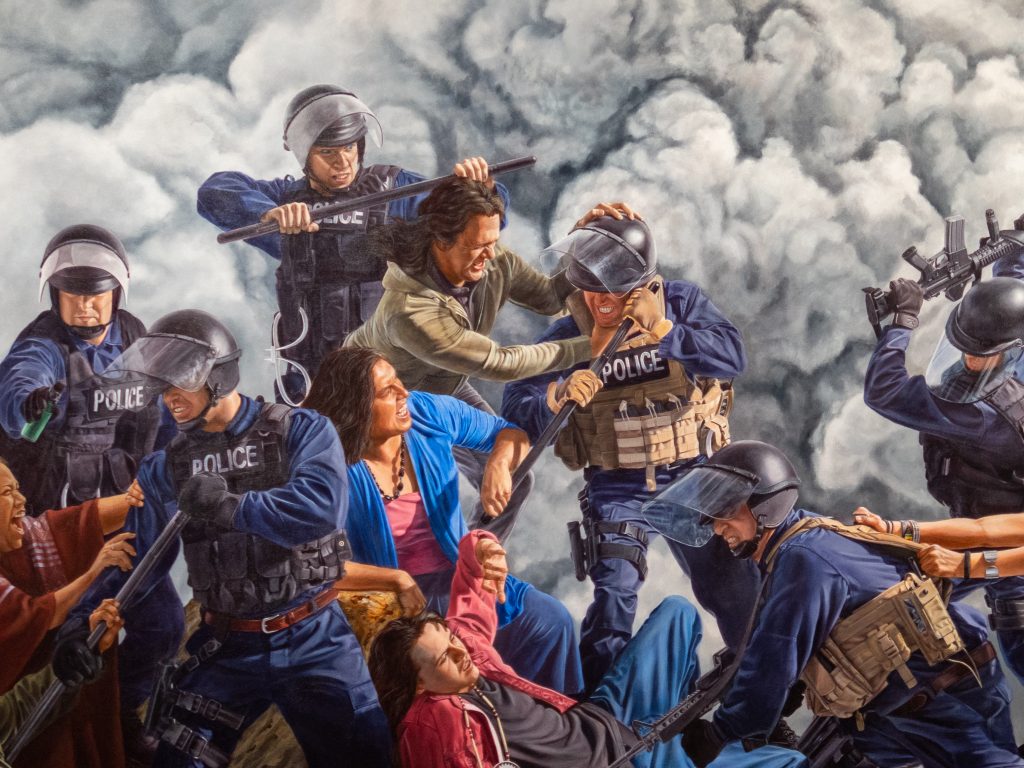
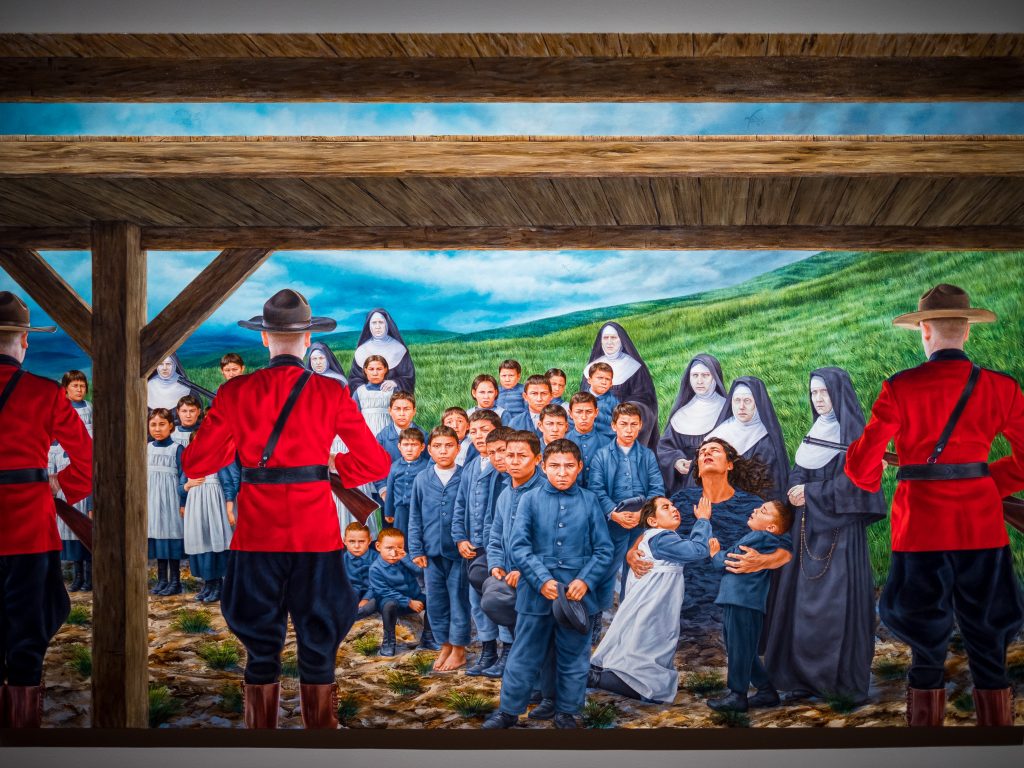
I had just come out of Kent Monkman’s exhibition at the Musée des Beaux Arts de Montréal when it became clear that what distinguishes this work is not critique alone nor reversal but a rare capacity to move fluently across multiple visual cultures and visual civilizations without collapsing them into metaphor. Monkman does not simply cite Western art history and Indigenous visual cultures side by side; he works from within both, mobilizing their internal logics, their modes of authority, and their techniques of address. The result is not hybridity in the decorative sense but a form of visual sovereignty exercised through mastery.
A useful thesis emerges here; Monkman’s paintings function as acts of historical repossession enacted at the level of visual grammar rather than iconography. In other words, his work repossesses history by reconfiguring the rules of representation, not just by changing what is represented. He does not argue against the canon from the outside; he inhabits its most prestigious forms, history painting, baroque theatricality, academic figuration, and dramatic realism, and then reprograms them using Indigenous epistemologies of land, body, and relationality. Indigenous visual traditions are not reduced to symbolic counterweights; they operate as structuring forces that reshape how narrative, space, and temporality behave within the frame.
Monkman’s work is best understood through the idea of medium as a site of governance; the canvas, the museum, the conventions of perspective and realism function as technologies of power, regimes of legibility and perception. These are systems that organize what is visible, what can be apprehended, and what is socially permissible to imagine. Monkman’s intervention is therefore infrastructural; he repurposes the medium itself, demonstrating how forms that once served colonial authority remain operative and can be redeployed to articulate Indigenous sovereignty.
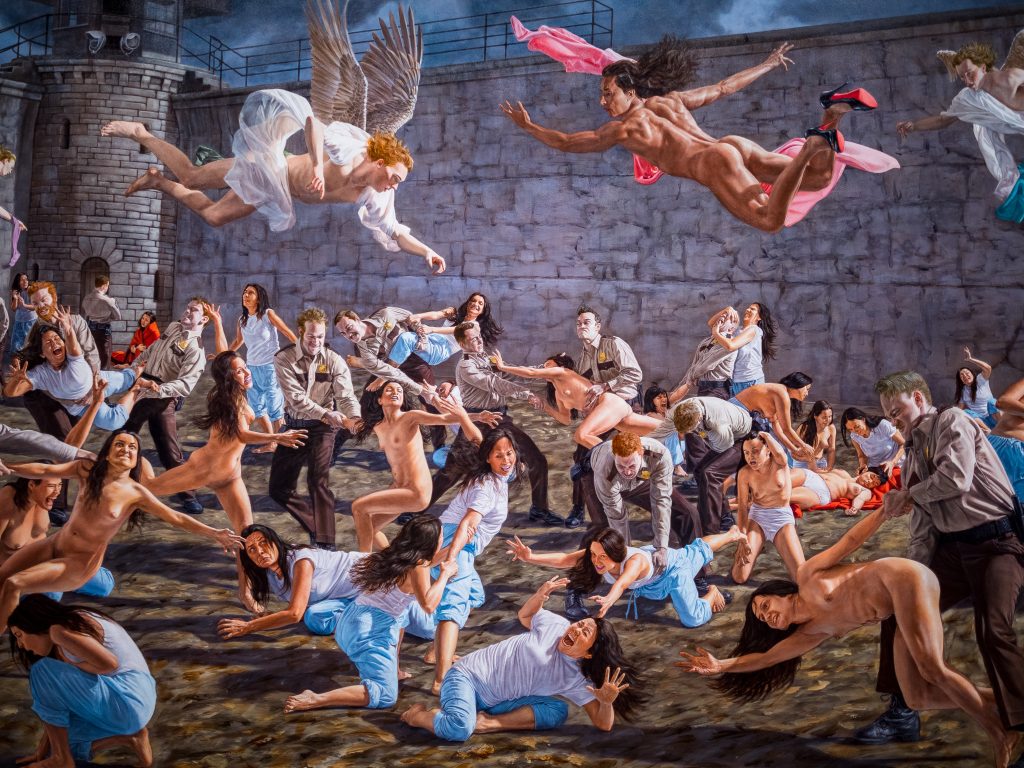
This operation unfolds across multiple scales of attention. In the body, hands and posture carry juridical weight, registering power and consent in ways that recall Caravaggio. Gesture precedes speech, and power is first registered anatomically. A hand resting possessively on a shoulder, a wrist twisted in restraint, a body leaning too far forward or collapsing under its own imbalance; these are not expressive flourishes but signs of command, consent, and coercion. Yet Monkman’s attentiveness extends beyond the gestural into the minutiae of each scene, recalling the densely populated moral ecology of a painter such as Bruegel or Bosch. Small interactions, subtle facial glances, objects in the background, and almost incidental gestures accumulate to form a network of interdependent actions. The paintings do not present a single, legible narrative; they present a field of social relations, a dispersed archive of micro-events.
Landscape functions as a key vector in this operation. The sweeping skies, distant mountains, and panoramic compositions evoke the sublime of Albert Bierstadt and the Hudson River School, yet Monkman retools this language so that land itself becomes legible as contested infrastructure. The horizon is not neutral; it is a site of occupation and resistance. The sublime becomes a device for exposing dispossession rather than producing aesthetic transcendence. In parallel, moments of collective human drama, the twisting, desperate bodies on rafts and in floodwaters, recall early nineteenth-century historical painting. Catastrophe is staged as spectacle, but the audience is made to understand that the spectacle emerges from structural violence rather than narrative fiction.
Monkman’s work registers catastrophe in a way that evokes Géricault’s Raft of the Medusa. The raft is not merely a historical reference; it is a pictorial logic of catastrophe as spectacle, a form of mass suffering staged for the gaze. Monkman appropriates this logic but redirects its vector. The suffering is not only a human tragedy but a structural consequence of colonial regimes. Bodies collapse, reach, recoil, and are propelled through space in ways that dramatize structural inequality without reducing the narrative to melodrama. The spectacle remains, but the audience is forced to recognise that the spectacle is not separate from the structure that produces it.
Miss Chief Eagle Testickle moves through these scenes not as a symbol but as a mobile intelligence; her posture is elastic, theatrical, and strategically excessive. She does not correct history; she exposes how history was staged to begin with. In doing so, Monkman reveals the continuity between techniques of Western visual authority and the colonial administration of bodies and land. Indigenous visual traditions intervene not as opposition but as alternative grammars of space, relationality, and temporality, producing a radically polyphonic field of sight.
Seen in Montreal, this matters; the city’s visual inheritance is saturated with Catholic baroque, imperial pageantry, and liberal narratives of tolerance. Monkman’s paintings do not reject this inheritance; they turn it inside out, showing how its techniques remain operative and how easily they can be reactivated. In doing so, the work also reaches back toward the twentieth century, where the surrealist project sought to reveal the unconscious structures that govern perception and desire. Like surrealism, Monkman deploys the logic of the uncanny, but he does so not to escape history or to dissolve the social world into dream, but to expose the way colonial power already contains the irrational, the obscene, and the absurd.
The excess does not produce humour; it produces absurdity, a structural mismatch that refuses relief. The paintings have the precision of historical illusion yet the logic of the dream image, so that the viewer experiences a dissonance between what is visible and what is permissible to see. The viewer is not permitted to laugh and move on; the scene is too precise, too intentional, too materially invested in the power it depicts. The absurdity is not an escape hatch; it is a diagnostic tool that reveals how the colonial order depends on spectacle, fantasy, and the staging of bodies as objects of both desire and control.
This exhibition makes a quiet but forceful claim; that the future of history painting does not lie in moral instruction or archival correction but in the strategic reoccupation of visual systems that once claimed universality. Monkman demonstrates that these systems were never neutral and that they are still available to those who understand them well enough to bend them. By drawing on gesture, minutiae, landscape, and catastrophe alike, he produces a visual language that is both encyclopedic and insubordinate; a sovereign grammar capable of registering the full weight of colonial and Indigenous histories simultaneously while insisting that vision itself is a terrain of power and negotiation.
Adam Tooze’s 2025 London Review of Books Autumn Lecture offers a diagnosis of a world whose organizing principles can no longer be captured by moral narratives or inherited geopolitical categories. The lecture is not concerned with adjudicating virtue or blame, but with understanding how power is materially organized, reproduced, and defended under contemporary conditions. What emerges is a picture of a global order under strain, not for lack of agency, but because it is saturated with it.
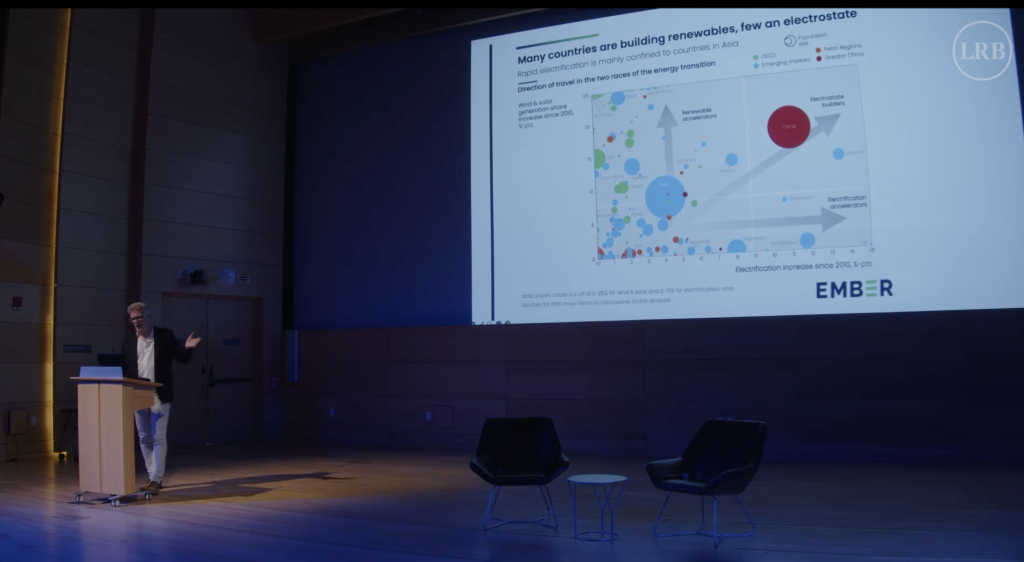
Screenshot of the 2025 LRB Lecture with a graph showing that while many countries are building on renewables, they are not focusing on the development of an integrated electrostate as China is.
At the centre of Tooze’s argument is a shift in form rather than in substance. The age of hydrocarbons is not ending so much as being structurally transformed. The decisive change is not from oil to electricity alone, but from commodity based power to system based power. Oil could be owned, traded, and stockpiled; electricity must be generated, transmitted, and stabilized across networks. It is an architecture rather than an object. As a result, power is no longer primarily a matter of possession, but of coordination and governance, of shaping the conditions under which the system reproduces itself.
Tooze asks whether the present moment should be understood as a new Cold War. He rejects the simplistic claim that the world is returning to bipolarity, yet he emphasises that the logic of alignment is reappearing. If this framing is accepted, the analytic tools of the earlier struggle remain valuable: the core question is not ideological victory but the maintenance of asymmetric advantage. In this context, the logic of structural preponderance, pace Leffler, is transformed, shifting from industrial mobilization to infrastructural centrality. Twentieth century dominance rested on industrial capacity, military deterrence, and institutional reach; preponderance was a question of who could mobilize the greatest resources and sustain the largest war machine. Today, advantage is produced through infrastructural centrality. The state or coalition capable of designing, securing, and scaling energy systems, supply chains, and technological platforms can shape the strategic choices of others. Power resides less in what one controls directly than in the constraints and possibilities one imposes on the system as a whole. The imperative is not simply to be strong, but to ensure that rivals cannot develop comparable capacity on their own terms, and that their strategic options remain dependent on the architecture one controls.
It is against this transformed logic of preponderance that Tooze identifies one of the lecture’s most disquieting political dynamics. In order to preserve its strategic position, the United States aligns functionally with Russia and the Gulf states. This also works towards explaining recent American imperialism toward Venezuela. The alignment is not driven by shared ideology but by shared dependence on the stability of energy, finance, and infrastructure. Tooze resists the claim that the world has returned to a Cold War. The resemblance lies not in bipolar rivalry but in the structural logic of alignment itself. When the system’s continuity is at stake, states organize around necessity rather than principle. Moral language recedes, and the maintenance of systemic order, ensuring that networks, flows, and capacities continue to reproduce, becomes the decisive mode of political behaviour. This is why the question of blocs is not merely rhetorical. The carbondollar bloc is an alignment built around energy and money, and its rival is not a single state but a competing system of electrification and green infrastructure.
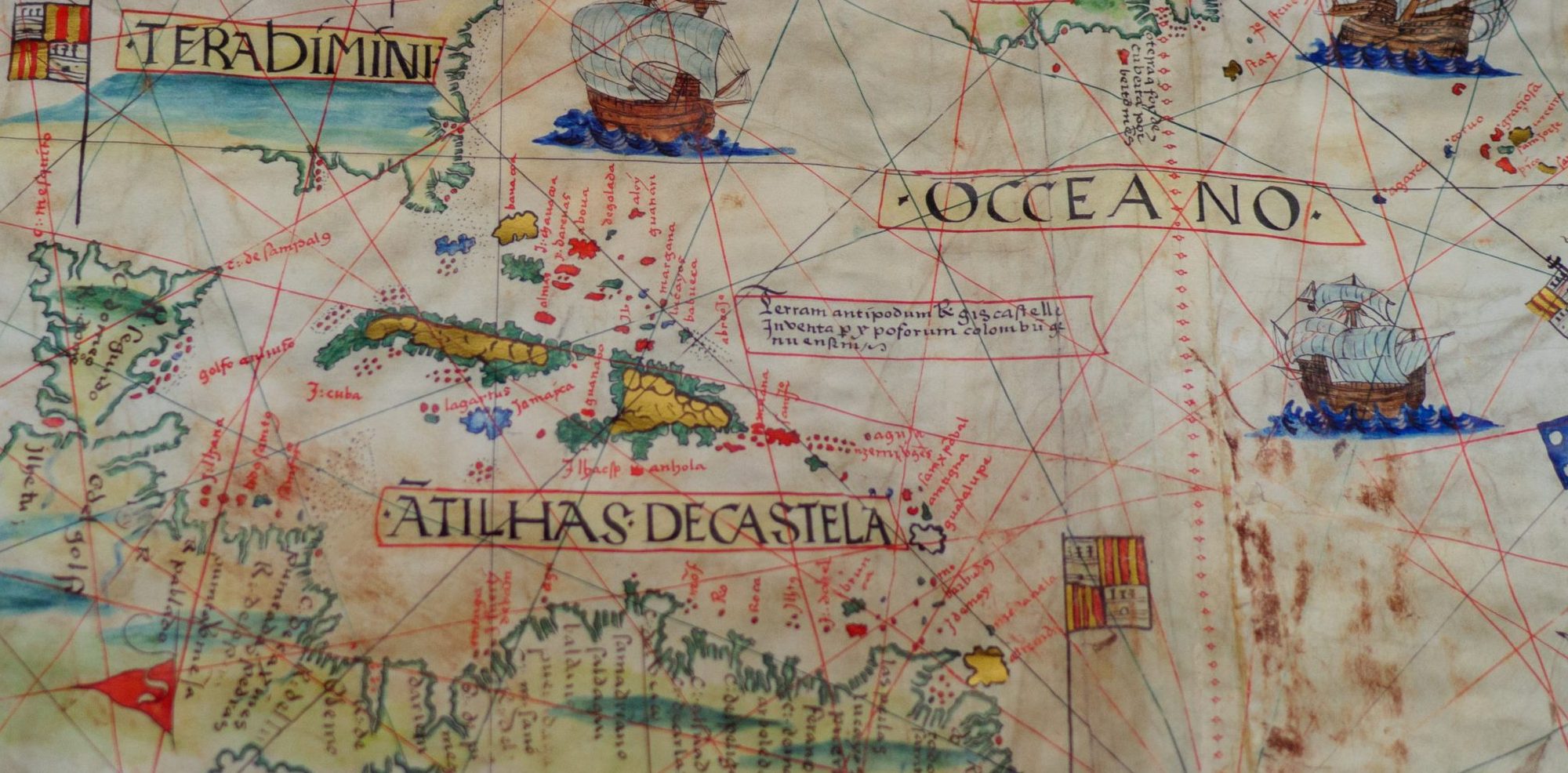
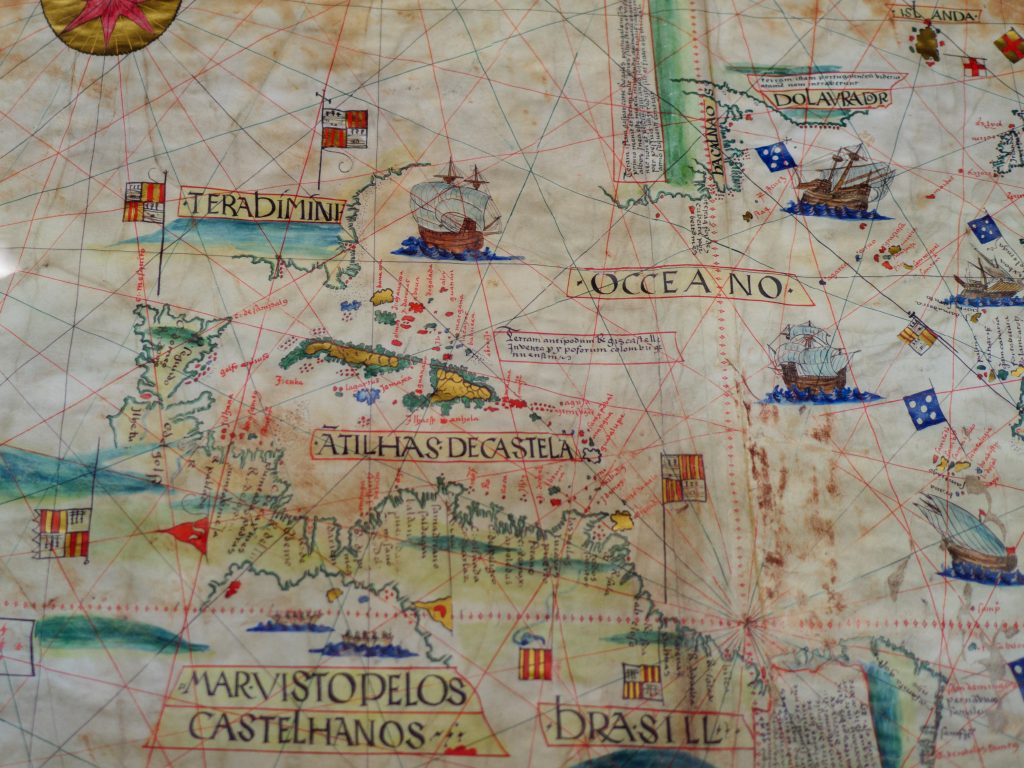
An early sixteenth century map from the Naval Museum in Madrid, in which the western hemisphere is beginning to be rendered as a navigable network. The map is not simply a representation of land, but a diagram of circulation, commerce, and imperial power, a visual precursor to the modern infrastructure of global exchange. Photo by me and a nod to Andre Gunder Frank’s Re-Orient.
The coherence of this alignment becomes clearer when energy and money are treated as a single system. If the United States and the Gulf states form a carbondollar bloc, the rivalry is not only over currency but over the material logic that currency is meant to stabilize. The carbondollar bloc is not simply the petrodollar system; it is the broader architecture that converts fossil energy into monetary power and stabilizes global exchange in a carbon based order. In the language of contemporary energy history, this system is sustained through the continual management of supply and demand, the policing of access, and the institutionalisation of energy as a strategic commodity, a logic that has shaped modern geopolitics for decades (see Daniel Yergin’s The Prize). The alternative Tooze identifies is not merely a competing currency arrangement, but a rival system organized around electrification and green infrastructure, the networks and materials required for a decarbonised economy. The contest, therefore, is not simply about which unit of account prevails, but about which regime of production and reproduction becomes the organizing principle of global power. In this light, the lecture reads not as a menu of policy choices but as a diagnosis of systemic vulnerability.
Tooze further clarifies this vulnerability through a distinction between state forms shaped by their energy regimes. The carbonstate is organized around rents, contracts, and legal stabilization; it is governed by lawyers, financiers, and institutions designed to manage scarcity, volatility, and the politics of extraction. The electrostate, by contrast, is organized around engineering, grids, capacity planning, and scale. Authority here is exercised through technical coordination rather than juridical mediation. This distinction helps explain the paradoxical character of the present moment; extraordinary levels of intentionality coexist with persistent instability. States act with confidence, undertaking large scale infrastructure projects and territorial reorganization, even as they confront overlapping crises that resist resolution. Tooze characterizes this condition not as incoherence, but as a second modernity, in which modernizing logics persist under radically altered planetary constraints.
The lecture also draws explicitly on Hayden White’s insight that historical understanding is shaped by narrative form. Tooze suggests that contemporary energy transitions are being framed through divergent narrative genres. In the Western case, the story takes the form of a Comedy. Societies awaken to the planetary consequences of their energy systems, recognize that the Great Acceleration entailed profound ecological damage, and attempt to correct course through regulation, decarbonization, and institutional reform. Yet this awakening is accompanied by a persistent impulse to preserve the underlying carbon order through technological innovation. The carbonstate does not simply admit the climate crisis, if it does admit it; it seeks to manage it, often by reframing solutions as new forms of efficiency or new modes of extraction, as with the rise of fracking. The tone is therefore ironic and self critical; reform is imagined as repair rather than rupture, and innovation is presented as a way to maintain continuity under the guise of transformation.
China’s trajectory, as Tooze presents it, follows a different narrative logic. It resembles Romance in the classical sense; a story of struggle against poverty and underdevelopment. Coal and carbon powered that struggle with full awareness of its costs. Environmental destruction and mass mortality were understood as the price of development and political survival. What distinguishes this trajectory is not denial, but sequencing. Violent industrialization was followed by an equally forceful pivot, beginning in the 2010s, toward electrification, green infrastructure, and technological remediation. This turn was not moralistic but existential. For the Chinese state, technological transformation becomes a condition of regime survival.
A long durée perspective sharpens the contrast. When viewed across megageographies inhabited by millions of individuals, the spatial and demographic challenges faced by different polities diverge dramatically. North America operates across a small number of such geographies; China across nearly twenty. The difference is not merely one of scale, but of governance. Managing electrification, infrastructure, and decarbonization across such complexity requires a distinct relationship between state, technology, and population. What appears externally as hyper agency emerges internally as a response to geographic and demographic necessity.
The lecture also implies a transformation in the conditions of authority themselves, a transformation in which the reproduced becomes the site of legitimacy. In earlier technological revolutions, the act of reproduction diminished the singularity of objects, loosening their grip on legitimacy and the circuits of circulation. Today, the rupture is not in the copy but in the system. Energy networks, supply chains, and computational infrastructures do not merely replicate discrete goods; they reproduce capacity, stability, and power across space and time. Authority no longer resides in a unique site or a singular owner but in the capacity to sustain and direct these reproducing systems. Strategic advantage is therefore less about possession than orchestration, about the ability to govern the flows that make modern life possible. This is why the distinction between carbonstate and electrostate matters; the former seeks to preserve reproduction through legal and financial mechanisms, the latter through technical coordination and scale. Control over reproduction becomes the new locus of aura, in the sense of Walter Benjamin’s reflections on the loss of singularity, the point at which infrastructure, technology, and authority fuse into a single, distributed sovereignty.
Tooze’s contribution lies in the clarity of this diagnosis. He resists both nostalgic analogies and technological determinism, offering instead a framework in which energy, money, infrastructure, and narrative are understood as mutually constitutive. Power in the twenty first century is not disappearing; it is relocating into systems that are harder to see and harder to contest. The new architecture of power is being built in grids, supply chains, and infrastructures of reproduction. Tooze gives us a way to see that architecture without pretending that it can be easily mastered.
Bacchus and Ariadne was painted by Titian between 1520 and 1523 for Alfonso I d’Este, Duke of Ferrara, as part of a cycle of mythological paintings for the Camerini d’Alabastro, a series of small, private chambers designed to display the duke’s taste, erudition, and engagement with classical culture. The work depicts the moment Bacchus first sees Ariadne on the island of Naxos as told by Ovid and others, blending narrative drama with symbolic and seasonal references, including astrological markers that would have been legible to learned Renaissance viewers. Today it is housed in the National Gallery in London. This post is dedicated to Sergei Zotov (Frances Yates Fellow, Warburg Institute) who instructed a course titled Visual History of European Alchemy that I enjoyed immensely.
In the early modern imagination, wine was more than a fermented beverage; it was a substance of transformation, a medium through which celestial and terrestrial realms could intersect, and a vehicle for alchemists to apprehend hidden patterns in nature. The fifth essence, that luminous principle distilled from wine, promised vitality, illumination, and the fusion of matter and spirit. Titian’s Bacchus and Ariadne, painted between 1520 and 1523, stages a mythic encounter suffused with this sense of transformation. The painting does not simply narrate a story; it performs an alchemical operation in light, pigment, and gesture, translating material into spirit through the formal language of Renaissance humanist painting.
Titian’s Bacchus and Ariadne at the National Gallery, London 📸 Photo by Me
In this composition, Ariadne assumes a role resonant with the constellation Venus. She is luminous, elevated, and poised, a figure whose presence signals fertility, cosmic harmony, and generative force. Renaissance humanists frequently identified Ariadne with Venus in allegorical and poetic discourse, emphasizing her celestial elevation, her beauty, and her function as an agent of natural and human abundance. This identification is reinforced by the sources Titian consulted. Both Ovid’s Metamorphoses and Catullus’ 64 describe Ariadne’s abandonment and subsequent apotheosis into the constellation Corona Borealis. Her celestial transformation aligns her with the principles Venus embodies: the ordering of natural rhythms, the mediation of desire and abundance, and the harmonization of earthly and heavenly forces. In Titian’s painting, Ariadne’s raised right arm marks the heliacal rising of Vindemiatrix (Epsilon Virginis), signalling the beginning of the grape harvest. Her gesture connects the narrative to the cycles of the cosmos and the timing of human labour, situating her simultaneously within myth, season, and celestial order. This temporal tension between the springtime flora and the autumnal astronomical signal creates a poly-temporal tableau in which narrative, season, and cosmos intersect: Ariadne, like us all, is suspended between the life-time of flowering and the death-time of harvest, between growth and fruition, between mortal grief and celestial transformation.
Ariadne at the Louvre. 📸 Photo by Me.
Bacchus is depicted as the constellation Hercules, leaping with muscular tension across the canvas. His leap is kinetic, cosmic, and narrative, connecting vineyard, myth, and sky. Hercules traditionally embodies struggle and ascension; Titian translates this into a corporeal movement that intersects with Ariadne’s stabilizing, Venus-like presence. The interaction of Bacchus and Ariadne is therefore not simply romantic; it is a moment in which cosmic, seasonal, and narrative energies converge, a visual analogue to the distillation of wine into its essential spirit.
The constellation Heracles (Hercules) from my star app.
Titian extends this cosmology into the Bacchic retinue, whose figures echo both mythic and celestial prototypes. Serpentus evokes the constellation Serpens, a visible celestial intermediary during harvest time, signaling transformation, danger, and the mediation between higher and lower realms. A small dog recalls the myth of Icarius, the shepherd of Attica who first learned the art of winemaking from Dionysus. When Icarius shared the fermented grape with his fellow shepherds, they mistook its intoxicating effects for poisoning and killed him; the dog, Maera, survived and led Icarius’ daughter Erigone to his body, marking the mythic origins of human engagement with wine. These figures link human action, natural processes, and celestial observation, embodying the duality inherent in wine and alchemy: vitality and revelation on one hand, peril and misinterpretation on the other.
Ovid, Metamorphoses 8. 175 ff (trans. Melville) (Roman epic C1st B.C. to C1st A.D.) : "She [Ariadne], abandoned [by Theseus], in her grief and anger found comfort in Bacchus' [Dionysos'] arms. He took her crown and set it in the heavens to win her there a star's eternal glory [as the constellation Corona]; and the crown flew through the soft light air and, as it flew, its gems were turned to gleaming fires, and still shaped as a crown their place in heaven they take between the Kneeler [the constellation Hercules] and him who grasps the Snake."
The vegetation further reinforces the alchemical and cosmological logic. Vines, both crown and trailing, signal Bacchus’s domain and the medium through which celestial essence is communicated. Blue iris and columbine mark the late spring season, while Mediterranean caper and horsetail add botanical specificity, suggesting Titian’s careful observation of nature or consultation of botanical illustrations. Wild roses and woodland trees enrich the ecological tapestry, situating the figures in a fertile, transformative landscape. These plants are not merely decorative; they serve as witnesses to and participants in the processes of transformation, linking the narrative to earthly abundance, seasonal rhythm, and the hidden forces alchemists sought to extract from natural substances.
Colour and light function analogously to alchemy. Titian suspends pigment in oil to create surfaces that radiate from within, turning flesh, drapery, and landscape into luminous material that enacts transformation visually. The billowing fabrics, the glow of Ariadne’s blue mantle, and the vivid interplay of greens and golds mirror the extraction of quintessence from matter, providing a painterly analogue to the separation, condensation, and refinement characteristic of distillation.
Alfonso d’Este, Duke of Ferrara from 1505 to 1534, cultivated a court that was intensely invested in both the arts and intellectual experimentation, including interests that intersected with alchemical thought. While there is no evidence that he practiced alchemy personally, his court was closely connected with scholars and natural philosophers who engaged in the study of transformation, the properties of substances, and the hidden order of nature. The Camerino d’Alabastro, for which Bacchus and Ariadne was commissioned, functioned as a site of cultivated curiosity where myth, science, and art converged, and Alfonso’s patronage encouraged painters like Titian to explore complex correspondences between matter, light, and the cosmos. In this environment, the language of transformation inherent in alchemical theory in which the extraction of quintessence, the harmonization of elements, and the revelation of hidden structures would have been intelligible to the duke and his circle, making a painting such as Bacchus and Ariadne resonate not only mythically but philosophically and cosmologically.
Bacchus and Ariadne can be understood as an alchemical tableau in which myth, matter, and cosmos converge. Bacchus brings the fermenting vine and the energy of transformation, while Ariadne, Venus-like, receives and channels these forces; the retinue and surrounding flora encode celestial rhythms and seasonal knowledge. By juxtaposing springtime blooms with the autumnal timing of the grape harvest, Titian emphasizes that transformation is not fixed to a single moment but unfolds across overlapping registers of time—cosmic, terrestrial, and human. In rendering myth, nature, and the heavens in a single luminous scene, the painting enacts the very process alchemists pursued: the extraction of essence, the harmonization of opposites, and the revelation of hidden order. Titian does not merely depict wine; he distills it, making visible the intersection of human imagination, natural processes, and celestial patterns in a work that is both sensual and intellectually radiant.
This project advances contemporary historiography by treating administrative data as active agents in knowledge production, showing how classification and archival practices shape what is knowable and who is visible. By integrating data-driven methods with historical inquiry, it expands methodological and epistemological approaches while highlighting the politics and contingencies of producing historical knowledge.
From the first moments I began working with immigration records, I was drawn not simply to their volume but to their structure, their silences, and the ways in which they delineate what counts as knowable. Administrative forms, legacy systems, and coding schemes do not merely record phenomena; they enact regimes of legibility that make certain lives, movements, and decisions visible while leaving others obscure. My historical purpose is to investigate immigration data as epistemological infrastructure; to trace the historical logics embedded within the records themselves; and to interrogate how these infrastructures have shaped the knowledge, governance, and social integration of migrants over time. In Canada, where immigration is central to demographic, social, and political life, this investigation carries particular significance. The distinctions embedded in administrative systems: temporary versus permanent, refugee versus economic, authorized versus unauthorized, are not neutral descriptors. They mark differential inclusion and exclusion, structure access to rights and opportunity, and channel life trajectories in ways that unfold across decades and even generations.
The conceptual lens I adopt situates this work within the contemporary data turn. Just as the linguistic turn revealed that language constitutes reality as much as it describes it, the data turn compels us to recognize that administrative records do not passively capture migration. They produce particular ways of seeing, categorizing, and governing mobility. The epistemological stakes of this shift are profound; knowledge is neither transparent nor self-evident. Databases, coding conventions, and legacy infrastructures act as mediators of understanding; they render some patterns readable, some phenomena legible, and others invisible. The work of a historian in this context is to unpack the structures, logics, and assumptions embedded in these systems; to interrogate how these data infrastructures themselves constitute knowledge; and to render visible the historical processes through which knowledge has been produced.
In examining Canadian immigration records, I am attentive to the long-term genealogies of classification, policy, and bureaucratic logic. Categories that distinguish temporary from permanent status, refugees from economic immigrants, or authorized from unauthorized presence are not merely operational tools. They are historically contingent constructs that reflect policy priorities, social anxieties, administrative conventions, and technical constraints. Each field, code, or administrative note carries traces of decisions made by analysts, clerks, and policymakers, whose choices shape both the legibility of migrants and the possibilities for historical reconstruction. By tracing the evolution of these categories, my research illuminates how the state has historically imagined migrants, structured opportunity, and mediated social belonging. In so doing, it foregrounds the interplay between administrative infrastructure, knowledge production, and the social experience of migration.
This project is informed by a dual sensibility that bridges analytic rigour and historical imagination. Administrative records are simultaneously precise and incomplete; they encode patterns yet leave gaps, silences, and ambiguities that demand interpretive work. The historian’s task is therefore translational: to render administrative time legible to analytical and historical time, to preserve provenance and integrity, and to enable longitudinal reconstruction while remaining attuned to the contingencies and biases embedded in the source material. In practical terms, this involves the harmonization of legacy systems such as FOSS, CAIPS, LIDS, and VIDS into contemporary platforms such as GCMS and, in the future, DPM3, while maintaining awareness of the temporal, technical, and policy contexts that shaped their design and evolution. It also entails linking these administrative records to longitudinal datasets such as the IMDB, provincial vital statistics, and Statistics Canada holdings such as the Census, thereby enabling a historically grounded understanding of migration trajectories and outcomes.
A defining dimension of this work is its methodological reflexivity. Immigration data is produced for operational purposes; it emerges from rhythms, constraints, and logics designed to facilitate case management rather than historical reconstruction. As such, the historian must engage in a form of translation that renders these operational temporities and structures legible to long-term analysis. This involves attending to provenance, documenting the evolution of codes, and creating linkages across disparate systems and historical periods. Such work is not merely technical; it is interpretive, epistemological, and historical. Every decision about how to harmonize, integrate, or interpret records is informed by an awareness that data is never neutral.
For instance, consider the historical distinction between temporary and permanent status in Canadian immigration records. These categories are operational; they guide processing, eligibility, and access. Yet they are also epistemic; they shape how analysts, researchers, and policymakers interpret migration flows, integrate newcomers, and assess policy outcomes. The thresholds, definitions, and coding conventions associated with these categories have shifted over time, reflecting evolving policy priorities, social pressures, and technical constraints. Reconstructing these categories longitudinally requires attention to their historical contingency and interpretive framing. It requires tracing not only what was recorded, but how it was recorded, and why it was recorded in particular ways. The historian must interrogate the temporal, institutional, and social processes that produced the data itself, and the consequences of those processes for what can be known and who can be represented.
This methodological reflexivity extends to the integration of legacy systems into contemporary analytical environments. FOSS, CAIPS, LIDS, and VIDS were designed to address discrete operational challenges; they did not anticipate integration into longitudinal analysis spanning decades. Harmonizing these records with GCMS, linking them to the IMDB and provincial datasets, and maintaining categorical integrity are acts of translation, mediation, and interpretation. Each harmonization decision carries epistemic consequences; categories may be redefined, temporal boundaries aligned, and linkages established in ways that preserve analytical fidelity while revealing the historical logic embedded in each system. The historian’s role is to make these processes legible, to document the choices and contingencies involved, and to reflect on how the resulting data architecture shapes both historical interpretation and contemporary knowledge production.
The translational work I undertake is also inherently historical. Data does not exist in a vacuum; it is embedded in social, political, and institutional contexts. Categories, codes, and records encode assumptions about identity, status, and belonging. By tracing these assumptions, we can reconstruct not only patterns of migration, but the epistemic and moral frameworks that underlie them. Administrative distinctions such as refugee versus economic migrant, temporary versus permanent, for example, carry enduring effects on social integration, access to rights, and the life courses of migrants. Longitudinal reconstruction allows us to see these effects across decades and generations, revealing how knowledge infrastructures mediate both historical outcomes and contemporary understanding.
Knowledge production is inseparable from the infrastructures that enable it. In the case of immigration, the categories, fields, and codes embedded in administrative systems are themselves agents of historical formation; they shape what is recorded, what is legible, and what can be interrogated. They establish epistemic boundaries around human movement, differentiating between those whose lives are visible to the state and those who remain peripheral, undocumented, or hidden. To study these infrastructures historically is to recognize that knowledge is not merely extracted from reality; it is enacted, performed, and maintained through bureaucratic, technical, and policy frameworks. This insight compels a dual orientation: we must attend both to the lives documented within the records and to the processes, logics, and assumptions that produced those records in the first place. The two are inseparable; neither the data nor the lived experience can be understood in isolation from the historical infrastructures that mediate them.
Administrative records are themselves temporal objects; they emerge from operational time, which often diverges sharply from the temporalities required for historical analysis. Case processing, workflow cycles, and program deadlines produce rhythms that are not aligned with longitudinal reconstruction or historical comparison. My work seeks to bridge these temporalities by developing methods that translate operational time into analytical and historical time while preserving the provenance, logic, and integrity of the original records. This involves detailed documentation of how systems were designed, how codes were defined, and how processes evolved over time. It also entails creating linkages across disparate datasets, jurisdictions, and decades, enabling historians and analysts to trace trajectories, reconstruct selection logics, and examine long-term outcomes. By treating administrative infrastructures as historical sources in their own right, I aim to render visible the processes through which knowledge is produced, structured, and constrained.
The historical significance of this work becomes clear when one considers the ways in which classification shapes social and political life. Categories such as temporary worker, refugee, or economic migrant do not merely reflect administrative convenience; they constitute frameworks for understanding social worth, civic belonging, and eligibility for rights. These distinctions operate over time, producing effects that extend far beyond the moment of record creation. A person classified as a member of a Designated Class in the 1980s experiences integration differently than an economic migrant in the same decade; their opportunities for settlement, access to services, and pathways to citizenship are shaped by policy, social perception, and the interpretive logic embedded in administrative systems. By reconstructing these categories longitudinally, historians can trace not only outcomes but the epistemic and moral frameworks that produced them. In this sense, administrative data is both archive and instrument: it preserves the historical record and simultaneously shapes the production of knowledge about social reality.
The Canadian context offers a particularly rich site for this inquiry. Immigration has been central to national identity and demographic transformation, and the Canadian state has maintained extensive administrative infrastructures for documenting and managing mobility. Legacy systems such as FOSS, CAIPS, LIDS, and VIDS reveal the historical layering of policy, technology, and bureaucratic practice; their integration into contemporary platforms such as GCMS illustrates the persistence and adaptation of epistemic structures over time. Linking these records to the IMDB, provincial vital statistics, and Statistics Canada holdings allows for the reconstruction of trajectories over decades, enabling scholars to examine long-term outcomes in settlement, health, education, and civic participation. It also allows us to interrogate the evolution of classificatory regimes, showing how policies, categories, and operational logics have shifted in response to political priorities, social anxieties, and technical constraints.
This approach is not merely technical; it is profoundly interpretive. Every choice in data harmonization, categorization, or linkage carries epistemic weight. To collapse temporal variation, reconcile divergent codes, or align fields across systems is to make an interpretive claim about continuity, equivalence, and historical meaning. The historian must therefore be reflexive about the assumptions and consequences embedded in these decisions. Translation is never neutral; it mediates between operational intent and analytical possibility, between past practices and present understanding. By foregrounding these processes, this work makes explicit the epistemic and moral stakes of historical reconstruction and demonstrates that data infrastructures are themselves sites of historical knowledge production.
At a conceptual level, this project challenges conventional understandings of knowledge and classification. The epistemology of state records is neither transparent nor self-evident; it is mediated, structured, and historically contingent. Administrative categories do not simply describe phenomena; they constitute them. To understand human mobility historically, we must therefore examine the processes through which it has been rendered knowable, the instruments through which it has been documented, and the assumptions through which it has been interpreted. This perspective situates my work within broader debates in the history of knowledge, the history of governance, and the emerging field of data studies, contributing to conversations about how epistemic infrastructures shape what can be known, acted upon, and remembered.
The intellectual trajectory that informs this research is itself interdisciplinary, bridging historical inquiry, archival practice, and the analytical rigour of data science. My engagement with legacy systems and contemporary databases has cultivated an understanding of both the technical and interpretive dimensions of knowledge production. It has taught me that precision in coding, integration, and harmonization must be paired with sensitivity to historical contingency, social meaning, and the ethical implications of classification. This dual perspective enables a historically grounded approach to longitudinal research, in which empirical analysis and conceptual reflection are inseparable. By combining these sensibilities, my work seeks to expand the methodological possibilities of immigration history and data-driven social research alike.
Historical examples illustrate the stakes of this approach. Consider the treatment of refugees in Canada during the late twentieth century: administrative categories codified notions of vulnerability, eligibility, and deservingness; they also reflected broader social and political anxieties, such as attitudes toward asylum seekers or debates over labour market needs. By tracing how these categories evolved across decades, one can reconstruct not only the patterns of settlement and integration but also the underlying epistemic frameworks that shaped public perception, policy design, and bureaucratic practice. Similarly, distinctions between temporary foreign workers and permanent residents reveal how labour needs, migration policy, and social hierarchies were encoded within administrative systems. These cases demonstrate that administrative infrastructures are not neutral repositories; they are active participants in the historical processes that structure human life, belonging, and opportunity.
The broader significance of this research extends beyond historical reconstruction. In an era dominated by the data turn, understanding the historical formation of epistemic infrastructures is essential for evaluating contemporary policy, governance, and social practice. By revealing how knowledge has been produced, mediated, and constrained, this work offers insight into the ethical and analytical responsibilities of researchers, policymakers, and institutions. It highlights the ways in which administrative categories can reproduce inequality, shape opportunity, and influence social perception. At the same time, it provides tools for rigorous longitudinal analysis, allowing scholars to reconstruct trajectories, interrogate selection logics, and examine long-term outcomes in ways that are both historically grounded and analytically robust.
Ultimately, my historical purpose is to make visible the infrastructures through which migration has been rendered knowable, to interrogate the epistemic and moral assumptions embedded within administrative systems, and to explore the consequences of these structures for both scholarship and social life. This work bridges empirical analysis, historical reflection, and methodological innovation, demonstrating that administrative data is not merely a technical tool but a site of historical knowledge production. By tracing the evolution of categories, codes, and systems, I aim to illuminate the interplay between policy, bureaucracy, and human experience; to reveal how knowledge infrastructures structure both possibility and constraint; and to contribute to a more nuanced, reflexive, and ethically aware understanding of migration in Canada and beyond.
Through this research, I seek to advance historical methodology, deepen understanding of Canadian immigration, and expand the conceptual frameworks through which data and history intersect. It is a project that integrates technical expertise with historical imagination, methodological rigour with interpretive sensitivity, and archival practice with theoretical reflection. By engaging with the infrastructures of knowledge themselves, I aim to demonstrate that history is not only about events, people, and policies; it is also about the instruments, categories, and processes through which the past becomes knowable, legible, and meaningful. In pursuing this purpose, I hope to contribute to a scholarly tradition that is attentive to the ethical, epistemological, and social dimensions of research, while offering new tools for understanding the complex interplay between data, governance, and human experience.
Relevant published works:
The Order of Things: An Archaeology of the Human Sciences by Michel Foucault Foucault’s work examines the historical formation of epistemes, the underlying structures that make knowledge possible within a given era. For this project, it provides a conceptual foundation for understanding immigration data as historically contingent knowledge; administrative categories, coding schemes, and legacy systems are not neutral reflections of reality, but products of specific epistemic frameworks. Foucault’s analysis supports my argument that data infrastructures themselves enact knowledge, determining who and what is legible within the bureaucratic archive.
How We Think: Digital Media and the Future of the Humanities by N. Katherine Hayles Hayles foregrounds the materiality and mediation of knowledge in digital and computational contexts, emphasizing how coding, databases, and technical infrastructures shape human understanding. This perspective is directly relevant to the translational and harmonization work in my project: legacy immigration records do not naturally yield historical insight. They must be interpreted, linked, and rendered legible across temporal and technical boundaries. Hayles’ emphasis on the interaction between human interpretive work and infrastructural mediation informs the project’s methodological approach and justifies a reflexive stance toward data as both archive and instrument of knowledge.
The Data Revolution: Big Data, Open Data, Data Infrastructures and Their Consequences edited by Rob Kitchin – this work situates data infrastructures within social, technical, and institutional contexts, highlighting that design choices, governance structures, and classification systems actively shape what can be known and what remains invisible. This aligns with my project’s focus on immigration records as epistemic infrastructure: coding schemes, legacy systems, and administrative categories not only organize information but constitute the very possibilities of knowledge about migration. Kitchin’s work provides conceptual tools for thinking about longitudinal linkages, interoperability, and the politics of classification, directly supporting my methodological and epistemological aims.
In the spectral interior of Painting (1946), a solitary figure occupies a suspended space, standing or perhaps hovering beneath an umbrella whose ribs inscribe a faint geometry across the violet air. Behind him, carcasses hang in sanguine suspension, their surfaces rendered with visceral immediacy that resists narrative containment, while a yellow boutonnière glows on the figure’s lapel with the precision of a small Rembrandtian sun. Curtains frame the scene like a stage, yet the space itself evades conventional depth, oscillating between theatre, interior, and liminal field. The image, scraped from the residue of catastrophe, does not pursue representation or abstraction in any conventional sense; it enacts the human body as an event within paint, registering its presence through tension, exposure, and gesture.
Before this work, Bacon’s early paintings had already revealed a fascination with the body as a site of dissolution and transformation. His prewar experiments, such as Crucifixion (1933), translated Expressionist and Surrealist vocabularies into a distinctly personal idiom, merging biomorphic abstraction with the residue of figuration. By the early 1940s, this interest in corporeal fragmentation reached its first major articulation in Three Studies for Figures at the Base of a Crucifixion (1944). There, distorted forms occupy a shallow, orange field, their mouths opened in silent convulsion, suggesting both scream and species—part human, part animal. The work’s triptych structure evokes religious painting while stripping it of transcendence, presenting flesh as spectacle and ordeal rather than redemption. The spatial compression and the emphasis on bodily distortion anticipate Painting (1946), where similar compositional tensions are reimagined within a more architectonic field. Between the two works lies a continuity of inquiry: the crucifixion as event becomes the grammar through which Bacon formulates a postwar phenomenology of the body.
Created in the immediate aftermath of the Second World War, Painting (1946) has often been read as an allegory of slaughter, a meditation on human destructiveness and the dehumanization of modernity, sometimes described in terms of “sacred violence.” Yet this reading risks imposing a moral narrative onto what Bacon approached as a phenomenological inquiry: the encounter with the body as matter, sensation, and site of perceptual engagement. In this sense, the painting is not a story about what happened to humanity, but a study of how the human figure emerges in paint, how forms coalesce under the pressures of gravity, space, and attention. The figure, the umbrella, and the surrounding carcasses operate within a unified visual ontology, each element a node in the network of perception that the painting constructs.
Bacon’s sense of embodiment is intensified by the historical moment, as the atomic bomb, the devastation of London from aerial bombing, and the collapse of Britain’s imperial order shaped his perception of the human body and its vulnerability. The postwar image-world, documented in photographs of ruins, mass graves, and the anonymous debris of cities, transformed the visible into a register of loss, where vision and memory were inseparable; to see was to recall, to witness, and to bear the imprint of catastrophe. Within this visual economy, Bacon’s figure appears precarious and contingent, dwarfed by forces political and technological as much as material. It does not restore order to experience but reveals the body as residue, caught within the circulation of destruction and survival that defined postwar perception. The painting enacts a phenomenology in which human finitude is measured against impersonal, almost cataclysmic forces; flesh becomes an emergent property, appearing only through its interaction with the conditions that undo it.
Bacon’s own account of the work underscores the primacy of emergence over prefiguration. He claimed the image “happened” to him, beginning as a bird alighting on a field and transforming into something grotesque, unbidden, and particular. In this methodology, accident is not a lapse of intention but a condition for the work’s very possibility. Each mark, smear, and overpainting becomes both material and event, a residue of process made visible. Art historians have identified a subtle echo of Poussin’s Adoration of the Golden Calfin these chaotic, contorted forms, where the human propensity toward frenzy, disintegration of order, and moral collapse are rendered through the careful choreography of bodies; Bacon internalizes and abstracts this, translating collective panic into a visceral, corporeal experience. The painting’s surfaces, shaped by the interplay of control and contingency, open a space for the viewer to apprehend the body not as symbol or narrative vehicle, but as a dynamic presence in time and space. The human figure appears as both phenomenon and condition of appearance, establishing a template for Bacon’s postwar practice in which body, matter, and perception are inseparable.
The body in Bacon’s work exists as matter before meaning. It is not a symbol, nor a vehicle for narrative; it is a residue of perceptual forces, a site where sensation, gravity, and temporal pressure converge. The surrounding carcasses reinforce this ontology of flesh, presenting mass and texture stripped of moral commentary, while the umbrella and suit, though formally distinct, are subjected to the same forces that govern the composition. Each element registers its presence through the tension of appearance rather than representation, even as critics have noted visceral associations with slaughter; as The Guardian observed, Bacon’s paintings recall the “smell of death” evoked by crucifixions and meat, yet this association emerges from perception rather than imposed narrative. The hanging flowers in the work allude to how butchers would manage this smell in their own shops.
Francis Bacon: Human Presence (2024), published by the National Portrait Gallery, offers a comprehensive look at Bacon’s portraiture from the 1950s onward, highlighting his psychologically charged approach, responses to other artists, and the development of his groundbreaking practice.
This attentiveness to surface, to the way flesh registers and refracts light, aligns with a broader epistemology of vision. Michael Baxandall’s concept of the “period eye,” describing historically contingent structures through which visual culture is perceived, resonates with Bacon’s approach in postwar Britain; the painter’s gaze is informed by photography, medical atlases, and wartime documentation, yet translated through a highly personal material practice. The body is dissected and catalogued not to convey scientific knowledge as Muybridge had done, but to make visible the conditions under which perception and sensation cohere. It is an epistemological inquiry enacted through paint.
Through this method, painting becomes a phenomenological operation. The surface records pressures, accidents, and iterative decisions of the studio while mediating the viewer’s encounter with the body. Portraiture is reflexive. Bacon establishes a principle that will define his postwar oeuvre: the human figure emerges through process and is inseparable from the physical, temporal, and perceptual forces that both produce and destroy it. Flesh is both object and event, and the work’s authority derives from its insistence on presenting the body as an active site of appearance rather than a preordained icon.
Camera: Francis Bacon – Photography, Film and the Practice of Painting by Martin Harrison examines how photographs, film, and media images shaped Bacon’s work. It traces influences from Velázquez, Poussin, Rodin, Muybridge, and Eisenstein, showing how these sources informed his painting practice and contributed to his stylistic development.
The environment around the main figure functions as more than backdrop; it actively shapes the experience of the body. Curtains, partitions, and the umbrella’s geometry organize the composition while simultaneously interrupting the gaze, producing a controlled yet unstable field of perception. These devices create a tension between containment and exposure: the figure is both framed and restrained, present yet partially obscured. The slatted geometry of the umbrella, and faint parallels to blinds or screens, introduces a subtle modulation of vision, suggesting that seeing is always mediated by structural conditions.
Through attention to framing and architecture, Bacon situates painting as an active negotiation between perception and presence. The visible world is not merely represented but interrogated; boundaries, partitions, and light conditions articulate the limits and possibilities of seeing, while the figure registers their effect. In this sense, the work functions simultaneously as a study of corporeal vulnerability and an exploration of the mechanics of vision, demonstrating that spatial organization is intrinsic to both the production and apprehension of the human form.
Francis Bacon: Painting, Philosophy, Psychoanalysis (2019), edited by Ben Ware, brings together essays exploring Bacon’s art through existential, phenomenological, and psychoanalytic lenses, engaging thinkers from Freud to Heidegger to illuminate his work and methods.
Painting (1946) gathers the formal and conceptual motifs that would shape Bacon’s postwar practice: the suspended figure, the carcass, the enclosing partitions, and the slatted geometries that regulate vision. Yet some of these elements predate the work itself and anticipate later developments. The figure’s dark suit and white collar recall the papal vestment in Velázquez’s Portrait of Innocent X (1650), while the partial enclosure evokes the architecture of both tribunal and confessional. These correspondences would resurface with full intensity in Head VI (1949) and the later Pope series, where the seated figure becomes the locus of both containment and exposure. The agape mouth reveals Bacon’s dialogue with the visual archives of the twentieth century, particularly the photograph of Joseph Goebbels at the Berlin Sportpalast, captured mid-oration with his mouth open in a gesture of command and fury. This image, a study in the performative collapse of authority, resonates alongside imagery from Eisenstein’s Battleship Potemkin (1925), where the scream becomes a register of terror and resistance.
Within this visual system, repetition operates not as redundancy but as investigation. Bacon revisits these motifs to test how the body, framed by its architectural and historical conditions, can register sensation without narrative mediation. Each recurrence refines the logic first articulated in Painting (1946), in which the figure is both object and event, suspended between enclosure and eruption. The later Pope paintings can be seen as variations on this initial grammar: they preserve the structure of the isolated body within a bounded field while deepening the tension between visibility and concealment that defines Bacon’s vision of postwar embodiment.
The spatial and material strategies crystallized in Painting (1946) consolidate concerns already present in Bacon’s earlier work, yet they also inaugurate the formal vocabulary of his postwar practice. Motifs (Rosie Broadley calls them ciphers) such as the suspended body, the enclosing framework, and the calibrated interplay of light and shadow had appeared in tentative form before 1946, but here they achieve a structural and conceptual coherence that would persist through the 1950s and 1960s. In the triptychs and later variations on the reclining figure, Bacon returns to these devices not through repetition alone but as a method of inquiry and study; each reengagement tests how flesh, form, and perception are continually reconstituted within the material field of painting.
Ultimately, Bacon’s work is significant not for a single figure or scene, but for the method it establishes, rendering the human body in all its fragility and intensity. His portraits function as studies of others and of himself, with painting acting as both mirror and medium, where perception, gesture, and material presence converge. The body emerges through interaction with space, light, and paint, enacting a subtle phenomenology in which flesh and vision co-arise. Portraiture becomes a site of inquiry, where artist, subject, and viewer intersect, and where the conditions of appearance are examined as rigorously as the forms themselves.