Translating Administrative Time: Data as Archive, Infrastructure as History in the Formation of Canadian Immigration

This project advances contemporary historiography by treating administrative data as active agents in knowledge production, showing how classification and archival practices shape what is knowable and who is visible. By integrating data-driven methods with historical inquiry, it expands methodological and epistemological approaches while highlighting the politics and contingencies of producing historical knowledge.

From the first moments I began working with immigration records, I was drawn not simply to their volume but to their structure, their silences, and the ways in which they delineate what counts as knowable. Administrative forms, legacy systems, and coding schemes do not merely record phenomena; they enact regimes of legibility that make certain lives, movements, and decisions visible while leaving others obscure. My historical purpose is to investigate immigration data as epistemological infrastructure; to trace the historical logics embedded within the records themselves; and to interrogate how these infrastructures have shaped the knowledge, governance, and social integration of migrants over time. In Canada, where immigration is central to demographic, social, and political life, this investigation carries particular significance. The distinctions embedded in administrative systems: temporary versus permanent, refugee versus economic, authorized versus unauthorized, are not neutral descriptors. They mark differential inclusion and exclusion, structure access to rights and opportunity, and channel life trajectories in ways that unfold across decades and even generations.

The conceptual lens I adopt situates this work within the contemporary data turn. Just as the linguistic turn revealed that language constitutes reality as much as it describes it, the data turn compels us to recognize that administrative records do not passively capture migration. They produce particular ways of seeing, categorizing, and governing mobility. The epistemological stakes of this shift are profound; knowledge is neither transparent nor self-evident. Databases, coding conventions, and legacy infrastructures act as mediators of understanding; they render some patterns readable, some phenomena legible, and others invisible. The work of a historian in this context is to unpack the structures, logics, and assumptions embedded in these systems; to interrogate how these data infrastructures themselves constitute knowledge; and to render visible the historical processes through which knowledge has been produced.

In examining Canadian immigration records, I am attentive to the long-term genealogies of classification, policy, and bureaucratic logic. Categories that distinguish temporary from permanent status, refugees from economic immigrants, or authorized from unauthorized presence are not merely operational tools. They are historically contingent constructs that reflect policy priorities, social anxieties, administrative conventions, and technical constraints. Each field, code, or administrative note carries traces of decisions made by analysts, clerks, and policymakers, whose choices shape both the legibility of migrants and the possibilities for historical reconstruction. By tracing the evolution of these categories, my research illuminates how the state has historically imagined migrants, structured opportunity, and mediated social belonging. In so doing, it foregrounds the interplay between administrative infrastructure, knowledge production, and the social experience of migration.

This project is informed by a dual sensibility that bridges analytic rigour and historical imagination. Administrative records are simultaneously precise and incomplete; they encode patterns yet leave gaps, silences, and ambiguities that demand interpretive work. The historian’s task is therefore translational: to render administrative time legible to analytical and historical time, to preserve provenance and integrity, and to enable longitudinal reconstruction while remaining attuned to the contingencies and biases embedded in the source material. In practical terms, this involves the harmonization of legacy systems such as FOSS, CAIPS, LIDS, and VIDS into contemporary platforms such as GCMS and, in the future, DPM3, while maintaining awareness of the temporal, technical, and policy contexts that shaped their design and evolution. It also entails linking these administrative records to longitudinal datasets such as the IMDB, provincial vital statistics, and Statistics Canada holdings such as the Census, thereby enabling a historically grounded understanding of migration trajectories and outcomes.

A defining dimension of this work is its methodological reflexivity. Immigration data is produced for operational purposes; it emerges from rhythms, constraints, and logics designed to facilitate case management rather than historical reconstruction. As such, the historian must engage in a form of translation that renders these operational temporities and structures legible to long-term analysis. This involves attending to provenance, documenting the evolution of codes, and creating linkages across disparate systems and historical periods. Such work is not merely technical; it is interpretive, epistemological, and historical. Every decision about how to harmonize, integrate, or interpret records is informed by an awareness that data is never neutral.

For instance, consider the historical distinction between temporary and permanent status in Canadian immigration records. These categories are operational; they guide processing, eligibility, and access. Yet they are also epistemic; they shape how analysts, researchers, and policymakers interpret migration flows, integrate newcomers, and assess policy outcomes. The thresholds, definitions, and coding conventions associated with these categories have shifted over time, reflecting evolving policy priorities, social pressures, and technical constraints. Reconstructing these categories longitudinally requires attention to their historical contingency and interpretive framing. It requires tracing not only what was recorded, but how it was recorded, and why it was recorded in particular ways. The historian must interrogate the temporal, institutional, and social processes that produced the data itself, and the consequences of those processes for what can be known and who can be represented.

This methodological reflexivity extends to the integration of legacy systems into contemporary analytical environments. FOSS, CAIPS, LIDS, and VIDS were designed to address discrete operational challenges; they did not anticipate integration into longitudinal analysis spanning decades. Harmonizing these records with GCMS, linking them to the IMDB and provincial datasets, and maintaining categorical integrity are acts of translation, mediation, and interpretation. Each harmonization decision carries epistemic consequences; categories may be redefined, temporal boundaries aligned, and linkages established in ways that preserve analytical fidelity while revealing the historical logic embedded in each system. The historian’s role is to make these processes legible, to document the choices and contingencies involved, and to reflect on how the resulting data architecture shapes both historical interpretation and contemporary knowledge production.

The translational work I undertake is also inherently historical. Data does not exist in a vacuum; it is embedded in social, political, and institutional contexts. Categories, codes, and records encode assumptions about identity, status, and belonging. By tracing these assumptions, we can reconstruct not only patterns of migration, but the epistemic and moral frameworks that underlie them. Administrative distinctions such as refugee versus economic migrant, temporary versus permanent, for example, carry enduring effects on social integration, access to rights, and the life courses of migrants. Longitudinal reconstruction allows us to see these effects across decades and generations, revealing how knowledge infrastructures mediate both historical outcomes and contemporary understanding.

Knowledge production is inseparable from the infrastructures that enable it. In the case of immigration, the categories, fields, and codes embedded in administrative systems are themselves agents of historical formation; they shape what is recorded, what is legible, and what can be interrogated. They establish epistemic boundaries around human movement, differentiating between those whose lives are visible to the state and those who remain peripheral, undocumented, or hidden. To study these infrastructures historically is to recognize that knowledge is not merely extracted from reality; it is enacted, performed, and maintained through bureaucratic, technical, and policy frameworks. This insight compels a dual orientation: we must attend both to the lives documented within the records and to the processes, logics, and assumptions that produced those records in the first place. The two are inseparable; neither the data nor the lived experience can be understood in isolation from the historical infrastructures that mediate them.

Administrative records are themselves temporal objects; they emerge from operational time, which often diverges sharply from the temporalities required for historical analysis. Case processing, workflow cycles, and program deadlines produce rhythms that are not aligned with longitudinal reconstruction or historical comparison. My work seeks to bridge these temporalities by developing methods that translate operational time into analytical and historical time while preserving the provenance, logic, and integrity of the original records. This involves detailed documentation of how systems were designed, how codes were defined, and how processes evolved over time. It also entails creating linkages across disparate datasets, jurisdictions, and decades, enabling historians and analysts to trace trajectories, reconstruct selection logics, and examine long-term outcomes. By treating administrative infrastructures as historical sources in their own right, I aim to render visible the processes through which knowledge is produced, structured, and constrained.

The historical significance of this work becomes clear when one considers the ways in which classification shapes social and political life. Categories such as temporary worker, refugee, or economic migrant do not merely reflect administrative convenience; they constitute frameworks for understanding social worth, civic belonging, and eligibility for rights. These distinctions operate over time, producing effects that extend far beyond the moment of record creation. A person classified as a member of a Designated Class in the 1980s experiences integration differently than an economic migrant in the same decade; their opportunities for settlement, access to services, and pathways to citizenship are shaped by policy, social perception, and the interpretive logic embedded in administrative systems. By reconstructing these categories longitudinally, historians can trace not only outcomes but the epistemic and moral frameworks that produced them. In this sense, administrative data is both archive and instrument: it preserves the historical record and simultaneously shapes the production of knowledge about social reality.

The Canadian context offers a particularly rich site for this inquiry. Immigration has been central to national identity and demographic transformation, and the Canadian state has maintained extensive administrative infrastructures for documenting and managing mobility. Legacy systems such as FOSS, CAIPS, LIDS, and VIDS reveal the historical layering of policy, technology, and bureaucratic practice; their integration into contemporary platforms such as GCMS illustrates the persistence and adaptation of epistemic structures over time. Linking these records to the IMDB, provincial vital statistics, and Statistics Canada holdings allows for the reconstruction of trajectories over decades, enabling scholars to examine long-term outcomes in settlement, health, education, and civic participation. It also allows us to interrogate the evolution of classificatory regimes, showing how policies, categories, and operational logics have shifted in response to political priorities, social anxieties, and technical constraints.

This approach is not merely technical; it is profoundly interpretive. Every choice in data harmonization, categorization, or linkage carries epistemic weight. To collapse temporal variation, reconcile divergent codes, or align fields across systems is to make an interpretive claim about continuity, equivalence, and historical meaning. The historian must therefore be reflexive about the assumptions and consequences embedded in these decisions. Translation is never neutral; it mediates between operational intent and analytical possibility, between past practices and present understanding. By foregrounding these processes, this work makes explicit the epistemic and moral stakes of historical reconstruction and demonstrates that data infrastructures are themselves sites of historical knowledge production.

At a conceptual level, this project challenges conventional understandings of knowledge and classification. The epistemology of state records is neither transparent nor self-evident; it is mediated, structured, and historically contingent. Administrative categories do not simply describe phenomena; they constitute them. To understand human mobility historically, we must therefore examine the processes through which it has been rendered knowable, the instruments through which it has been documented, and the assumptions through which it has been interpreted. This perspective situates my work within broader debates in the history of knowledge, the history of governance, and the emerging field of data studies, contributing to conversations about how epistemic infrastructures shape what can be known, acted upon, and remembered.

The intellectual trajectory that informs this research is itself interdisciplinary, bridging historical inquiry, archival practice, and the analytical rigour of data science. My engagement with legacy systems and contemporary databases has cultivated an understanding of both the technical and interpretive dimensions of knowledge production. It has taught me that precision in coding, integration, and harmonization must be paired with sensitivity to historical contingency, social meaning, and the ethical implications of classification. This dual perspective enables a historically grounded approach to longitudinal research, in which empirical analysis and conceptual reflection are inseparable. By combining these sensibilities, my work seeks to expand the methodological possibilities of immigration history and data-driven social research alike.

Historical examples illustrate the stakes of this approach. Consider the treatment of refugees in Canada during the late twentieth century: administrative categories codified notions of vulnerability, eligibility, and deservingness; they also reflected broader social and political anxieties, such as attitudes toward asylum seekers or debates over labour market needs. By tracing how these categories evolved across decades, one can reconstruct not only the patterns of settlement and integration but also the underlying epistemic frameworks that shaped public perception, policy design, and bureaucratic practice. Similarly, distinctions between temporary foreign workers and permanent residents reveal how labour needs, migration policy, and social hierarchies were encoded within administrative systems. These cases demonstrate that administrative infrastructures are not neutral repositories; they are active participants in the historical processes that structure human life, belonging, and opportunity.

The broader significance of this research extends beyond historical reconstruction. In an era dominated by the data turn, understanding the historical formation of epistemic infrastructures is essential for evaluating contemporary policy, governance, and social practice. By revealing how knowledge has been produced, mediated, and constrained, this work offers insight into the ethical and analytical responsibilities of researchers, policymakers, and institutions. It highlights the ways in which administrative categories can reproduce inequality, shape opportunity, and influence social perception. At the same time, it provides tools for rigorous longitudinal analysis, allowing scholars to reconstruct trajectories, interrogate selection logics, and examine long-term outcomes in ways that are both historically grounded and analytically robust.

Ultimately, my historical purpose is to make visible the infrastructures through which migration has been rendered knowable, to interrogate the epistemic and moral assumptions embedded within administrative systems, and to explore the consequences of these structures for both scholarship and social life. This work bridges empirical analysis, historical reflection, and methodological innovation, demonstrating that administrative data is not merely a technical tool but a site of historical knowledge production. By tracing the evolution of categories, codes, and systems, I aim to illuminate the interplay between policy, bureaucracy, and human experience; to reveal how knowledge infrastructures structure both possibility and constraint; and to contribute to a more nuanced, reflexive, and ethically aware understanding of migration in Canada and beyond.

Through this research, I seek to advance historical methodology, deepen understanding of Canadian immigration, and expand the conceptual frameworks through which data and history intersect. It is a project that integrates technical expertise with historical imagination, methodological rigour with interpretive sensitivity, and archival practice with theoretical reflection. By engaging with the infrastructures of knowledge themselves, I aim to demonstrate that history is not only about events, people, and policies; it is also about the instruments, categories, and processes through which the past becomes knowable, legible, and meaningful. In pursuing this purpose, I hope to contribute to a scholarly tradition that is attentive to the ethical, epistemological, and social dimensions of research, while offering new tools for understanding the complex interplay between data, governance, and human experience.

Relevant published works:

The Order of Things: An Archaeology of the Human Sciences by Michel Foucault
Foucault’s work examines the historical formation of epistemes, the underlying structures that make knowledge possible within a given era. For this project, it provides a conceptual foundation for understanding immigration data as historically contingent knowledge; administrative categories, coding schemes, and legacy systems are not neutral reflections of reality, but products of specific epistemic frameworks. Foucault’s analysis supports my argument that data infrastructures themselves enact knowledge, determining who and what is legible within the bureaucratic archive.

How We Think: Digital Media and the Future of the Humanities by N. Katherine Hayles
Hayles foregrounds the materiality and mediation of knowledge in digital and computational contexts, emphasizing how coding, databases, and technical infrastructures shape human understanding. This perspective is directly relevant to the translational and harmonization work in my project: legacy immigration records do not naturally yield historical insight. They must be interpreted, linked, and rendered legible across temporal and technical boundaries. Hayles’ emphasis on the interaction between human interpretive work and infrastructural mediation informs the project’s methodological approach and justifies a reflexive stance toward data as both archive and instrument of knowledge.

The Data Revolution: Big Data, Open Data, Data Infrastructures and Their Consequences edited by Rob Kitchin – this work situates data infrastructures within social, technical, and institutional contexts, highlighting that design choices, governance structures, and classification systems actively shape what can be known and what remains invisible. This aligns with my project’s focus on immigration records as epistemic infrastructure: coding schemes, legacy systems, and administrative categories not only organize information but constitute the very possibilities of knowledge about migration. Kitchin’s work provides conceptual tools for thinking about longitudinal linkages, interoperability, and the politics of classification, directly supporting my methodological and epistemological aims.

The Ethics of Plenitude: Pluribus and the Paradox of Abundance

I just started watching Pluribus, and after three episodes, the show certainly is thought-provoking. An alien virus has made everyone around Carol Sturka perfectly happy, while she alone remains immune, exposing the absurdities of this artificially cheerful world. Like Gilligan’s earlier work and contemporary series such as White Lotus and Severance, Pluribus explores the ethics of abundance, showing how privilege and surplus can constrain perception, alienate consciousness, and reveal the limits of happiness itself. I don't think there are any spoilers below but buyer beware. 

Vince Gilligan’s Pluribus emerges as a contemporary meditation on privilege, consciousness, and the paradoxical consequences of abundance. The series situates its protagonist, Carol Sturka, within a world of totalized plenitude, where an alien virus has imposed universal happiness, rendering conflict, frustration, and desire largely obsolete. Unlike Gilligan’s earlier work, where scarcity and ambition catalyze moral compromise, Pluribus stages a reversal: surplus itself generates existential tension and ethical exposure. The series’ formal and narrative ingenuity lies in this inversion; it posits that discontent is not merely a social or economic condition but an ontological necessity, essential to reflective consciousness and moral agency. Carol’s immunity to the hive-mind functions as the narrative fulcrum; her solitude enables her to perceive the absurdity of a world insulated from struggle and to enact critique through both observation and the meta-narrative of her authorship. Her vocation as a novelist within the series underscores the persistence of narrative as a medium for ethical and imaginative engagement, suggesting that even in an artificially harmonious society, reflection and moral discernment remain contingent upon the recognition of deficiency. For instance, when Carol observes neighbours engaged in superficially perfect domestic routines, their automated cheer and polite courtesy highlight the emptiness beneath their compliance; her marginality allows her to read these gestures as performative rather than authentic, echoing Gilligan’s interest in the moral visibility of character seen in Breaking Bad.

This exploration resonates strongly with another contemporary media offering: White Lotus, which similarly interrogates the vacuity and moral precarity of affluence, though it does so within a realist-comic register; for example, the tension between the wealthy resort guests and the staff exposes ethical blind spots, hypocrisy, and narcissism that parallel the hive-mind’s elimination of struggle in Pluribus. Whereas White Lotus relies upon character-driven friction and social satire, Pluribus employs speculative exaggeration to render the consequences of privilege both literal and philosophical; the virus functions as a structural amplification of the dynamics evident in the resort’s gilded microcosm, revealing how material plenitude can obscure ethical and emotional perception. Carol’s discontent functions as a critical mirror to the hive-mind, much as observational narration in White Lotus illuminates the foibles and insecurities of the wealthy; in each case, surplus does not generate freedom but exposes constraints on awareness and moral reflection.

This convergence of spectacle and structure reveals a shared concern with the architecture of insulation itself. Both White Lotus and Pluribus dramatize environments in which systems of comfort have assembled into invisible prisons, yet they differ crucially in their treatment of complicity. Where White Lotus stages privilege as a social performance requiring active maintenance (guests must continually rationalize, deflect, and perform their entitlement), Pluribus presents it as involuntary absorption, a condition imposed rather than chosen. This distinction illuminates a central anxiety in contemporary narrative: whether ethical failure stems from willful blindness or structural determination. Carol’s immunity renders her uniquely capable of witnessing both dimensions; she observes a society that has automated the very self-deceptions White Lotus‘s guests labour to sustain. The hive-mind represents the logical terminus of privilege; it produces a state in which ethical compromise requires no effort because ethical consciousness itself has been eliminated. Yet if White Lotus suggests that wealth corrodes moral perception through gradual habituation, Pluribus asks a more unsettling question: what remains of agency when happiness is no longer a pursuit but an imposition? This query finds its most acute articulation in Severance, where the mechanics of division literalize the psychic fragmentation latent in both earlier works.

Severance offers a further parallel in its exploration of alienation induced by structural and technological intervention; the bifurcation of work and personal consciousness mirrors the hive-mind of Pluribus, producing environments in which experience is regulated and perception constrained. The early scenes in Lumon Industries, in which employees operate under divided consciousness, echo Carol’s isolation: both narratives dramatize the cognitive and ethical consequences of insulation from the full spectrum of human experience. Both series suggest that ethical and existential reflection arises from disruption; in Pluribus, Carol’s immunity creates the friction necessary for perception, whereas in Severance, the narrative tension emerges from the impossibility of total integration. In each case, discontent and awareness are inseparable, demonstrating that narrative and moral agency require conditions of insufficiency or limitation, even within worlds engineered for optimization and contentment.

Taken together, these works reveal a contemporary preoccupation with the paradoxical consequences of abundance; wealth, comfort, and structural optimization do not guarantee moral clarity or emotional fulfillment but frequently amplify alienation, narcissism, and ethical fragility. This shared concern marks a departure from earlier interrogations of privilege, which tended to focus on the mechanisms of acquisition or the violence required to sustain advantage. Instead, PluribusWhite Lotus, and Severance direct their attention to the afterlife of privilege: the psychic and moral conditions produced when comfort becomes totalizing. Pluribus extends Gilligan’s longstanding interest in character under pressure into a speculative register, literalizing the effects of privilege and happiness as externalized conditions rather than internal compromises. Where Walter White’s descent required accumulating choices and moral erosions, Carol’s predicament is imposed from without; she suffers not from what she has done but from what has been done to her world. Her suffering is not simply an individual deficit but a diagnostic lens, revealing the limitations imposed by a world in which friction, conflict, and scarcity have been removed. The work thus inverts the logic of Gilligan’s earlier achievement: if Breaking Bad demonstrated how scarcity and ambition corrupt, Pluribus reveals how surplus and satisfaction anesthetize.

The series’ alignment with White Lotus and Severance situates it within a broader aesthetic discourse in which contemporary anxiety about wealth, control, and social engineering is interrogated through narrative form, characterological depth, and speculative exaggeration. Yet Pluribus occupies a distinct position within this discourse; it combines White Lotus‘s satirical acuity with Severance‘s speculative architecture, producing a hybrid form that is simultaneously comic, philosophical, and dystopian. Carol’s authorial vocation becomes crucial here; as a novelist within the narrative, she performs the very act of critical observation that the work itself enacts. Her writing functions as resistance, a refusal to accept the hive-mind’s foreclosure of narrative complexity and moral ambiguity. In this sense, Pluribus is not merely about the dangers of imposed happiness but about the necessity of narrative itself as a mode of ethical engagement. The work suggests that storytelling requires discord; without conflict, there can be no plot, no character development, no meaningful choice. Carol’s immunity preserves not only her consciousness but her capacity to generate narrative, to transform experience into reflection.

Carol's immunity positions her as a failed node, a processor that refuses synchronization with the network. This technological allusion underscores the series' concern with systems engineering applied to consciousness itself, suggesting that the hive-mind represents not natural evolution but an imposed architecture of connectivity that sacrifices autonomy for seamless integration.

Ultimately, Pluribus functions as both philosophical inquiry and literary artifact, dramatizing the necessity of discontent for consciousness and moral judgment. By centring a protagonist immune to artificially imposed happiness, Gilligan stages a meditation on the enduring value of imperfection and the ethical imperative of observation. The series reveals what White Lotus and Severance also demonstrate: that contemporary anxieties about wealth, control, and social engineering find their most incisive expression through narrative speculation. Where White Lotus exposes the vacuity beneath privilege through guests’ frustrated desires, and Severance reveals how structural division constrains ethical awareness, Pluribus literalizes these dynamics through its alien virus, rendering metaphorical conditions concrete. Together, these works suggest that the most profound human tensions and imaginative possibilities emerge not from deprivation alone, but from the recognition of what abundance obscures. Privilege does not merely corrupt; it blinds, narrows, and flattens the texture of experience until existence becomes indistinguishable from performance. In a world engineered for contentment, Carol’s suffering becomes diagnostic: it reveals that meaning, agency, and moral clarity require precisely the friction that privilege seeks to eliminate. Her pain is not pathology but lucidity; her isolation is not exile but the necessary distance from which critique becomes possible. The work thus moves not toward resolution but toward affirmation: that consciousness, narrative, and ethical life depend upon the preservation of discomfort, the refusal of totalized harmony, and the recognition that human flourishing requires not the absence of struggle but its meaningful presence.

Seeing, Hearing, Speaking: From Buddhist Ethics to Moral Blindness in Contemporary Media

The three wise monkeys—see no evil, hear no evil, speak no evil—have travelled from 17th-century Japanese shrines to contemporary streaming television. This post traces their journey, exploring how a moral maxim rooted in Buddhist ethics has become a symbol of complicity, selective perception, and critique of power in shows like Alien: Earth, The White Lotus, and Only Murders in the Building.

The motif of see no evil, hear no evil, speak no evil is one of the most recognizable symbolic triads in global visual culture. Its origins are usually traced to early modern Japan, where in 1617 the sculptor Hidari Jingorō carved the three wise monkeys at the Tōshō-gū shrine in Nikkō. The phrase in Japanese—mizaru, kikazaru, iwazaru—literally means “do not see, do not hear, do not speak.” The pun arises because the suffix -zaru indicates negation while saru also means monkey. The monkeys therefore embody the maxim in a visual and linguistic fusion. The religious background is both Buddhist and Confucian. In Indian sources that travelled along Buddhist transmission routes, there are injunctions to avoid corrupting the senses by guarding sight, hearing, and speech. These were absorbed into Chinese and then Japanese traditions where self-regulation of perception and conduct became moral instruction. The monkeys therefore originally symbolised virtue, discipline, and the refusal to indulge in evil by policing the senses.

At Nikkō Tōshōgū, a UNESCO World Heritage site dedicated to Tokugawa Ieyasu, a famed carving of three monkeys adorns the stable for sacred horses. Known in Japanese as “sanzaru” and in English as the “three wise monkeys,” it remains the shrine’s most celebrated image.

Once the motif left its shrine context, its meaning began to migrate and transform. When European travellers encountered the monkeys and reproduced them in prints and decorative arts, they became part of the broader art movement of Japonisme, which captivated Western artists and collectors in the mid-19th century with Japanese aesthetics and symbolism. The monkeys, admired for their compositional clarity and triadic structure, were often reinterpreted to suit European tastes; in Victorian England and later in North America, to “see no evil” no longer signified virtuous self-restraint but deliberate blindness. The phrase became a critique of those who ignored corruption, injustice, or cruelty by pretending not to notice. Detached from their Buddhist ethical origins, the monkeys were recast as symbols of hypocrisy, complicity, and self-preservation—a critical lens on human evasions that persists today.

In contemporary streaming media, the three monkeys have shed any quaint or exotic connotation to become a living, adaptive symbol of denial and selective perception. Science fiction, satire, and crime comedy all engage the motif because these genres are preoccupied with what is seen, heard, and spoken, and with the consequences of turning away. The monkeys now function as a lens through which audiences can examine not only character behaviour but also the structural mechanics of power, privilege, and moral evasion that shape modern narrative worlds.

In Alien: Earth, the narrative stages a civilization dominated by corporate elites whose decisions exert life-or-death consequences with near-total impunity. The refusal to see, hear, or speak operates as a cultivated strategy of wilful ignorance; executives and powerful actors turn away from the human costs of their ambition, masking exploitation and ethical transgression behind layers of procedure and profit. The three monkeys emerge as an ironic emblem of this structural blindness, highlighting how moral abdication is embedded in systems of power. Knowledge and warning exist, yet they are ignored, deferred, or commodified, producing a world in which suffering is visible but systematically unacknowledged. By invoking this ancient motif, the series critiques not only individual denial but also the political and technological mechanisms that enable it, offering a cynical meditation on complicity, control, and the ethics of corporate governance.

In The White Lotus, the satirical lens exposes how privilege enforces selective perception as a form of social power. The wealthy guests and resort operators deliberately ignore the labour, inequality, and suffering that sustain their comfort; to “see no evil, hear no evil, speak no evil” becomes a strategy of moral insulation. The three monkeys here serve as an ironic emblem of systemic blindness, illustrating how performative innocence masks structural exploitation. What began as a religious maxim for ethical self-discipline is transformed into a critique of entitlement and complicity, showing how social and economic hierarchies institutionalize ignorance while allowing moral corruption to proliferate under the guise of civility and leisure.

White Lotus Season Three

Comedy offers yet another transformation of the motif in Only Murders in the Building. The trio of amateur detectives should in principle be the antithesis of the monkeys; their task is to observe, listen, and speak. Yet their eccentricity and missteps mean that they often fail to see what is in plain sight, to hear crucial truths, or to articulate findings coherently. The irony lies in the fact that the very structure of the series invites viewers to identify with these failures, to enjoy complicity in the gaps between evidence and interpretation. The comic inflection therefore reveals how the motif can be mobilised not only as critique of blindness but also as a mirror of the audience’s own desire for mediated narratives of crime and justice.

Only Murders in the Building, Season Five.

Taken together, these examples demonstrate that the three monkeys remain a powerful semiotic device, capable of registering complicity, denial, and ethical abdication across cultures and media. In Japan they disciplined perception; in the West they became shorthand for deliberate blindness and hypocrisy; in contemporary streaming television they expose the mechanics of privilege, power, and selective attention, showing how systems of wealth, authority, and narrative control facilitate moral evasion. The migration of the motif illustrates how a Buddhist ethical maxim has been transformed into a critical instrument, tracing the enduring intersections of ignorance, responsibility, and spectacle in human society. Perhaps its most urgent lesson today is a return to its original purpose: guarding our senses against the constant onslaught of information, opinion, and moral distraction in the age of social media.

The Aesthetics of Technological Otherness: Hybrid Bodies, Horror, and Fear in Alien: Earth

I have been really enjoying Alien: Earth so far; the series blends suspense, striking visuals, and complex ethical dilemmas in ways that are both intriguing and thought-provoking, like the original movie and its sequels-some more than others. It situates horror at the intersection of technological, corporeal, and ecological systems. Fear arises not simply from alien lifeforms but from the networks that generate and contain them: corporate infrastructures, technological apparatuses, and ethical contingencies. The series presents alienness as simultaneously aesthetic, perceptual, and ethical; hybrid bodies, synthetic forms, and immersive environments create a field in which horror, reflection, and perception converge. Wendy, the synthetic-human protagonist, functions as both observer and observed, mediating the apprehension of systemic otherness in ways that are affective, philosophical, and ethical.

The series’ temporal structure transforms suspense into a layered and reflective experience. Horror extends beyond the story itself through multimedia storytelling, combining streaming episodes, podcasts, behind-the-scenes features, and immersive experiences; viewers navigate multiple layers of time simultaneously, moving between the immediate events on screen, anticipated developments, and knowledge of the franchise’s history. Familiarity with canonical moments from the original films intersects with the series’ present narrative, creating a suspended space in which ethical reflection and anticipation converge. Horror arises not only from the presence of alien lifeforms but from our awareness of systemic conditions: corporate ambition, technological experimentation, and ecological vulnerability. The opening sequence of the hibernation pods exemplifies this vividly; its cinematography recalls the original film and its sequels, framing enclosed bodies with high-contrast lighting and deep spatial perspective, linking Alien: Earth to its cinematic predecessors. Fear emerges as viewers recognize the continuity of containment, vulnerability, and technological mediation across decades of franchise design, transforming suspense into both ethical reflection and perceptual engagement.

Hibernation pods: Alien, 1979
Hibernation pods: Alien: Earth 2025

Spatial and visual configurations further mediate this apprehension. Enclosures—spaceships, research stations, and terrestrial landscapes—function as immersive topologies that simultaneously protect and threaten. Within these spaces, uncanny lifeforms such as the eye-octopus and the sheep operate as emblematic vectors of aesthetic and ethical reflection. The eye-octopus, with its multiplicity of eyes, renders vision itself alien; it confronts the human spectator with the limits of embodied understanding and the redistribution of agency. The sheep, serene and unassuming, functions as a locus of ethical contemplation; it makes visible the consequences of technological intervention and foregrounds the fragility of life within systems of control. Screenshots of critical sequences, such as the opening of hibernation pods or close-ups of Wendy navigating alien environments, underscore the deliberate continuity and evolution of franchise aesthetics. These motifs operate less as spectacle than as instruments for the apprehension of relational and systemic conditions; horror is inseparable from ethical reflection and perceptual calibration.

Hybrid corporeality is central to the series’ treatment of otherness. Wendy’s body, like the eye-octopus, unsettles hierarchies of perception and agency; she occupies a liminal zone where human, synthetic, and alien attributes interpenetrate, at once vulnerable and empowered, observer and observed. The sheep, by contrast, anchors human action in an ethical frame, its vulnerability exposing the consequences of technological mediation. Together, these figures exemplify Technological Otherness, where fear and reflection arise from relational structures rather than from isolated monsters. The sheep, like their use in Severance, stand as markers of human experimentation and technological control; whether as literal subjects of manipulation, as in cloning or laboratory testing, or as symbolic witnesses to systemic intervention, they foreground ethical responsibility and the consequences of humans exercising power over life.

Horror in Alien: Earth is inseparable from its temporal, spatial, and corporeal registers. Alien lifeforms, corporate systems, and experimental technologies intersect to produce systemic contingency, while bodies and enclosures function as both protection and exposure. Visual motifs such as the eye-octopus, the sheep, and the hibernation pods crystallize these tensions, linking continuity of aesthetic form with ethical consequence. Horror becomes the recognition of vulnerability, agency, and systemic mediation.

The series thus develops a logic of horror that is perceptual, aesthetic, and ethical. Human, alien, and synthetic forms are mutually constitutive within environments structured by relational networks. Horror is not mere shock; it is the perception of contingency and the embodied awareness of survival within technological and corporate frameworks.

This aesthetic design resonates with art-historical traditions, where spatial construction, light, and corporeal orientation mediate intellectual and ethical reflection. Hybrid figures like the eye-octopus evoke post-humanist questions of embodiment and agency, while the sheep embodies the fragility of life under systemic intervention. Horror emerges from negotiating these registers, where immersion, perception, and ethics converge.

Alien: Earth demonstrates that contemporary horror is inseparable from the conditions that produce it. Narrative, visual, and temporal design collaborate to construct systemic fear, implicating audiences within networks of surveillance, hybridity, and containment. In this sense, the series synthesizes aesthetic spectacle with ethical inquiry and philosophical meditation.

The sheep with the octopus eye embodies uncanny, ethically charged otherness.

Its achievement lies in rendering horror both perceptual and reflective. Temporal distribution, spatialized aesthetics, and hybrid corporeality create an immersive sphere where fear is experienced as systemic and ethical encounter. Figures such as the eye-octopus and the sheep, alongside the hibernation pods echoing the 1979 film and its sequels, make visible the interrelation of agency, vulnerability, and consequence. Horror becomes not only spectacle but also a medium for apprehending how otherness is constituted, observed, and experienced. It compels recognition that fear is shaped by technological infrastructures and corporate power, exposing how otherness is managed, exploited, and contained within systems of control.

I note that there are still two episodes left in this season and I, for one, look forward to this each week although I sometimes wonder why they make such secure facilities but leave man/alien sized crawl spaces available throughout the complex?

More thoughts On the Calculation of Volume

James Joyce’s Ulysses transformed modern literature by distilling the immensity of lived experience into the span of a single day. June 16, 1904, becomes in Joyce’s hands a universe unto itself: a temporal container vast enough to hold myth, politics, history, desire, and the smallest gestures of the everyday. The novel’s radical gesture was not merely narrative compression but the demonstration that the totality of modernity, its anxieties, its fragmentations, its pleasures, could be staged within the ordinary hours of a single date. Solvej Balle’s On the Calculation of Volume undertakes a similarly ambitious project, though refracted through a contemporary sensibility that is both ecological and philosophical. In Balle’s work, November 18 is not only the date around which Tara Selter’s consciousness circles but also an emblem of how time itself can collapse, repeat, and be lived otherwise.

The significance of November 18, especially in its Danish context, underscores that this is no arbitrary choice. It suggests a historical memory and collective atmosphere imprinted onto the present. Yet in Balle’s rendering, the repetition of this day becomes less about history as event and more about the possibility of inhabiting duration differently. Where Joyce excavates the myths and archetypes lying beneath the surface of modern Dublin, Balle turns to the structures of temporality itself, showing how repetition might create not stasis but a heightened awareness of interconnection. November 18 becomes an aperture through which the density of life (ethical, social, ecological) can be perceived.

As I noted in my other article about these books, the temporal compression of November 18 finds a parallel in the sestertius of Antoninus Pius that Tara Selter contemplates. The coin, depicting Annona with the modius, grain, cornucopia, and ship’s prow, condenses the Roman system of provision into a single, graspable unit, where the measurement of grain enforces both nourishment and governance. The modius standardizes abundance, making it calculable, equitable, and socially legible. In reflecting on this coin, Tara apprehends the ethical and material stakes of measurement, just as the recurring day crystallizes human experience into a disciplined, perceptible unit of time. Measurement, whether of grain or hours, becomes an ethical practice, an engagement with responsibility and the limits inherent in sustaining life, much like the gathering, interpreting, and distributing of data and algorithms, where each unit carries moral weight, shaping outcomes with both insight and consequence.

The resonance with Walter Benjamin’s notion of history as constellations of fragments is strikingly evident in Balle’s work. Perhaps its because his work has been on my mind lately but Benjamin posits that history is not a continuous progression but a montage of moments, objects, and dates that can illuminate the totality of a system when apprehended with insight; each fragment, each artefact, carries the potential to reveal the hidden structures of power, social relation, and human intention. In Balle, both the sestertius and November 18 function precisely as such fragments. The coin, with its depiction of Annona and the modius, condenses the economic, administrative, and symbolic machinery of the Roman Empire into a single tangible unit; November 18 compresses the ethical, temporal, and ecological stakes of modern existence into a recurring day. Together, they operate as microcosms, each having its own aura, carrying within it a dense network of dependencies, obligations, and consequences, where the material, social, and natural orders intersect.

Yet Balle’s use of repetition diverges from Benjamin’s messianic impulse toward redemption. The recurrence of November 18 is not a promise of liberation or fulfilment but a careful interrogation of limits and attentiveness. The reader, following Tara Selter’s consciousness, is invited to inhabit a temporal loop that foregrounds responsibility, patience, and the ethical weight of observation. Each repetition becomes its own sphere or container: an opportunity to measure, to account, to confront scarcity and abundance alike, compelling a sustained focus that parallels the meticulous attention the Roman administration had to give to the distribution of grain. In this sense, Balle transforms Benjamin’s fragmentary flash into a disciplined experience: repetition illuminates the structures and stakes of life not by producing transcendence but by demanding care, precision, and a continuous negotiation with both the natural and social orders. The coin and the day together suggest that understanding the whole is inseparable from attention to the smallest units (whether of grain, of time, or of ethical action) and that these units carry their own weight as sites of reflection, responsibility, and moral reckoning.

In this respect, I was reminded of Byung-Chul Han’s reflections on the exhaustion produced by late-modern temporality and how this provides a counterpoint to Balle’s literary experiment. I find his work to be quite challenging but worthwhile. Han diagnoses contemporary life as dominated by relentless acceleration, the ceaseless expansion of tasks, information, and digital stimuli, and the consequent erosion of coherent narrative or ethical orientation; meaning is dispersed across a multitude of fleeting flows, leaving the individual fatigued, overstimulated, and disoriented. Balle, by contrast, deliberately inverts this condition. In On the Calculation of Volume, November 18 is not a day among many but a temporal loop, a durational container in which events repeat and attention must be sustained. The temporal compression forces a confrontation with the minutiae of existence and the limits of endurance, compelling both protagonist and reader to recover subtle distinctions, relational patterns, and ethical nuances that are ordinarily lost in the acceleration of ordinary life.

Where Han describes exhaustion as the product of constant motion and dispersal, Balle depicts a different form of fatigue: the strain of repetition, the psychological and ethical labour of inhabiting a single day over and over, attending to the consequences of each gesture, thought, and measurement. Yet this repetition is paradoxically generative rather than purely oppressive. By arresting time, Balle opens space for new modes of perception: the attentiveness to measurement, to the ethical distribution of resources, to the interplay of human action and ecological consequence becomes possible precisely because the temporal horizon is constrained. The fatigue here is not a loss of agency but a crucible for intensified awareness, a disciplined encounter with the ethical, temporal, and material stakes of ordinary life. The volume of it all. Through this temporal inversion, Balle stages a critique of modernity’s over-acceleration, showing that slowing, repeating, and attending can reveal dimensions of experience that rapidity conceals, and that the act of returning, calculating, and noticing can itself become a mode of ethical and perceptual renewal, much like meditation or the disciplined rhythm of pranayama cultivates awareness, patience, and a conscious engagement with the flow of breath and time.

The concept of vast, interconnected phenomena that defy easy comprehension resonates with Balle’s text in profound ways. These are occurrences whose scale and duration extend beyond the grasp of typical human understanding—events like climate change or global environmental shifts. In On the Calculation of Volume, November 18 serves as a miniature version of such an overwhelming phenomenon. Though it appears as a single day, its repetition gives it a temporal and ethical magnitude that challenges simple linear understanding. Each recurrence builds upon the previous one, adding layers of consequence and action, creating a sense of accumulating significance that mirrors how large-scale ecological changes unfold over time. Just as these crises stretch across generations and ecosystems, the repeated presence of November 18 compels the reader to engage with time and consequence in new, complex ways.

The hyperobject-like nature of November 18 compels Tara Selter (and, by extension, us, the readers) to inhabit temporality differently. One must attend simultaneously to the immediate, tangible realities of action and measurement and to the broader, often imperceptible consequences that unfold across the infinite loop of the day. This dual awareness mirrors the ecological imperative imposed by climate change: human agency operates within systems whose scale is difficult to grasp, yet it remains consequential. Tara’s recognition that she can “overuse” objects, whether by drinking too much coffee at her usual café until supplies run low or finding something missing from the grocery shelf, further emphasizes how small, individual actions reverberate through larger systems. In these moments, she becomes acutely aware of the fragility and limitations inherent in the cycles of consumption, a reflection of the broader, often invisible systems that govern availability and scarcity.

Balle dramatizes this tension in literary form, using repetition to make perceptible the otherwise invisible structures of responsibility, scarcity, and ethical consequence. In doing so, the novel cultivates a sensibility or an affect attuned to both temporal and ecological depth, encouraging readers to recognize that living responsibly entails not only action but careful, sustained attention to the interplay between the measurable and the immeasurable. In this light, Balle’s work offers a subtle critique of the prevailing data-driven narrative, suggesting that while the rise of algorithms and metrics promises clarity, it often oversimplifies the complexities of human experience. The novel’s focus on repetition and attention to the limits of measurement reminds us that not everything can be quantified, and that some truths, especially those that lie in the realms of ethics, ecology, and human relationships, elude the grasp of data.

Taken together, the coin, the day, and the novel itself function as material arguments about how humans orient themselves in worlds of overwhelming density. Joyce taught us that one day could be all days, that the everyday was vast enough to hold mythic significance. Balle takes up this challenge for our contemporary condition, showing how repetition, stasis, and recursion can equally serve as apertures onto the totality of our lives. November 18 becomes a new “Bloomsday,” not for Dublin but for the precarious world we now inhabit: a world where administration, ethics, ecology, and philosophy converge upon the smallest units of experience, compelling us to ask not only how to live through time but how to live in time differently.

The Theology of Measurement: Annona, the Modius, and Balle’s On the Calculation of Volume (Volumes I and II)

Sestertius (Coin) Portraying Emperor Antoninus Pius from the Art Institute of Chicago

I have just finished reading the first two English-translated volumes of Solvej Balle’s On the Calculation of Volume. In these volumes, the protagonist, Tara Selter, reflects on a single object whose significance extends far beyond its material form: a sestertius of Antoninus Pius showing Annona enthroned, holding grain and a cornucopia, with a modius and a ship’s prow at her side. Though small and utilitarian, the coin, embodies a dense convergence of administration, ethics, and philosophy. It is not merely a medium of exchange; it functions as a material argument, condensing political, social, and theological reasoning into a tangible and accessible object. This object is a totem used by the author to explore the larger theme of how measurement structures human understanding and moral responsibility, showing that quantification (like that of the temporal unit of the “day” of November 18), is never purely technical but always entwined with ethical, political, and social dimensions.

Through her reflection on the coin, Tara confronts the central concern of the book: how measurement, here represented by the modius, structures both human understanding and moral responsibility. The image of Annona transforms a technical act into a reflection on governance, obligation, and the translation of natural abundance into regulated, distributable form. In the books, Tara becomes Annona. The coin demonstrates that quantification is never purely instrumental; it is simultaneously practical, ethical, and theological. By situating Tara’s encounter within the intellectual and administrative context of imperial Rome, Balle foregrounds a broader meditation on the nature of measurement, its consequences, and its moral significance.

The protagonist encounters not merely an ancient coin but a compressed meditation on the very nature of measure. The sestertius of Antoninus Pius depicting Annona, holding grain and cornucopia, with the modius and a ship’s prow beside her, is never treated as incidental ornament. It functions as a text in its own right, a statement in bronze that carries the weight of theology, administration, and mathematics all at once.

The choice of a sestertius is deliberate. This denomination offered a broad metal disc suitable for allegorical images and political messaging; it was more than a medium of exchange, it was a medium of thought. The Annona type of Antoninus Pius, struck in the 150s, is precisely the kind of object that the protagonist seizes upon: an artefact whose apparent banality conceals a dense weave of symbolism, administrative practice, and philosophical resonance. The coin passes hand to hand, but it also passes idea to idea, translating the act of provision into a language of images.

On its surface, the sestertius stages a double drama. The obverse presents the emperor’s portrait, a carefully chiselled symbol of enduring authority and serenity untouched by war. The reverse depicts Annona, the embodiment of Rome’s sustenance, ensuring that grain reaches the populace. The protagonist recognises that this duality conveys a compact theology of rule in which sovereign power and the material well-being of the people are inseparable; governance is not merely the issuing of decrees but the assurance that bread will reach citizens. Holding the coin is to grasp a microcosm of the empire’s bargain, where loyalty and obedience are repaid with sustenance and order.

This reflection opens into the larger meditation of the narrative. If Annona represents provisioning and the modius is her attribute, then measurement emerges as the hinge of both empire and ecology. The protagonist sees that imperial authority is exercised not only through images, ships, and laws but above all through measure; translating abundance into equitable portions parallels her own understanding that the sustainability of her world depends upon attention to limits and careful accounting of resources. The coin crystallizes a deeper truth: authority, provision, and action, whether imperial or personal, are inseparably bound to measurement and consequence.

The modius occupies a complex space at the intersection of the practical and the symbolic. In everyday Roman life, it was a standardized container for grain, essential to ensuring that the cura annonae, the administration of the city’s food supply, functioned effectively. The emperor was responsible for guaranteeing that each measure distributed to the populace was neither deficient nor excessive, yet on the sestertius, the modius assumes significance beyond the utilitarian; it signifies the translation of nature’s unbounded fertility into a quantity that is comprehensible and governable by human standards. The coin communicates that grain, harvested across distant provinces and transported across the Mediterranean, is made intelligible, distributable, and ultimately just through precise measurement.

Measurement carries a moral and symbolic weight. By resting her hand upon the modius, Annona conveys that volume is not a simple numerical abstraction; abundance must be managed, scarcity moderated, and the gifts of the earth integrated into the social order. The bronze of the coin makes this promise tangible and enduring, circulating among citizens as a reminder that imperial authority extends not only to law and territory but also to the sustenance of life itself. In this way, the act of measuring, ordinarily performed in granaries, is elevated on the coin to a gesture that combines technical exactitude with moral and quasi-theological significance; it prepares the protagonist to reflect on measurement as an act of justice and obligation.

The protagonist comes to understand that the act of measuring is central to the ethical and conceptual framework of the text. The calculation of volume is inseparable from questions of justice and responsibility; every measure carries consequences for the distribution of resources. The modius on the Antoninus Pius sestertius becomes a concrete representation of this principle, demonstrating that the management of abundance requires precision and accountability. The protagonist recognises that excesses of nature can be translated into ordered, comprehensible, and equitable forms only through careful calculation.

She observes that measurement enacts a moral and social contract; to quantify is to mediate between potential chaos and structured provision, between natural plenitude and human need. The modius functions as both a mathematical device and a symbol of responsibility, revealing that human comprehension and moral stewardship are inseparable, and that the act of measurement becomes a disciplined, quasi-theological exercise through which the natural and social orders are harmonized.

Annona is not merely a figure on a coin; she serves as a conceptual lens through which the protagonist understands the relationship between nature, measurement, and human obligation. Unlike Ceres, who embodies growth and fertility, Annona translates the boundless potential of the harvest into a regulated, measurable form that sustains society. Her posture, the placement of the modius, and the presence of the cornucopia and ship’s prow signify governance, order, and provision rather than mere abundance. She mediates between the natural world and human society, demonstrating that volume, when measured, becomes both a material and ethical instrument.

The protagonist notes that mediation operates across scales; from individual granaries to the imperial logistics network, Annona embodies the principle that measurement structures relations between humans and nature. The sestertius communicates that abundance must be mediated through calculation, that provision requires oversight, and that human responsibility is embedded in the act of measurement. Annona thus emerges as a symbol of the theological and moral dimensions of measurement; to quantify is to act within a framework of obligation and care, to convert natural plenitude into ethical order, and to recognise that human intervention is necessary to transform potential into practical sustenance.

Her encounter with the Annona sestertius crystallises the central argument: measurement is never purely technical but always imbued with ethical and quasi-theological significance. Volume is both a mathematical and moral category; it governs physical substances and social relations alike. The modius becomes a point of reflection, showing that quantifying is inseparable from human responsibility and oversight.

Through this encounter, she interprets measurement as a disciplined engagement with the world. To set grain into a modius is to convert potential into ordered provision; to calculate volume is to exercise judgment that mediates between abundance and scarcity. The sestertius demonstrates that the logic of measure extends beyond granaries into broader moral and civic understanding, where precision, accountability, and stewardship are intertwined. It embodies the convergence of human comprehension, ethical responsibility, and governance, making abstract principles tangible and situating the protagonist within a system where mathematics, obligation, and moral reflection are inseparable. Tara’s choice and agency are rife with meaning.

The Annona sestertius, seen through Balle’s lens, encapsulates the text’s exploration of how measurement structures both human understanding and moral responsibility. Calculation is never neutral or purely technical; it is a deliberate act through which abundance is rendered comprehensible, ordered, and ethically distributed. The coin, combining imperial portraiture with symbolic imagery, reveals the intersection of human governance, natural plenitude, and moral obligation. Volume functions as a medium in which mathematics, ethics, and theology converge. Measurement becomes a mode of care; an affect: it is simultaneously practical, moral, and a form of stewardship that binds the natural and social orders. The protagonist’s reflection affirms the central thesis: the theology of measurement, articulated through the modius and Annona, demonstrates that human calculation is a conduit for order, justice, and the harmonization of nature and society.

Further reading: These two books are both valuable resources for understanding how Roman imagery communicates political, ethical, and symbolic meanings, making them especially useful for the analysis of the Annona sestertius in this essay and the book. 
- Paul Zanker – The Power of Images in the Age of Augustus
- Richard Brilliant – Visual Narratives: Storytelling in Roman Art

The Red Cross on White: Sovereignty, Community, and Visual Memory from Piero della Francesca’s Resurrection to 28 Years Later

This article examines the red cross on white banner as a recurring visual form deeply embedded in shifting contexts of power, identity, and affect. Originating as a protective emblem in medieval maritime and military traditions closely linked to Saint George’s cross, a symbol of chivalric defence and communal solidarity, the banner moves beyond fixed symbolism to function as a dynamic boundary marker. It mediates complex relationships between self and other, sacred and secular, order and chaos. Through its reappearance in both Piero della Francesca’s Resurrection and Danny Boyle’s 28 Years Later, this study reveals how visual culture operates as lived environments, a shared space of meaning and feeling where historical experience and political authority are continually negotiated and reconfigured across time and media.

Piero della Francesca’s Resurrection (circa 1463–1465) demands attention not only for its serene, monumental depiction of Christ rising from death but also for the vivid red cross on a white banner that Christ carries. This banner transcends traditional iconography to become a liminal object central to the painting’s complex visual and symbolic architecture. It functions simultaneously as a sign of resurrection, a marker of sovereign authority, and a token of communal identity. Its formal presence is woven through the spatial and political dimensions of the work, inviting a deeper interrogation of its role as a boundary-defining membrane hovering at the threshold between life and death, sacred and civic, order and chaos.

The red cross on white has a history stretching back well before Piero’s time. In the early medieval period, maritime republics such as Genoa and Pisa adopted it as an identifying banner for their ships. Flying this emblem across the Mediterranean was not simply an act of identification but a performative claim to protection and legitimacy. These maritime powers used the banner to signal their Christian affiliation while negotiating the precarious boundaries of trade and conflict. The red cross on white became a floating jurisdiction, a visual claim conferring both divine sanction and legal protection.

By the late twelfth century, the emblem had become closely linked with Saint George, whose legendary battle with the dragon enshrined a narrative of salvation through militant intervention. The banner known as Saint George’s cross was adopted by England and the City of London and raised on ships entering the Mediterranean from around 1190 onwards. The flag signified Christian identity but also English claims to authority in contested political and commercial arenas. The story of Saint George and the dragon embodies a complex relationship between violence and protection, sacrifice and sovereignty. The banner encapsulates this tension as both a symbol of deliverance and a marker of territorial and communal defence.

In Piero’s Resurrection, this banner’s visual and symbolic weight is central. Christ holds it aloft in a posture that is both active and contemplative, standing yet seated in a way that defies simple categorization as Baxandall points out in an essay in Words for Pictures. The banner functions as a vertical axis dividing the pictorial space, its stark red cross cutting through the calm landscape and the sleeping soldiers at Christ’s feet. These soldiers lie in twisted, almost theatrical repose, evoking classical motifs where mortals fall into sleep in the divine presence. Their slumber is a suspension between life and death that mirrors the paradox of resurrection itself.

The painting’s precise use of perspective places the event within a rational, measured space, reflecting Renaissance art’s focus on order and control. Yet Christ’s figure and the banner disrupt this order. The banner remains visually flat and iconic against the scene’s depth, functioning as a sign that exists between representation and symbol. This creates a tension that casts the banner as a boundary object, both material and image, marking the intersection of divine and human realms.

The painting’s original setting further deepens its layered meanings. It was made for the Palazzo della Residenza in Sansepolcro, a place of political governance rather than religious worship. The painted columns, which recall classical motifs, reflect the civic purpose of the space. In this context, the resurrection is not simply a religious event but a metaphor for political renewal and communal identity. The banner Christ carries thus serves as a symbol of sovereignty that unites theological and civic authority, affirming the community’s claim to order and divine favour. A more fluid boundary between the sacred and the profane.

Piero’s composition evokes classical mythology, particularly the story of Zeus, whose presence causes mortals to fall into sleep, blurring the lines between waking and dreaming, presence and absence. Christ’s paradoxical posture, both standing and seated, captures this very tension. The interplay of light and shadow creates sharp contrasts on the tomb and figures, crafting a metaphysical stage where earthly and divine realms meet. The banner’s flatness stands out against the scene’s three-dimensional depth, functioning like a herald’s standard that conveys both representational and symbolic meaning.

The painting’s placement within a civic building dedicated to governance adds a rich and multifaceted layer to its meaning. The architectural framing, including painted columns and classical motifs, deliberately evokes the language of political power and institutional authority. This setting transforms the resurrection from a solely religious event into one deeply embedded within the life and identity of the community’s civic structure. By situating this sacred moment within the space where political decisions were made, the artwork suggests a profound fusion between spiritual and secular realms. Divine authority and civic governance are presented as mutually reinforcing forces, each lending legitimacy and order to the other.

Within this framework, the banner Christ carries assumes a dual role that is both theological and political. On the one hand, it proclaims the divine victory over death, embodying the promise of resurrection and eternal life central to Christian faith. On the other hand, it acts as a powerful symbol of communal sovereignty and social cohesion. The banner asserts the community’s claim to stability and order, signalling a collective identity forged through shared beliefs and governance. It functions as a visible marker of political legitimacy grounded not only in faith but also in the practical necessities of maintaining civic order and solidarity.

This dual significance reveals how power was conceived during the Renaissance as a complex interplay between spiritual sanction and temporal authority. The banner mediates this relationship by bridging theological concepts of salvation with the concrete realities of political life. It stands as a tangible symbol through which divine mandate and social institution converge, reinforcing the idea that civic authority is inseparable from the sacred. In doing so, the banner becomes more than an emblem; it embodies the intertwined nature of sovereignty, community, and transcendence within Renaissance culture, reminding viewers that political power is always underwritten by deeper metaphysical claims.
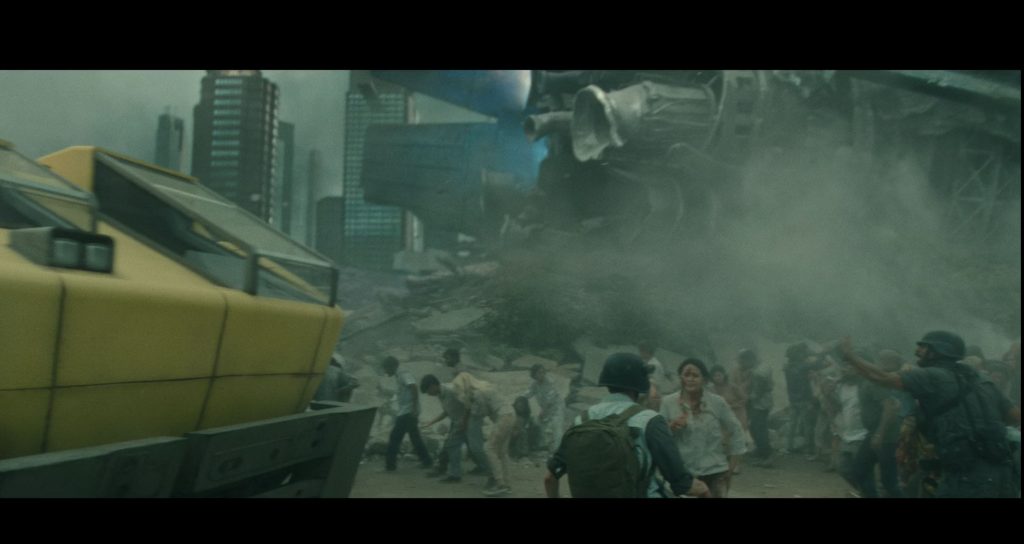
This emblem’s persistence resonates powerfully in Danny Boyle’s 2025 film 28 Years Later, where the red cross on white flies above a fortified English enclave set within a barren, post-apocalyptic world. While removed from its original sacred and civic contexts, the banner retains its core associations with sovereignty, protection, communal identity, and traditional Christian resurrection. In the film, it functions as a complex symbol of resurrection, exclusion, and survival, a fragile claim to authority amid the breakdown of social order and the constant threat of contagion.

In this dystopian environment, the banner continues to signify resurrection and divine sanction in the traditional sense. At the same time, it marks a clear boundary between the enclave’s survivors and the hostile, chaotic world beyond, a world devastated by viral plague and inhabited by the infected. The banner acts as a membrane that both protects those within and excludes those outside, drawing lines of inclusion and exclusion that are political, social, and existential. It defines fragile limits of safety and belonging in a reality where trust is scarce and order has collapsed.

The emotional power of the banner remains strong, recalling the protective logic embedded in its medieval Mediterranean origins and the militant saint whose legend shaped the symbol’s meaning. This connection reveals how visual signs are adapted to new contexts, expressing ongoing human struggles with survival, identity, authority, and hope. In 28 Years Later, the banner suggests a desperate effort to reclaim legitimacy, sovereignty, and the promise of renewal amidst the ruins of political and social structures.

Further complexity arises in the banner’s symbolism within this post-apocalyptic narrative. It simultaneously gestures toward the resurrection of humanity, as a hope for survival and renewal, and the grim return of the undead, virus-made zombies embodying chaos, death, and uncontrollable rage. This dual meaning complicates the banner’s message, making it a marker of both life and death, order and dissolution. It captures the paradox of a community striving to maintain control and meaning while facing overwhelming forces.

Boyle’s use of this emblem creates tension between nostalgia for a lost social order and the urgent, precarious conditions of life in the present. The banner stands not simply as a nationalist or territorial flag but as a symbol charged with the emotional weight of memory, loss, faith, and the human will to endure. Its survival across centuries and media demonstrates the capacity of visual culture to carry historical memory and political theology into new realms, adapting as a dynamic site where past and present, sacred and secular, life and death converge.

The ongoing transformation of the red cross on white reveals how visual symbols carry complex histories while responding to new political and emotional demands. Both Piero’s fresco and Boyle’s film use the banner as a visual device that shapes space, defines identity, and mobilizes affect. Its clarity and legibility allow it to function as a boundary or sphere, separating life from death, inclusion from exclusion, and order from chaos. Its persistence across time and media underlines its role not as a fixed meaning but as a contingent, evolving instrument of power.

This approach avoids reductive allegory or oversimplification. Instead, it highlights how images like the red cross on white operate as vessels for political theology, visual culture, and affective experience. As the banner travels from the frescoed walls of a Tuscan civic palace to the dystopian landscapes of contemporary cinema, it carries a history of sovereignty and community that remains both ancient and urgently relevant. Its migration and transformation teach us how visual forms negotiate power, identity, and survival across moments of historical rupture.

In addition to the other Baxandall mentioned in the text, here are the works that are behind my thinking: 

Baxandall, Michael. Painting and Experience in Fifteenth-Century Italy: A Primer in the Social History of Pictorial Style. Oxford University Press, 1972.

Freedberg, David. The Power of Images: Studies in the History and Theory of Response. University of Chicago Press, 1989.

Panofsky, Erwin. Renaissance and Renascences in Western Art. Harper & Row, 1960.

Abstracted Intelligence: AI, Intellectual Labour, and Berkeley’s Legacy in Public Policy

This was meant to be a review of Revolutionary Mathematics by Justin Joque, but it became an essay on one of his points. A friend sent me a great review—so I’m off the hook. Joque’s book examines the radical potential of mathematics to reshape society, critiquing conventional practice and positioning math as a tool for social change. He explores its intersections with culture and activism, urging us to rethink its role beyond traditional frameworks. For me, it sparked deeper questions about thinking itself—how knowledge, data epistemology, and human insight are fundamentally threatened by our growing reliance on the technology of ghostly inference, where intellectual labour is not merely automated but restructured, displacing those who once performed it while subtly embedding the very biases and inequalities it claims to transcend.

Joque’s reference to George Berkeley (March 1685 – January 1753) in his book piqued my curiosity, especially as Berkeley’s critique in The Analyst (1734) challenged the abstract nature of infinitesimals in calculus, an idea that I just re-read in Wittgenstein. These are, essentially, like quarks or clouds—elusive and intangible, but unlike quarks, which we can at least observe through their effects, or clouds that we can still see, the infinitesimals remain purely abstract, with no direct manifestation. Berkeley argued that these unobservable entities lacked connection to the empirical world, undermining their validity. This critique feels remarkably relevant today, especially with the rise of Artificial Intelligence (AI: see note below). As machines increasingly make decisions based on data, the human dimension of intellectual labour risks being diminished to mere computational tasks. Just as Berkeley questioned mathematical abstractions, we must consider the implications of this abstraction on human intelligence in the AI era.

The rise of artificial intelligence (AI) has become one of the defining phenomena of the 21st century, promising to revolutionize intellectual and manual labour across sectors; however, this promise comes with an implicit threat: the displacement of human thought and expertise by computational models, transforming the nature of governance and intellectual work. The increasingly widespread belief in AI as an agent of efficiency and progress echoes earlier philosophical debates about the nature of knowledge, reality, and the human condition. From the critique of metaphysical abstraction in the Enlightenment to contemporary concerns about automation, the tension between human intellect and technological systems is palpable.

Artificial Intelligence in this essay refers to a broad range of technologies, including artificial intelligence (AI), augmented intelligence (AI), large language models (LLMs), and other related computational tools that enhance decision-making, learning, and data processing capabilities. These technologies encompass machine learning, deep learning, and natural language processing systems that assist or augment human intelligence using computer algorithms.

This philosophical concern is rooted in the intersection of metaphysics and epistemology, where Bayesian probability can offer a framework for assessing belief and knowledge. As machines take over decision-making, Bayesian inference could be used to model how human understanding is increasingly reduced to probabilistic reasoning, driven by data rather than lived experience. The concept of “infinitesimals” in Berkeley’s work, too small to observe directly, mirrors AI’s abstraction, with Bayesian probability similarly depending on unseen or abstract factors. Just as Berkeley questioned mathematical abstractions, we must scrutinize the abstraction of human intelligence through AI systems and their probabilistic reasoning.


AI systems, particularly in governance, often prioritize efficiency over nuance, leading to challenges in addressing complex social issues. For example, AI-based predictive policing models aim to reduce crime by analyzing past data to forecast criminal activity. However, these systems can perpetuate biases by over-policing certain communities or misinterpreting patterns. In Canada, this is evident in the overrepresentation of Indigenous communities in crime statistics, where AI-driven policies may misdiagnose the root causes, such as historical trauma or systemic discrimination, instead of addressing the socio-cultural context that fuels these disparities.

The implementation of AI in public service delivery also poses risks of oversimplification, especially when addressing the needs of vulnerable groups. For instance, in Canada, Indigenous communities have historically faced barriers in accessing health care, education, and social services. AI systems may identify general patterns of need based on demographic data, but they often fail to recognize specific local and cultural factors that are critical in understanding these needs. By relying solely on data-driven models, policymakers risk overlooking essential aspects of accessibility, such as language, geography, or traditional knowledge systems, which are integral to Indigenous communities’ well-being. This could lead to recommendations that do not effectively support their unique requirements.

Furthermore, while AI can process vast amounts of data, its inability to understand cultural nuances means that these models often miss the lived realities of marginalized groups. For example, the challenges faced by immigrants and refugees in Canada are deeply rooted in socio-cultural factors that are not always captured in statistical datasets. AI systems designed to assess eligibility for settlement programs or integration services may overlook the role of social capital, support networks, or personal resilience—factors crucial for successful integration into Canadian society. As a result, AI can produce one-size-fits-all solutions that neglect the complexity of individual experiences, further deepening inequality.

These examples underscore the limitations of AI in governance. While AI systems can process vast amounts of data, they lack the cultural sensitivity and emotional intelligence required to address the intricacies of human experience. Human oversight remains crucial to ensure that AI-driven decisions do not ignore the lived realities of marginalized communities, particularly Indigenous peoples and immigrants in Canada. The challenge is not just technical, but ethical—ensuring that AI serves all citizens equitably, taking into account diverse cultural and social contexts. It is essential that AI is integrated thoughtfully into governance, with a focus on inclusivity and the preservation of human agency.

Berkeley argues that these "infinitesimal" quantities, which are too small to be perceived, cannot be validly used in reasoning, as they detach mathematics from tangible reality. For Berkeley, mathematical concepts must be rooted in empirical experience to be meaningful, and infinitesimals fail this test by being incapable of direct observation or sensory experience.

AI has begun to transform the landscape of intellectual labour, particularly in fields that heavily rely on data analysis. Where human analysts once crafted insights from raw data, AI systems now process and distill these findings at unprecedented speeds. However, the value of human expertise lies not only in the speed of calculation but in the depth of context that accompanies interpretation. While AI systems can detect patterns and correlations within data, they struggle to navigate the complexities of the lived experience—factors like historical context, cultural implications, or social nuances that often turn a dataset into meaningful knowledge.

Data analytics, now increasingly dependent on algorithmic models, also underscores this divide. Machine learning can spot trends and produce statistical conclusions, yet these models often fail to question underlying assumptions or identify gaps in the data. For instance, predictive analytics might flag trends in employment patterns, but it is the human analyst who can explore why certain trends occur, questioning what the numbers don’t tell us. AI is exceptional at delivering quick, accurate results, but without the reflective layer of human interpretation, it risks presenting a skewed or incomplete picture—particularly in the realm of social data, where lived experiences are often invisible to the machine.

As AI continues to infiltrate sectors like healthcare, immigration, criminal justice, and labour economics, it is increasingly tasked with decisions that once relied on human intellectual labour. However, these systems, built on historical data, often fail to account for the subtle shifts in context that data analysis demands. Machine learning systems may flag patterns of healthcare access based on prior records, but they might miss changes in societal attitudes, emerging public health challenges, or new patterns of inequality. These are the kinds of factors that require a human touch, bridging the gap between raw data and its true significance in real-world terms.

This shift is also reshaping the role of data analysts themselves. Once, data analysts were the interpreters, the voices that gave meaning to numbers. Today, many of these roles are becoming increasingly automated, leaving the human element more on the periphery. As AI systems dominate the decision-making process, intellectual labour becomes more about overseeing these systems than about active analysis. The danger here is the erasure of critical thinking and judgment, qualities that have historically been central to intellectual work. While AI excels at scaling decision-making processes, it lacks the ability to adapt its reasoning to new, unforeseen situations without human guidance.

As AI continues to evolve, its influence on governance and intellectual work deepens. The history of data-driven decision-making is marked by human interpretation, and any move toward a purely algorithmic approach challenges the very foundation of intellectual labour. The increasing reliance on AI-driven processes not only risks simplifying complex social issues but also leads to the marginalization of the nuanced understanding that human intellectual labour brings. This tension between machine efficiency and human insight is not merely a technological concern but a philosophical one—a challenge to the nature of work itself and the role of the intellectual in an age of automation.

This shift invites a reconsideration of the historical context in which intellectual labour has developed, a theme that is crucial in understanding the full implications of AI’s rise. The historical evolution of data analysis, governance, and intellectual work has always involved a negotiation between human cognition and technological advancement. As we look toward the future, we must ask: in an age increasingly dominated by machines, how will we ensure that human experience and judgment remain central in shaping the decisions that affect our societies? This question points toward an urgent need to ground AI in a historical context that recognizes its limitations while acknowledging its potential.

As AI becomes more central in shaping political and social policies, particularly regarding immigration, there are concerns about its ability to reflect the complex realities of diverse communities. The reliance on AI can lead to oversimplified assumptions about the needs and circumstances of immigrants, especially when addressing their integration into Canadian society. AI systems that analyze immigration data could misinterpret or fail to account for factors such as socio-economic status, cultural differences, or regional disparities, all of which are critical to creating inclusive policies.

This evolving landscape signals a deeper erosion of the social contract between Canadians and their governments. In immigration, for example, particularly in light of the 2023–2026 Data Strategy and the findings of CIMM – Responses to the OAG’s Report on Permanent Residents, ensuring human oversight becomes increasingly crucial. Without it, there is a risk of diminishing the personal, human elements that have historically been central to governance. The shift towards automated decision-making could alienate citizens and weaken trust in political institutions, as it overlooks the nuanced needs of individuals who are part of the democratic fabric.

AI’s increasing role in governance marks a shift toward the disembodiment of knowledge, where decisions are made by abstract systems detached from the lived experiences of citizens. As AI systems analyze vast amounts of data, they reduce complex human situations to numerical patterns or algorithmic outputs, effectively stripping away the context and nuance that are crucial for understanding individual and societal needs. In this framework, governance becomes a process of automating decisions based on predictive models, losing the human touch that has historically provided moral, ethical, and social considerations in policy formulation.

The consequences of this abstraction in governance are far-reaching. AI systems prioritize efficiency and scalability over qualitative, often subjective, factors that are integral to human decision-making. For example, immigration decisions influenced by AI tools may overlook the socio-political dynamics or personal histories that shape individuals’ lives. When policy decisions become driven by data points alone, the systems designed to serve citizens may end up alienating them, as the systems lack the empathy and contextual understanding needed to address the full complexity of human existence. This hollowing out of governance shifts power away from human oversight, eroding the ability of democratic institutions to remain responsive and accountable to the people they serve.

The COVID-19 pandemic served as a catalyst for the rapid integration of AI in governance and society. As governments and businesses shifted to remote work models, AI tools were leveraged to maintain productivity and ensure public health safety. Technologies like contact tracing, automated customer service bots, and AI-driven health analytics became critical in managing the crisis. This acceleration not only enhanced the role of AI in public sector decision-making but also pushed the boundaries of its application, embedding it deeper into the governance framework.

The pandemic also saw the domestication of AI through consumer devices, which became central to everyday life. With lockdowns and social distancing measures in place, reliance on digital tools grew, and AI-powered applications—like virtual assistants, fitness trackers, and personalized recommendation systems—found a more prominent place in households. These devices, which had once been seen as niche, became essential tools for managing work, health, and social connections. The widespread use of AI in homes highlighted the shift in governance, where decision-making and the management of societal norms increasingly came under the control of automated systems, marking a techno-political shift in how people interact with technology.In revisiting Berkeley’s critique of infinitesimals, we find philosophical parallels with the rise of AI. Berkeley questioned the very foundation of knowledge, suggesting that our perceptions of the material world were based on subjective experience, not objective truths. Similarly, AI operates in a realm where data is processed and interpreted through systems that may lack subjective human experience. AI doesn’t “understand” the data in the same way humans do, yet it shapes decision-making processes that affect real-world outcomes, creating an abstraction that can be detached from human experience.

This disconnection between machine and human experience leads to the dehumanization of knowledge. AI systems operate on algorithms that prioritize efficiency and optimization, but in doing so, they strip away the nuanced, context-driven understanding that humans bring to complex issues. Knowledge, in this sense, becomes something disembodied, divorced from the lived experiences and emotions that give it meaning. As AI continues to play a central role in governance, the process of knowledge becomes more mechanized and impersonal, further eroding the human dimension of understanding and ethical decision-making. The philosophical concerns raised by Berkeley are mirrored in the ways AI reshapes how we conceptualize and act on knowledge in a tech-driven world.

The rapid integration of AI into intellectual labour and governance presents a profound shift in how decisions are made and knowledge is structured. While AI offers the promise of efficiency and precision, its growing role raises critical concerns about the erosion of human agency and the humanistic dimensions of governance. As AI systems replace human judgment with algorithmic processes, the risk arises that complex social, political, and ethical issues may be oversimplified or misunderstood. The hollowing out of governance, where decision-making is increasingly abstracted from lived experiences, mirrors the philosophical critiques of abstraction seen in Berkeley’s work. The human element, rooted in experience, judgment, and empathy, remains crucial in the application of knowledge. Without mindful oversight, the adoption of AI in governance could result in a future where technology governs us, rather than serving us. To navigate these challenges, preserving human agency and ensuring that AI tools are used as aids rather than replacements is essential to maintaining a just and ethical society.

Berkeley’s philosophy of “immaterial ghosts”, where the immaterial influences the material world, aligns with Richter’s cloud paintings at Ottawa’s National Gallery of Canada, which evoke a similar sense of intangible presence. Both focus on the unseen: Berkeley’s spirits are ideas that influence our perceptions, while Richter’s clouds, as abstract forms, suggest the unknowable and elusive. In this way, Berkeley’s invisible world and Richter’s cloudscapes both invite us to confront the limits of human understanding, where the unseen shapes the visible.