There was a time when images were evidence. A medieval map was not just a representation but a claim to knowledge, an argument about how the world was structured. A Renaissance painting revealed divine order, a photograph proved that something was. Today, we face a new kind of image—one that does not record but generates, one whose authority does not come from witnessing reality but from statistical inference. AI-generated imagery does not document the world; it thinks the world.
For centuries, knowledge was structured around categories. Aristotle, Linnaeus, and later the Encyclopédistes built systems to organize the world, classifying nature, history, and human thought into legible hierarchies. Even with the rise of empirical science, knowledge remained something accumulated, structured, and verified through observation.
mid journey image #prompt = [coffee in St. Peter’s Square –ar1:1]
The algorithm, however, does not organize knowledge in this way. It does not categorize the world from above but learns patterns from within. Unlike an 18th-century taxonomist, an AI system does not define a tiger by its stripes or its feline characteristics—it simply processes vast quantities of data, detecting statistical correlations that allow it to recognize a tiger without ever defining it.
This is a profound shift. Knowledge, once built through observation and classification, is now generated by inference. The AI-generated image follows this logic. It does not capture a moment, as a photograph once did, nor does it interpret a subject, as a painting might. Instead, it predicts what an image should look like, based on probabilities. The result is something fundamentally different from representation: an image that emerges from a machine’s internal logic rather than from reality itself.
For centuries, images were linked to material constraints: pigments on a canvas, light on film, a chemical process that left behind a physical trace. Even digital images, while infinitely replicable, still maintained a relationship to a source—a photograph taken, a frame captured. AI-generated imagery untethers itself from this history. It is not a copy but an invention, synthesized from a dataset of other images, none of which serve as the original.
This is not just a technological change; it is an epistemological one. If we once sought truth in the documentary image, where do we look now? If an AI can generate a face that has never existed, what happens to our belief in the evidentiary power of the portrait? And if an algorithm can create art indistinguishable from human creativity, what happens to the very idea of authorship?
We might think of AI as a historian of its own kind—one that does not preserve the past but extracts patterns from it. The great archives of human culture—museums, libraries, film reels—once functioned as repositories of collective memory. AI, trained on these vast datasets, does not remember but predicts. It does not curate the past; it recombines it.
The implications of this shift extend beyond aesthetics. In medicine, AI does not diagnose based on fixed categories but on pattern recognition, seeing correlations that escape human detection. In law, AI systems sift through precedent not to enforce continuity but to optimize decisions. Across disciplines, knowledge is becoming less about interpretation and more about computation.
Yet there is something unsettling in this. AI-generated imagery reminds us that knowledge, long thought to be something we built, structured, and controlled, may now be something we train—a vast statistical model that does not explain but predicts, does not reason but generates.
midJourney image #prompt = [grid of a single leaf –ar 1:1]
If the image was once a window onto the world, AI has made it a hall of mirrors, endlessly reflecting a logic we do not fully understand. The question is no longer whether these images are real, but rather: whose reality do they belong to?
The paradox of concrete as both the symbol of modernity and its antithesis—destruction—has been beautifully and vividly re-examined in the 2024 documentary by Viktor Kossakovsky, Architecton. The film opens with the ravaged remains of concrete structures in Ukraine, setting the stage for an exploration not only of architecture’s relationship to materiality but of its role in the broader narrative of progress and decay. Through this lens, Kazimir Malevich’s geometrically pure forms gain new resonance, shifting from abstract utopian ideals to poignant metaphors for the tension between stability and fragility inherent in all human endeavours.
The ruins of Baalbek, stark against the infrared sky, their massive columns diminished yet unwavering. Their presence in the landscape is both imposing and ghostly, a relic of human ambition that now exists in a state of suspension, neither fully intact nor wholly lost. In the documentary’s meditation on concrete and stone, Baalbek serves as a distant counterpoint—where modern concrete is cast and shaped to fit the needs of the present, these ancient stones, quarried and placed millennia ago, endure as both triumph and ruin, a reminder that all architecture, no matter how permanent it seems, is ultimately subject to time.
One striking quotation from the documentary reads: “After water, concrete is the most widely used substance on Earth.” This simple statement highlights concrete’s ubiquity and significance in shaping the modern world. Water—life’s most fundamental element—has long been the basis of human survival and connection with nature, while concrete, as the second most used material, represents humankind’s drive to dominate and define its surroundings. Yet, despite its ubiquity, concrete’s eventual decay exposes a different truth: the same forces that humans attempt to master—through architecture, engineering, and design—are ultimately beyond control. Concrete, while seemingly permanent, is just as vulnerable as the stone it mimics, subject to the ravages of time, war, and nature.
In one particularly striking image, a solitary man with a wheelbarrow is dwarfed by a massive block of stone, carved millennia ago and abandoned. This visual echoes the evocative imagery of Michelangelo’s Prisoner statues, housed in Florence’s Accademia Gallery. These figures, half-formed, trapped in their stone prison, seem to struggle towards liberation, embodying both the act of creation and the stasis of unfulfilled potential. The abandoned stone, much like these unfinished figures, occupies a space between being and non-being, between intention and entropy. The stone seems to call out for a form that has not yet been realized, just as the massive concrete structures in the documentary gesture toward what could have been—monuments of progress now succumbed to time and violence. In this way, both the material and its artistic potential exist in a state of suspended animation, caught between the historical force of its creation and the inevitable dissolution of all things.
Integral to this exploration is the use of infrared imagery, a technological choice that disrupts our traditional understanding of built structures. Infrared, often used to reveal hidden heat signatures, transforms concrete buildings into spectral forms. What was once solid, monumental, and permanent is reduced to an ethereal presence, a visual manifestation of the invisible energies and decay beneath the surface. It’s as though the material itself is attempting to communicate its vulnerability—an image of architecture that exposes itself not as a static entity, but as a system of energies, histories, and eventual dissolution.
A crucial scene in the film—an extended sequence of a massive rockslide—underscores the inherent power of stone, nature’s counterpoint to human architecture. As colossal boulders cascade down the mountainside, the camera lingers on the massive, unyielding force of the stone. This raw, natural destruction stands in stark contrast to the calculated, human-made beauty of classical architecture. The imagery here is a reminder that stone, while emblematic of permanence, is also vulnerable to the overwhelming forces of nature. This stark juxtaposition of classical ruins, once thought to be eternal, returning to the earth, punctuates the fragility of human ambition and the fleeting nature of monumental achievement.
The pairing of concrete and rock, two materials that symbolize permanence, with such violence and collapse speaks to their liminal nature. Both substances, when used for habitation or as symbols, straddle the boundary between human-made constructs and the natural world. They strain the traditional distinctions between subject and object, man and nature—two concepts that architecture has long worked to contain and define. Concrete, as both a building material and a symbol of modernity, offers the illusion of control over nature. Yet, it is precisely this illusion that makes it so susceptible to forces beyond our grasp. Rock, though an ancient and seemingly immutable material, can also become a harbinger of destruction when untethered from human will. These materials blur the boundaries of the architectural discourse, pointing to an inherent instability between humanity’s ambitions and the larger natural forces at play.
Concrete, though seemingly durable, is as much a material of transience as it is of permanence. The structures it creates can endure for centuries, but the very process of their construction—through human labour, environmental forces, and the inevitable decay—ensures their eventual dissolution. In this, concrete is emblematic of the human condition: the striving for permanence caught in the endless flux of change and decay.
Through this lens, the interaction between concrete and rock becomes a reflection of the tension between human intention and natural forces. These materials are not mere objects to be shaped or controlled but are agents in their own right, influencing the spaces they inhabit. When viewed through infrared, they reveal themselves not as passive backdrops but as active participants in the construction of meaning. Concrete’s malleability and rock’s permanence, when combined, create a tension that straddles the boundary between subject and object, a dialectic that architecture itself has long sought to transcend. If technologies shape our understanding of reality, then the use of infrared here forces us to confront the complex interplay between human creation and the natural world.
Malevich’s Architecton, in this context, becomes more than a study of abstract form. It serves as a blueprint for reconsidering the purpose and meaning of architecture in a time when the very materials that define our spaces are constantly in flux. If the built environment is constantly being reshaped by forces both seen and unseen, then architecture is not a static monument but an ongoing negotiation between humanity and the materials that constitute it. And in the suspended forms of stone and concrete, we find a reminder that art, too, lies at the intersection of creation and destruction—a space where form is constantly being struggled into existence, only to eventually fade back into the material world.
The argument that multimodal AI collapses the text-image distinction is, at first glance, compelling. However, this claim relies on an implicit assumption that such a distinction was ever stable or clearly demarcated. A closer examination reveals that AI’s generative processes do not so much “collapse” the distinction as they do mechanize an already-existing instability—one that has long been explored through avant-garde literary and artistic practices, particularly in asemic writing.
Throughout the 20th century, artists and writers repeatedly disrupted the supposed boundary between text and image. Dadaist collage, Surrealist automatic writing, and concrete poetry all foregrounded the materiality of language, demonstrating that text could function visually as much as linguistically. In Lettrism, pioneered by Isidore Isou in the 1940s, letters were untethered from conventional phonetic or semantic meaning, transformed into visual compositions. Henri Michaux’s asemic ink drawings similarly dissolved the distinction between writing and mark-making, demonstrating that the act of inscription need not resolve into legibility. These historical precedents complicate the article’s central claim: rather than producing an unprecedented collapse, AI merely accelerates and mechanizes a longstanding artistic impulse to question the division between reading and seeing.
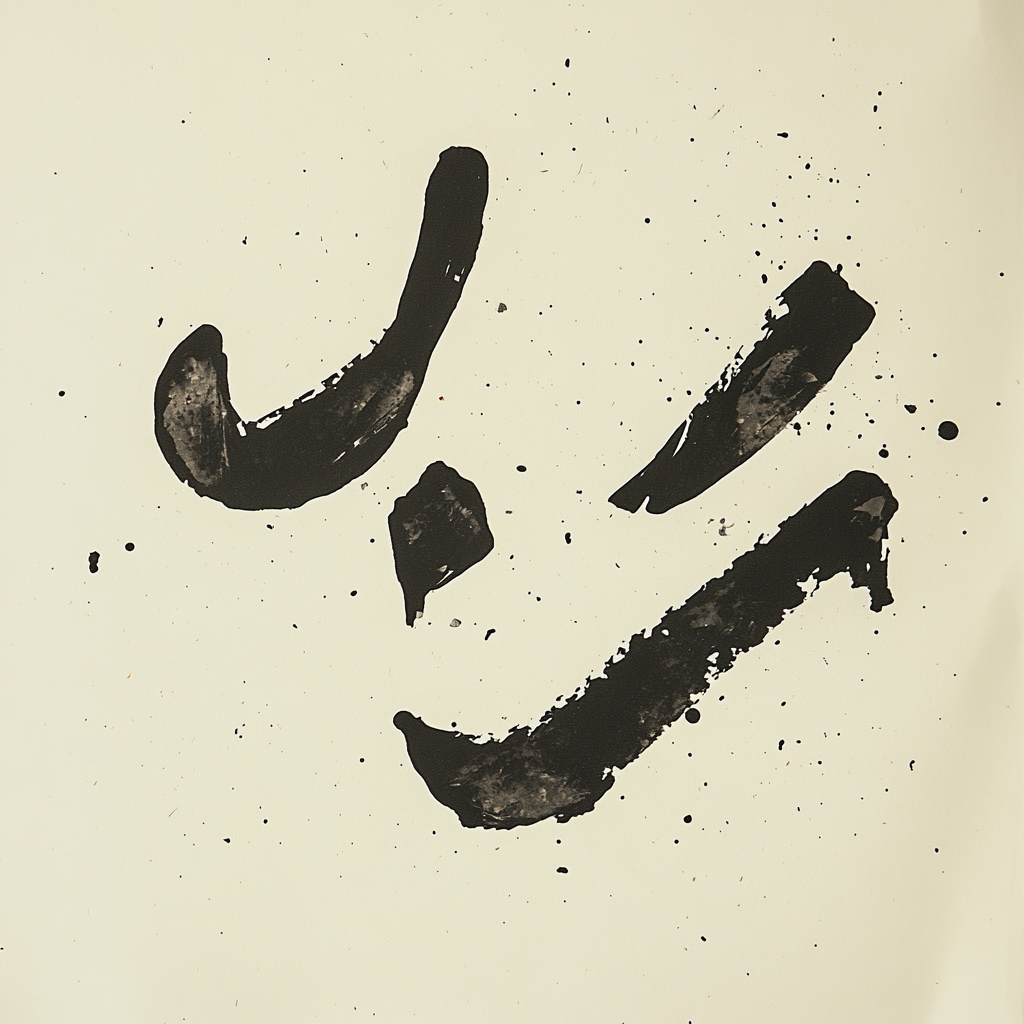
Asemic writing resists the tyranny of meaning, inviting the reader into an interpretative space where language dissolves into pure form.
If asemic writing operates through intentional illegibility, inviting interpretation while resisting definitive meaning, AI-generated text-image hybrids do not resist meaning so much as they produce an excess of it. The logic of machine learning generates outputs that are overdetermined by probabilistic associations rather than by authorial intent. Cy Twombly’s gestural inscriptions, for instance, suggest meaning without fully disclosing it; their power lies in their resistance to linguistic capture. By contrast, AI-generated multimodal outputs do not refuse meaning but generate an abundance of semiotic possibilities, saturating the interpretative field. The article does not fully account for this distinction, treating AI’s multimodal capabilities as a collapse rather than an overproduction, a shift from resistant ambiguity to computational fluency.
What is most fundamentally altered by AI is not the existence of an intermediary space between text and image but the industrialization of indeterminacy itself. Asemic writing historically resists institutional legibility, positioning itself against systems of meaning-making that demand clear semiotic functions. AI, however, converts indeterminacy into a computational process, endlessly producing outputs that are neither fully readable nor wholly visual but are nevertheless monetized and instrumentalized. Where the illegibility of Chinese wild cursive calligraphy or Hanne Darboven’s sprawling numerical texts was once a site of aesthetic resistance, AI-driven multimodality turns this ambiguity into a product, systematizing what was once an act of refusal.
By severing the link between signifier and signified, asemic writing exposes the visual unconscious of text, revealing writing as an act of mark-making rather than communication.
Rather than signaling the collapse of the text-image distinction, AI-driven multimodality reveals how this boundary has always been porous. The article’s central argument overlooks the long history of artistic and literary practices that have anticipated and complicated the very phenomenon it describes. A more nuanced approach would recognize that AI does not dissolve the distinction between text and image so much as it absorbs their instability into a system that operationalizes ambiguity at scale, transforming what was once a site of aesthetic and conceptual resistance into an automated process of production.
This was meant to be a review of Revolutionary Mathematics by Justin Joque, but it became an essay on one of his points. A friend sent me a great review—so I’m off the hook. Joque’s book examines the radical potential of mathematics to reshape society, critiquing conventional practice and positioning math as a tool for social change. He explores its intersections with culture and activism, urging us to rethink its role beyond traditional frameworks. For me, it sparked deeper questions about thinking itself—how knowledge, data epistemology, and human insight are fundamentally threatened by our growing reliance on the technology of ghostly inference, where intellectual labour is not merely automated but restructured, displacing those who once performed it while subtly embedding the very biases and inequalities it claims to transcend.
Joque’s reference to George Berkeley (March 1685 – January 1753) in his book piqued my curiosity, especially as Berkeley’s critique in The Analyst (1734) challenged the abstract nature of infinitesimals in calculus, an idea that I just re-read in Wittgenstein. These are, essentially, like quarks or clouds—elusive and intangible, but unlike quarks, which we can at least observe through their effects, or clouds that we can still see, the infinitesimals remain purely abstract, with no direct manifestation. Berkeley argued that these unobservable entities lacked connection to the empirical world, undermining their validity. This critique feels remarkably relevant today, especially with the rise of Artificial Intelligence (AI: see note below). As machines increasingly make decisions based on data, the human dimension of intellectual labour risks being diminished to mere computational tasks. Just as Berkeley questioned mathematical abstractions, we must consider the implications of this abstraction on human intelligence in the AI era.
The rise of artificial intelligence (AI) has become one of the defining phenomena of the 21st century, promising to revolutionize intellectual and manual labour across sectors; however, this promise comes with an implicit threat: the displacement of human thought and expertise by computational models, transforming the nature of governance and intellectual work. The increasingly widespread belief in AI as an agent of efficiency and progress echoes earlier philosophical debates about the nature of knowledge, reality, and the human condition. From the critique of metaphysical abstraction in the Enlightenment to contemporary concerns about automation, the tension between human intellect and technological systems is palpable.
Artificial Intelligence in this essay refers to a broad range of technologies, including artificial intelligence (AI), augmented intelligence (AI), large language models (LLMs), and other related computational tools that enhance decision-making, learning, and data processing capabilities. These technologies encompass machine learning, deep learning, and natural language processing systems that assist or augment human intelligence using computer algorithms.
This philosophical concern is rooted in the intersection of metaphysics and epistemology, where Bayesian probability can offer a framework for assessing belief and knowledge. As machines take over decision-making, Bayesian inference could be used to model how human understanding is increasingly reduced to probabilistic reasoning, driven by data rather than lived experience. The concept of “infinitesimals” in Berkeley’s work, too small to observe directly, mirrors AI’s abstraction, with Bayesian probability similarly depending on unseen or abstract factors. Just as Berkeley questioned mathematical abstractions, we must scrutinize the abstraction of human intelligence through AI systems and their probabilistic reasoning.
AI systems, particularly in governance, often prioritize efficiency over nuance, leading to challenges in addressing complex social issues. For example, AI-based predictive policing models aim to reduce crime by analyzing past data to forecast criminal activity. However, these systems can perpetuate biases by over-policing certain communities or misinterpreting patterns. In Canada, this is evident in the overrepresentation of Indigenous communities in crime statistics, where AI-driven policies may misdiagnose the root causes, such as historical trauma or systemic discrimination, instead of addressing the socio-cultural context that fuels these disparities.
The implementation of AI in public service delivery also poses risks of oversimplification, especially when addressing the needs of vulnerable groups. For instance, in Canada, Indigenous communities have historically faced barriers in accessing health care, education, and social services. AI systems may identify general patterns of need based on demographic data, but they often fail to recognize specific local and cultural factors that are critical in understanding these needs. By relying solely on data-driven models, policymakers risk overlooking essential aspects of accessibility, such as language, geography, or traditional knowledge systems, which are integral to Indigenous communities’ well-being. This could lead to recommendations that do not effectively support their unique requirements.
Furthermore, while AI can process vast amounts of data, its inability to understand cultural nuances means that these models often miss the lived realities of marginalized groups. For example, the challenges faced by immigrants and refugees in Canada are deeply rooted in socio-cultural factors that are not always captured in statistical datasets. AI systems designed to assess eligibility for settlement programs or integration services may overlook the role of social capital, support networks, or personal resilience—factors crucial for successful integration into Canadian society. As a result, AI can produce one-size-fits-all solutions that neglect the complexity of individual experiences, further deepening inequality.
These examples underscore the limitations of AI in governance. While AI systems can process vast amounts of data, they lack the cultural sensitivity and emotional intelligence required to address the intricacies of human experience. Human oversight remains crucial to ensure that AI-driven decisions do not ignore the lived realities of marginalized communities, particularly Indigenous peoples and immigrants in Canada. The challenge is not just technical, but ethical—ensuring that AI serves all citizens equitably, taking into account diverse cultural and social contexts. It is essential that AI is integrated thoughtfully into governance, with a focus on inclusivity and the preservation of human agency.
Berkeley argues that these "infinitesimal" quantities, which are too small to be perceived, cannot be validly used in reasoning, as they detach mathematics from tangible reality. For Berkeley, mathematical concepts must be rooted in empirical experience to be meaningful, and infinitesimals fail this test by being incapable of direct observation or sensory experience.
AI has begun to transform the landscape of intellectual labour, particularly in fields that heavily rely on data analysis. Where human analysts once crafted insights from raw data, AI systems now process and distill these findings at unprecedented speeds. However, the value of human expertise lies not only in the speed of calculation but in the depth of context that accompanies interpretation. While AI systems can detect patterns and correlations within data, they struggle to navigate the complexities of the lived experience—factors like historical context, cultural implications, or social nuances that often turn a dataset into meaningful knowledge.
Data analytics, now increasingly dependent on algorithmic models, also underscores this divide. Machine learning can spot trends and produce statistical conclusions, yet these models often fail to question underlying assumptions or identify gaps in the data. For instance, predictive analytics might flag trends in employment patterns, but it is the human analyst who can explore why certain trends occur, questioning what the numbers don’t tell us. AI is exceptional at delivering quick, accurate results, but without the reflective layer of human interpretation, it risks presenting a skewed or incomplete picture—particularly in the realm of social data, where lived experiences are often invisible to the machine.
As AI continues to infiltrate sectors like healthcare, immigration, criminal justice, and labour economics, it is increasingly tasked with decisions that once relied on human intellectual labour. However, these systems, built on historical data, often fail to account for the subtle shifts in context that data analysis demands. Machine learning systems may flag patterns of healthcare access based on prior records, but they might miss changes in societal attitudes, emerging public health challenges, or new patterns of inequality. These are the kinds of factors that require a human touch, bridging the gap between raw data and its true significance in real-world terms.
This shift is also reshaping the role of data analysts themselves. Once, data analysts were the interpreters, the voices that gave meaning to numbers. Today, many of these roles are becoming increasingly automated, leaving the human element more on the periphery. As AI systems dominate the decision-making process, intellectual labour becomes more about overseeing these systems than about active analysis. The danger here is the erasure of critical thinking and judgment, qualities that have historically been central to intellectual work. While AI excels at scaling decision-making processes, it lacks the ability to adapt its reasoning to new, unforeseen situations without human guidance.
As AI continues to evolve, its influence on governance and intellectual work deepens. The history of data-driven decision-making is marked by human interpretation, and any move toward a purely algorithmic approach challenges the very foundation of intellectual labour. The increasing reliance on AI-driven processes not only risks simplifying complex social issues but also leads to the marginalization of the nuanced understanding that human intellectual labour brings. This tension between machine efficiency and human insight is not merely a technological concern but a philosophical one—a challenge to the nature of work itself and the role of the intellectual in an age of automation.
This shift invites a reconsideration of the historical context in which intellectual labour has developed, a theme that is crucial in understanding the full implications of AI’s rise. The historical evolution of data analysis, governance, and intellectual work has always involved a negotiation between human cognition and technological advancement. As we look toward the future, we must ask: in an age increasingly dominated by machines, how will we ensure that human experience and judgment remain central in shaping the decisions that affect our societies? This question points toward an urgent need to ground AI in a historical context that recognizes its limitations while acknowledging its potential.
As AI becomes more central in shaping political and social policies, particularly regarding immigration, there are concerns about its ability to reflect the complex realities of diverse communities. The reliance on AI can lead to oversimplified assumptions about the needs and circumstances of immigrants, especially when addressing their integration into Canadian society. AI systems that analyze immigration data could misinterpret or fail to account for factors such as socio-economic status, cultural differences, or regional disparities, all of which are critical to creating inclusive policies.
This evolving landscape signals a deeper erosion of the social contract between Canadians and their governments. In immigration, for example, particularly in light of the 2023–2026 Data Strategy and the findings of CIMM – Responses to the OAG’s Report on Permanent Residents, ensuring human oversight becomes increasingly crucial. Without it, there is a risk of diminishing the personal, human elements that have historically been central to governance. The shift towards automated decision-making could alienate citizens and weaken trust in political institutions, as it overlooks the nuanced needs of individuals who are part of the democratic fabric.
AI’s increasing role in governance marks a shift toward the disembodiment of knowledge, where decisions are made by abstract systems detached from the lived experiences of citizens. As AI systems analyze vast amounts of data, they reduce complex human situations to numerical patterns or algorithmic outputs, effectively stripping away the context and nuance that are crucial for understanding individual and societal needs. In this framework, governance becomes a process of automating decisions based on predictive models, losing the human touch that has historically provided moral, ethical, and social considerations in policy formulation.
The consequences of this abstraction in governance are far-reaching. AI systems prioritize efficiency and scalability over qualitative, often subjective, factors that are integral to human decision-making. For example, immigration decisions influenced by AI tools may overlook the socio-political dynamics or personal histories that shape individuals’ lives. When policy decisions become driven by data points alone, the systems designed to serve citizens may end up alienating them, as the systems lack the empathy and contextual understanding needed to address the full complexity of human existence. This hollowing out of governance shifts power away from human oversight, eroding the ability of democratic institutions to remain responsive and accountable to the people they serve.
The COVID-19 pandemic served as a catalyst for the rapid integration of AI in governance and society. As governments and businesses shifted to remote work models, AI tools were leveraged to maintain productivity and ensure public health safety. Technologies like contact tracing, automated customer service bots, and AI-driven health analytics became critical in managing the crisis. This acceleration not only enhanced the role of AI in public sector decision-making but also pushed the boundaries of its application, embedding it deeper into the governance framework.
The pandemic also saw the domestication of AI through consumer devices, which became central to everyday life. With lockdowns and social distancing measures in place, reliance on digital tools grew, and AI-powered applications—like virtual assistants, fitness trackers, and personalized recommendation systems—found a more prominent place in households. These devices, which had once been seen as niche, became essential tools for managing work, health, and social connections. The widespread use of AI in homes highlighted the shift in governance, where decision-making and the management of societal norms increasingly came under the control of automated systems, marking a techno-political shift in how people interact with technology.In revisiting Berkeley’s critique of infinitesimals, we find philosophical parallels with the rise of AI. Berkeley questioned the very foundation of knowledge, suggesting that our perceptions of the material world were based on subjective experience, not objective truths. Similarly, AI operates in a realm where data is processed and interpreted through systems that may lack subjective human experience. AI doesn’t “understand” the data in the same way humans do, yet it shapes decision-making processes that affect real-world outcomes, creating an abstraction that can be detached from human experience.
This disconnection between machine and human experience leads to the dehumanization of knowledge. AI systems operate on algorithms that prioritize efficiency and optimization, but in doing so, they strip away the nuanced, context-driven understanding that humans bring to complex issues. Knowledge, in this sense, becomes something disembodied, divorced from the lived experiences and emotions that give it meaning. As AI continues to play a central role in governance, the process of knowledge becomes more mechanized and impersonal, further eroding the human dimension of understanding and ethical decision-making. The philosophical concerns raised by Berkeley are mirrored in the ways AI reshapes how we conceptualize and act on knowledge in a tech-driven world.
The rapid integration of AI into intellectual labour and governance presents a profound shift in how decisions are made and knowledge is structured. While AI offers the promise of efficiency and precision, its growing role raises critical concerns about the erosion of human agency and the humanistic dimensions of governance. As AI systems replace human judgment with algorithmic processes, the risk arises that complex social, political, and ethical issues may be oversimplified or misunderstood. The hollowing out of governance, where decision-making is increasingly abstracted from lived experiences, mirrors the philosophical critiques of abstraction seen in Berkeley’s work. The human element, rooted in experience, judgment, and empathy, remains crucial in the application of knowledge. Without mindful oversight, the adoption of AI in governance could result in a future where technology governs us, rather than serving us. To navigate these challenges, preserving human agency and ensuring that AI tools are used as aids rather than replacements is essential to maintaining a just and ethical society.
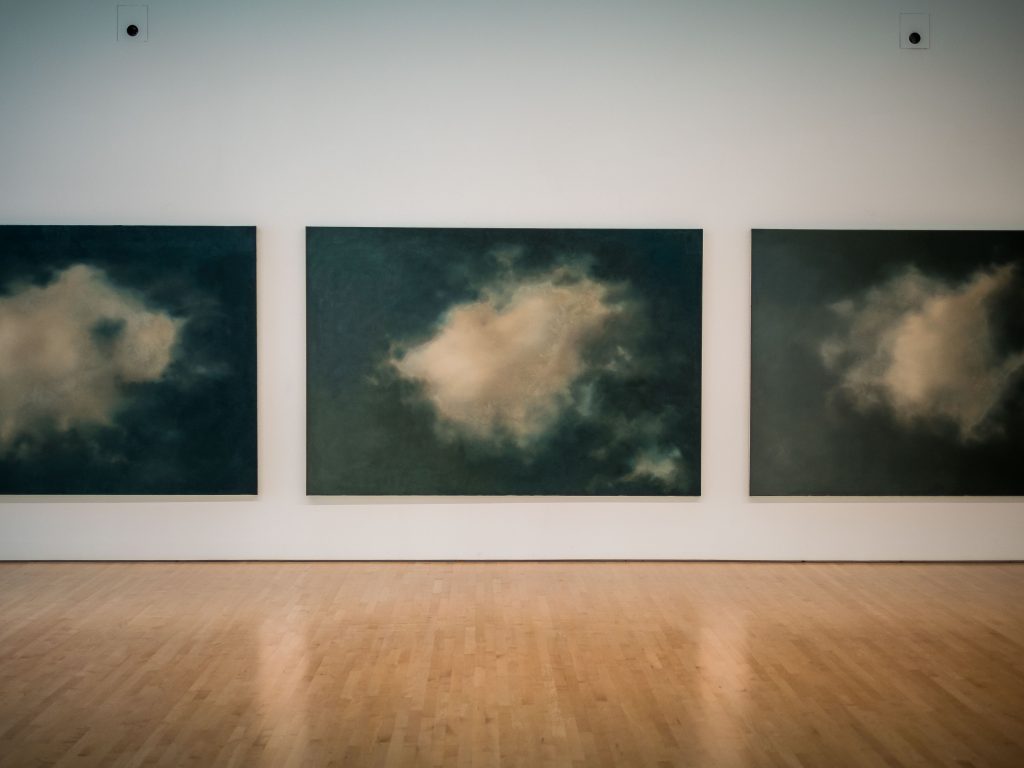
Berkeley’s philosophy of “immaterial ghosts”, where the immaterial influences the material world, aligns with Richter’s cloud paintings at Ottawa’s National Gallery of Canada, which evoke a similar sense of intangible presence. Both focus on the unseen: Berkeley’s spirits are ideas that influence our perceptions, while Richter’s clouds, as abstract forms, suggest the unknowable and elusive. In this way, Berkeley’s invisible world and Richter’s cloudscapes both invite us to confront the limits of human understanding, where the unseen shapes the visible.
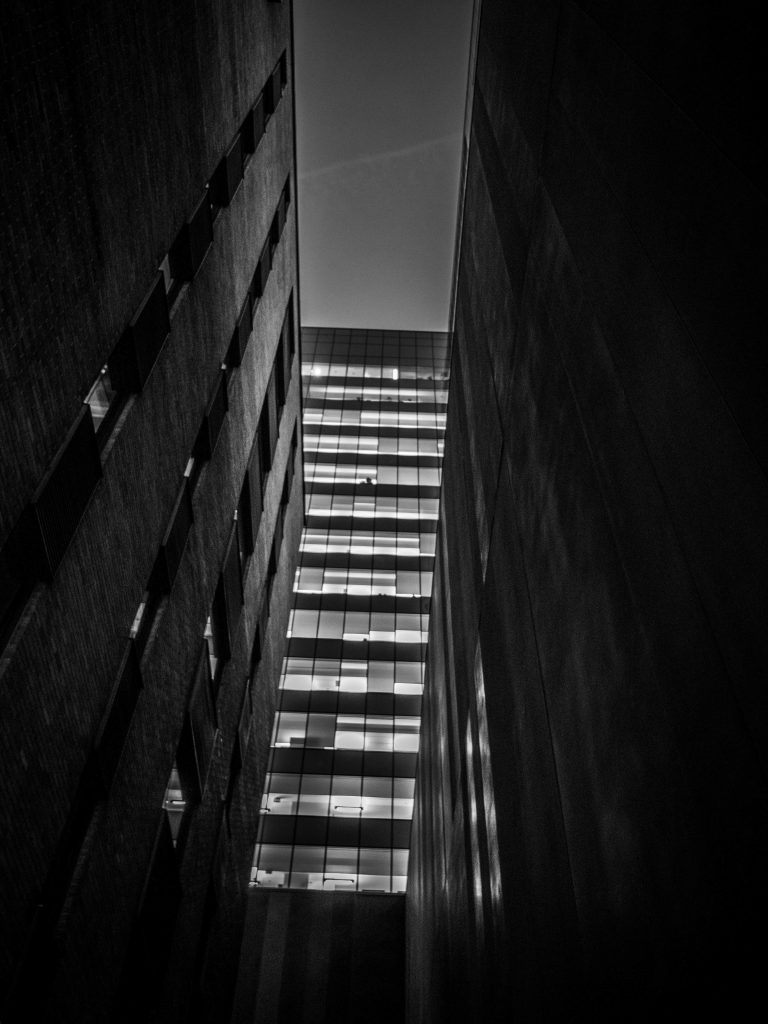
In black and white, architecture transforms into pure form—sharp lines and intricate textures stand out, while windows become portals to another world. The absence of colour forces the eye to focus on structure, light, and shadow, revealing the timeless beauty of built environments.
Looking up at the National Art Gallery in Ottawa, the stark contrasts of its glass and stone façade come to life in black and white. The sharp edges and sweeping curves of the architecture create a powerful dialogue between light and shadow, revealing the gallery’s majestic presence.
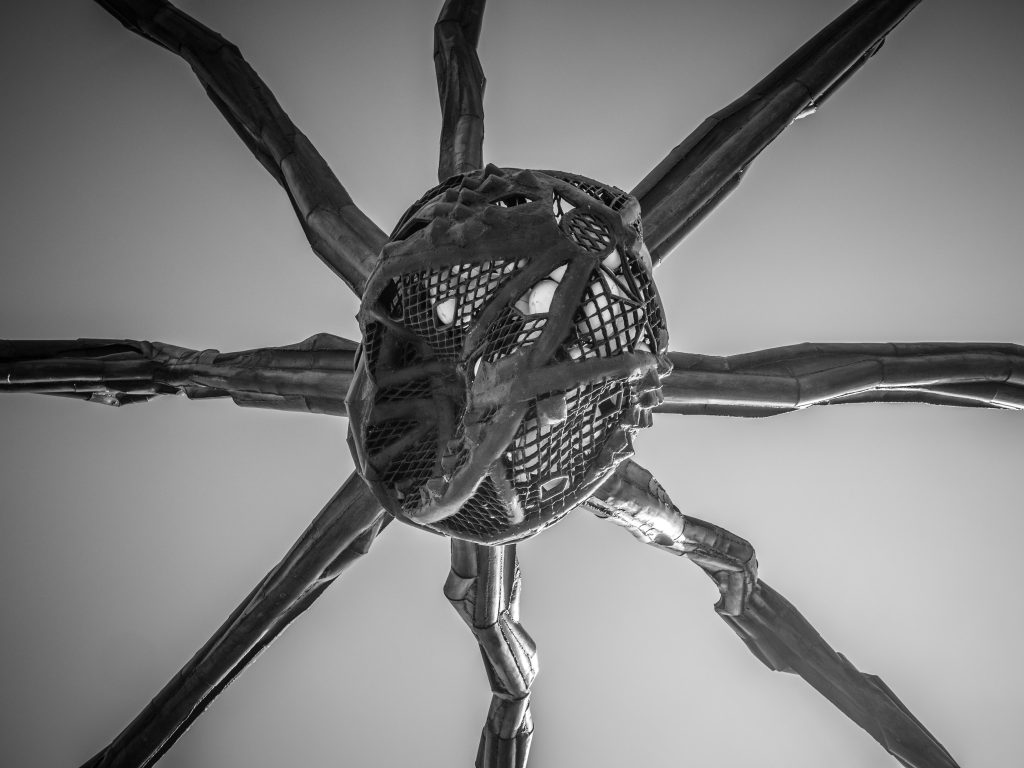
Looking up at the Maman statue outside the National Art Gallery in Ottawa, its towering, spider-like form becomes an intense study in contrast. The black and white frame emphasizes the intricate details of its legs and body, casting dramatic shadows that evoke both awe and vulnerability.
Ecce Homo by Caravaggio (?) at the Prado. I can hear the security guard now!
On my recent trip to Madrid, I had the chance to see the newly unveiled Ecce Homo at the Prado, a painting believed to be by Caravaggio. However, I find myself skeptical about its attribution. The dating places it in his later period in Naples, but stylistically, it resonates more with his earlier works, if at all. The strong use of light and shadow is reminiscent of Caravaggisti more than Merisi’s, and the way figures are treated, suggest echoes of his youth rather than his mature style. This disconnect raises questions about the complexities of dating and attributing art, especially works from such a turbulent time in Caravaggio’s career.
Ecce Homo—”Behold the Man.” A phrase uttered by Pilate, but in painting, it’s more than just a biblical moment. It’s an image of suffering, exposure, and recognition—or lack thereof. There’s something uncomfortable about these depictions: Christ, beaten and humiliated, made a spectacle before the crowd. He is both king and victim, sacred yet mocked. Artists have returned to this moment for centuries, not just to retell the Passion story but to wrestle with deeper questions about power, vulnerability, and what it means to really see another person.
The phrase Ecce Homo—“Behold the Man”—captures a profound theological paradox within the Passion narrative. Pilate’s words (John 19:5) seem to present Jesus both as the King of the Jews and as a humiliated criminal, crowned with thorns rather than a royal diadem. The inscription above Christ’s head on the cross (John 19:19), “Jesus of Nazareth, King of the Jews,” amplifies this irony. While Pilate’s statement could be seen more as a political gesture in the context of Roman authority and a question of Jesus’ messianic claims, the truth embedded in this moment transcends his intentions: Christ’s kingship is revealed through sacrifice, not earthly power. This tension invites deeper reflection on how we understand divine kingship—not as dominance, but as a vulnerability that paradoxically holds all power.
In Western Catholic painting, Ecce Homo serves as a profound visual commentary on the tension between Christ’s divine kingship and his earthly humiliation. Artists such as Caravaggio, Titian, and Rembrandt have captured the scene with an intensity that underscores this paradox. Christ, bound and crowned with thorns, is portrayed not just as a suffering man but as the focal point of redemption. In these works, the duality of his nature—both human and divine—becomes palpable, encouraging the viewer to confront their understanding of kingship, suffering, and salvation through the lens of Christ’s sacrifice.
The Ecce Homo theme, originating in early Christianity, traces a complex philosophical journey through humanism and beyond. In the Renaissance, it highlighted suffering as central to human dignity, a paradox of vulnerability and strength. This duality of human frailty and resilience persists in philosophical thought, provoking reflection on the nature of suffering, redemption, and the complexities of the human condition. The theme continues to influence thinkers, encouraging deeper exploration into how suffering shapes both individual and collective existence.
This tension in Ecce Homo is revealed through the way artists have engaged with the subject, using “picturing” as a tool to convey both divine kingship and human suffering. In the Renaissance, artists like Titian or Bosch often depicted Christ’s suffering with an air of quiet dignity, where his gaze, whether meeting ours or turning inward, suggests both presence and contemplation. In contrast, Caravaggio and the Baroque artists push the emotional intensity of the scene further, employing stark contrasts of light and shadow to amplify the rawness of Christ’s ordeal. These depictions do not merely visualize suffering; they invite the viewer to feel the violence, to hear the mocking crowd, to experience the visceral reality of Christ’s vulnerability. This technique shifts the act of “picturing” into a more embodied experience, bridging the divide between observer and the scene, compelling the viewer to confront the deeply human, yet paradoxically sacred, nature of the moment.
Nietzsche, of course, couldn’t resist borrowing the phrase, twisting it for his own purposes. His Ecce Homo wasn’t about suffering at all, but self-affirmation. A way of saying, “Here I am, on my own terms.” In a way, that’s the opposite of the Ecce Homo in painting, where Christ is stripped of control, turned into an object for others to judge. But maybe that contrast is the point. The paintings ask something of us—not just to look, but to decide what we see.
While the Lost Caravaggio: The Ecce Homo Unveiled exhibition at the Prado presents a newly discovered painting, I remain skeptical of its attribution to Caravaggio. Regardless of its origins, the theme of Ecce Homo remains a profound reflection on Christ’s suffering and kingship, deeply intertwined with theological exploration. This rediscovery encourages a broader dialogue about how this moment of humiliation, vulnerability, and sacrifice has been visualized across centuries. For more information, visit the Prado’s website.
Really enjoyed this work by Virgine Brunelle the other night at the National Art Centre. After a pretty awesome meal at 1Rideau I sat down for a sensory explosion of both visual and audio sensations.
In Fables, Virginie Brunelle creates a visceral exploration of chaos and resilience, where contemporary feminine archetypes collide in a raw, primal dance. Drawing from her background in violin, Brunelle intricately weaves rhythm and movement, pushing the boundaries of traditional dance. The performers’ bodies, mostly naked and raw, amplified by their breath and cries, move through a sonic landscape composed by Philippe Brault and performed live by Laurier Rajotte on the piano, embodying a world in turmoil yet yearning for hope and humanity.
A particularly striking element is the immersive audio experience in the opening set, where a cast member swings a microphone close to the dancers, amplifying their physicality. This not only heightened the intimacy of the piece but also allowed me to feel the dancers’ movements—every breath, every collision becomes a tactile experience. Very immersive. The live soundscape intertwines with the dancers’ raw physicality, drawing the audience deeper into the emotional urgency of the piece. This fusion of sight and sound creates a profound connection, turning the stage into a space where chaos, music, and movement converge in a shared sensory reality.
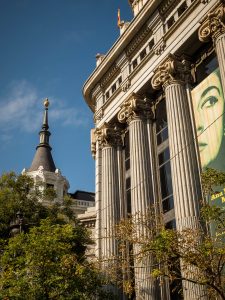
Madrid’s architecture is a testament to the tides of history that have shaped this vibrant city. From the austere grandeur of its Habsburg-era buildings to the flourishes of Bourbon elegance, each structure reveals the ambitions and artistry of its time. The intricate details of Baroque façades echo the opulence of Spain’s Golden Age, while the orderly Neo-Classical designs of later centuries reflect a yearning for rationality and order. Iconic buildings like the Prado Museum, with its majestic neoclassical facade, and the nearby Thyssen-Bornemisza and Reina Sofía galleries, highlight the city’s devotion to both art and architecture, blending the historical with the contemporary. Together, these architectural landmarks form a living chronicle of a city that has been both the seat of empire and the cradle of modern creativity.
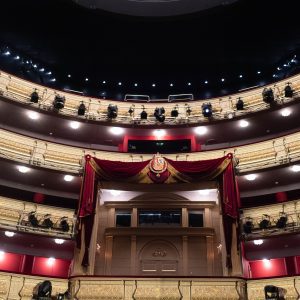
The Teatro Real, Madrid’s grand opera house, exemplifies this interplay of art and history. Built in the mid-19th century, it survived the upheavals of revolution and restoration, bearing witness to the cultural resilience of the city. Inside, music and performance have bridged generations, making it a temple to Spain’s enduring artistic spirit. Nearby, the Edificio Capitol on Gran Vía tells another story: one of modernity and innovation. Its Art Deco curves and illuminated signs capture a moment when Madrid looked to the future, embracing cinematic glamour and urban dynamism.
At the heart of this city’s historical and artistic identity stands the Cervantes Monument in Plaza de España, a tribute to Spain’s greatest literary voice. The bronze figures of Don Quixote and Sancho Panza stride forward on their eternal quest, embodying not only the timelessness of Cervantes’ work but also the universal struggle between idealism and reality. Here, surrounded by Madrid’s layered architectural legacy, history and art converge, reminding us that each era contributes its own verse to the city’s unfolding story.
I wanted to see a flamenco show while I was in Madrid and the one I went to was highly rated and close to my hotel. An evening of flamenco in Madrid is an experience that immerses you in the heart and soul of Andalusian culture. As the first notes of the guitar ring out, the air fills with an electric energy, drawing you into the world of passionate rhythms and intense emotion. The setting was cave-like, great for the acoustics. The dancers, with fiery eyes and graceful yet powerful movements, seem to pour everything into every step, the click of their heels echoing like thunder.