
Carbon / Renewables, and Artificial Intelligence: Infrastructure, Power, and the Geography of Computation

The most important assumption embedded in the AI boom is not that intelligence demand will grow. It is that intelligence will remain centralized. This assumption is rarely examined because it has been inherited from the economics of fossil fuels and cloud computing. Yet the rise of local models raises the possibility that intelligence may increasingly resemble renewable energy: abundant, distributed, and locally generated. If so, the consequences extend far beyond technology markets. They would reshape the geography of power itself.

The artificial intelligence boom rests on a surprisingly narrow assumption. Across financial markets, technology firms, governments, and the media, there is broad agreement that demand for computation will continue rising for years, perhaps decades. This expectation underpins hundreds of billions of dollars in investment in data centres, power generation, semiconductor fabrication, and the infrastructure required to support them. Every new hyperscale facility is celebrated as evidence of an inevitable future.

Yet the AI boom assumes more than rising demand. It assumes that intelligence itself will remain centralized.

History suggests this distinction matters. The most consequential technologies are often remembered not for what they did, but for how they were organized. Coal transformed the nineteenth century because it created new relationships between capital, labour, and the state. Oil reshaped the twentieth because its production favoured scale, concentration, and control over strategic resources. The internet altered communication because it reorganized the architecture through which information flowed. Infrastructure, not technology alone, determines who holds power and who depends on whom.

This perspective echoes a broader insight found in the work of Adam Tooze (see my review of his LRB speech from last year) and earlier scholars such as Lewis Mumford and Thomas P. Hughes. Modern power is exercised through infrastructure. Energy systems, financial networks, logistics chains, communications platforms, and technical standards shape economic and political outcomes as surely as governments or markets. The central question is not who possesses resources, but who controls the systems upon which others depend.

Viewed this way, artificial intelligence appears less as a technological breakthrough than as the latest chapter in a much older story. The critical issue is not whether AI becomes more capable. It is whether AI reinforces an existing logic of concentration or introduces a new logic of distribution.

Technological revolutions are often portrayed as disruptions that overturn existing hierarchies. More often, they reinforce them. The industrial revolution concentrated production in factories. Electrification produced centralized grids. The oil economy elevated a small number of producers, refiners, and states to strategic importance. In each case, the enduring consequences flowed from the infrastructure surrounding the technology rather than the technology itself.

Artificial intelligence may prove no different. Today’s debate is dominated by benchmarks, reasoning capabilities, and the race toward increasingly powerful models. Future historians may care less about which model first surpassed a particular threshold than about who owned the computational infrastructure, who controlled access to intelligence, and who captured the resulting economic rents.

The current trajectory clearly favours concentration. Frontier AI models require enormous amounts of capital, energy, specialized hardware, and technical expertise. These requirements create formidable barriers to entry and strengthen the position of a small number of firms whose advantages compound over time. More compute produces better models; better models attract more users and investment; investment finances still larger infrastructure. Scale begets scale.

The pattern closely resembles the political economy of fossil fuels. Oil production rewarded concentration because extraction, refining, and distribution required large-scale infrastructure. The result was not merely economic power but geopolitical influence. Control over energy became a source of leverage; access became a strategic concern. Contemporary discussions of AI increasingly adopt the same language. Semiconductors are treated as strategic assets. Data centers are becoming critical infrastructure. Electricity generation is framed as a prerequisite for national competitiveness.

Yet there is another possibility. While investment flows toward larger centralized systems, local AI models are improving at extraordinary speed. Tasks that recently required cloud-scale resources can increasingly be performed on consumer hardware. More efficient models, better chips, and advances in compression are steadily reducing computational requirements.

This raises a question largely absent from current forecasts: what if intelligence follows a trajectory closer to renewable energy than fossil fuels?
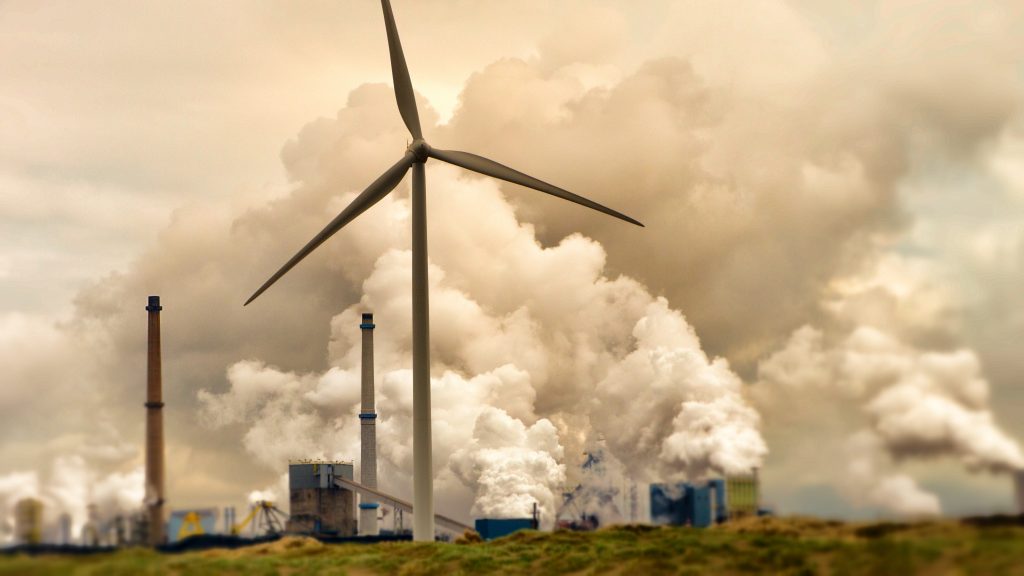
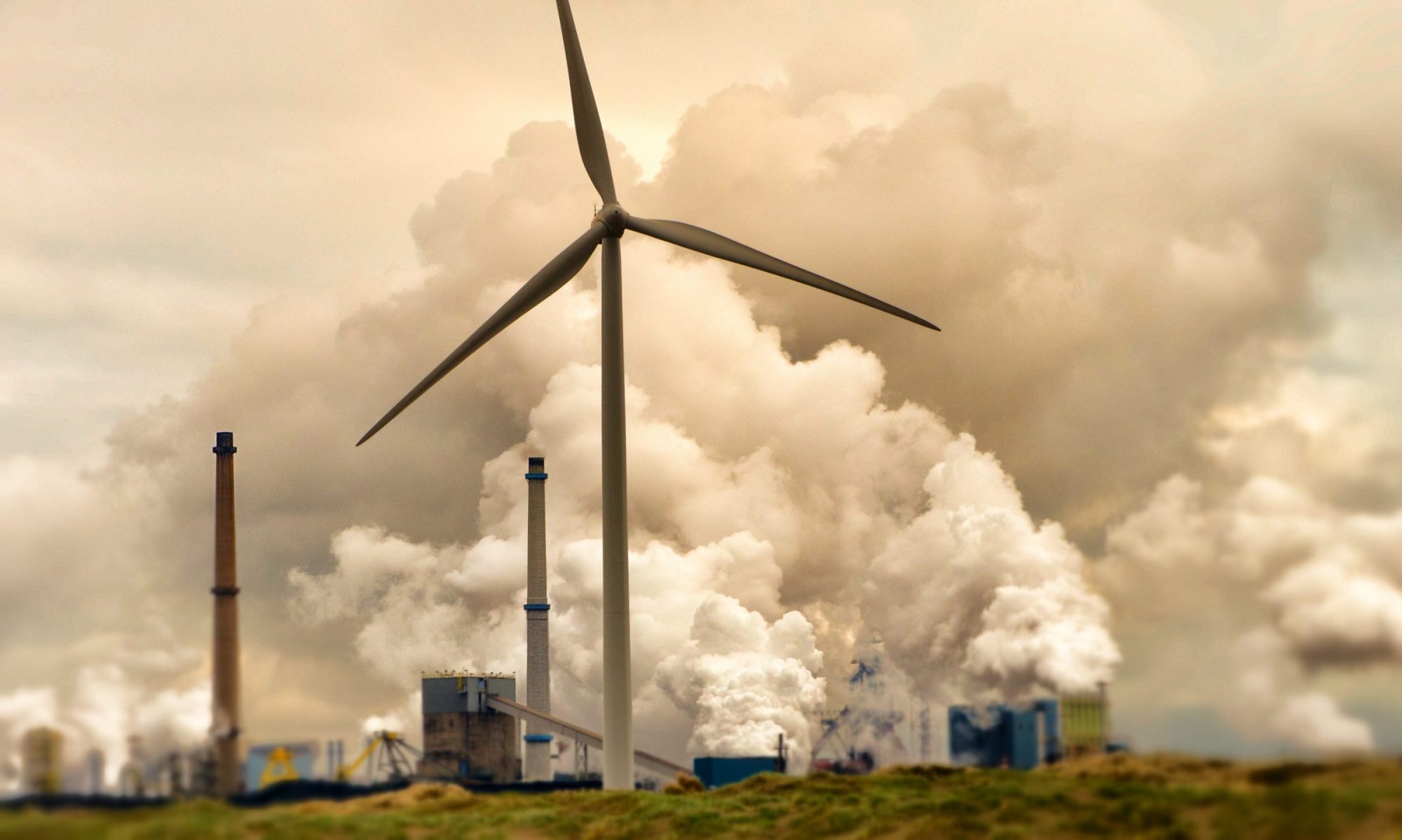
A photo of the hydro generation near IJmuiden aan Zee in the Netherlands.

The comparison is ultimately about power. Oil is concentrated; solar is distributed. Oil creates dependency because production is controlled by a relatively small number of actors. Solar reduces dependency by allowing energy to be generated where it is consumed. The transition from fossil fuels to renewables is therefore not merely an energy transition; it is a transformation in the architecture of power.

A similar distinction may emerge in AI. Frontier models resemble large power stations, requiring immense capital and centralized infrastructure. Local models resemble distributed generation. They may not match frontier performance, but they offer advantages in autonomy, resilience, privacy, and cost.

The conventional response is that efficiency increases demand. Following Jevons (Jevon’s Paradox), many argue that cheaper AI will simply generate more AI usage, just as cheaper storage produced more data and cheaper computation produced more software. This is likely correct. But it misses the crucial point. Efficiency can increase demand while simultaneously changing where that demand is satisfied.

The rise of personal computers increased demand for computation without requiring all computation to remain centralized. Smartphones expanded computing while placing substantial capability directly into users’ hands. Growth and distribution are not mutually exclusive.

The key question, therefore, is not whether demand for intelligence will grow. It almost certainly will. The more important question is whether that demand requires centralized infrastructure. Most users do not need frontier performance; they need systems that are good enough. If local models satisfy most everyday tasks, intelligence may become increasingly distributed even as overall demand continues to rise.

The implications extend far beyond technology markets. Infrastructure shapes political and economic power. A world dominated by centralized AI would deepen dependence on a small number of firms and states. A world of widely distributed intelligence would produce a different balance between autonomy and dependency, concentration and diffusion.

The most important assumption embedded in the AI boom is not that demand for intelligence will continue growing. It is that intelligence will remain centralized. If that assumption proves wrong, the consequences will extend far beyond technology. They will reshape the political economy of computation and, potentially, the geography of power itself.

This argument builds most directly on the work of Lewis Mumford and Thomas P. Hughes. In Technics and Civilization (1934), Mumford argued that technologies are never merely technical; they embody social and political choices, often reinforcing either centralized or decentralized forms of power. Hughes, in Networks of Power: Electrification in Western Society, 1880–1930 (1983), shifted attention from individual inventions to the large technological systems that emerge around them, showing how infrastructure, institutions, capital, and governance become inseparable. Together, they suggest that the key question about AI is not how intelligent it becomes, but what kind of system it creates. This perspective has been extended by Alfred Chandler (The Visible Hand, 1977), Manuel Castells (The Rise of the Network Society, 1996), James C. Scott (Seeing Like a State, 1998), Timothy Mitchell (Carbon Democracy, 2011), David Edgerton (The Shock of the Old, 2006), and more recently Adam Tooze, all of whom examine how infrastructure shapes economic, political, and social power.

The Architectonics of Power The Carbonstate, the Electrostate, and the New Strategic Order – Adam Tooze’s 2025 LRB Autumn Lecture 

Adam Tooze’s 2025 London Review of Books Autumn Lecture offers a diagnosis of a world whose organizing principles can no longer be captured by moral narratives or inherited geopolitical categories. The lecture is not concerned with adjudicating virtue or blame, but with understanding how power is materially organized, reproduced, and defended under contemporary conditions. What emerges is a picture of a global order under strain, not for lack of agency, but because it is saturated with it.

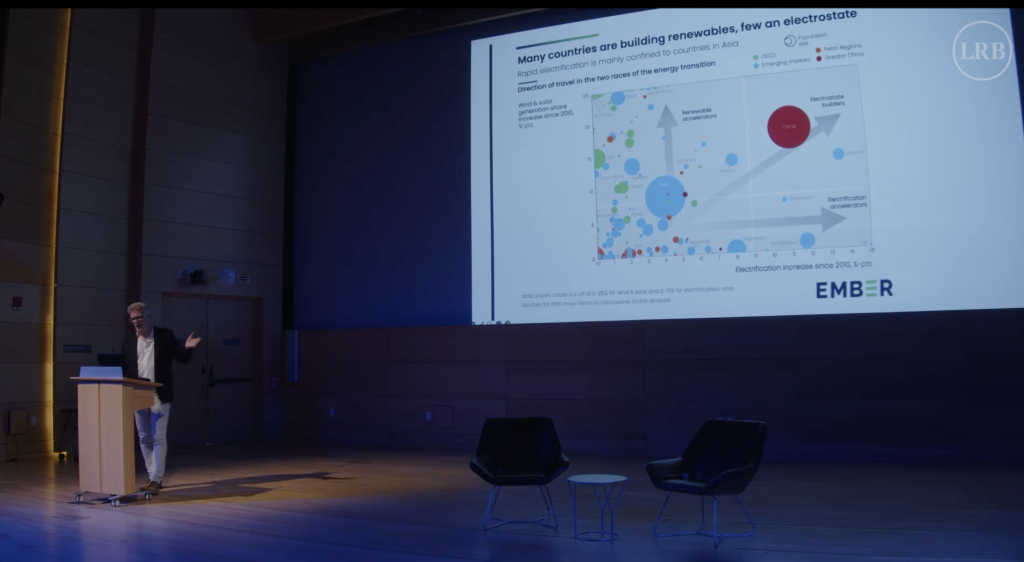
Screenshot of the 2025 LRB Lecture with a graph showing that while many countries are building on renewables, they are not focusing on the development of an integrated electrostate as China is.

At the centre of Tooze’s argument is a shift in form rather than in substance. The age of hydrocarbons is not ending so much as being structurally transformed. The decisive change is not from oil to electricity alone, but from commodity based power to system based power. Oil could be owned, traded, and stockpiled; electricity must be generated, transmitted, and stabilized across networks. It is an architecture rather than an object. As a result, power is no longer primarily a matter of possession, but of coordination and governance, of shaping the conditions under which the system reproduces itself.

Tooze asks whether the present moment should be understood as a new Cold War. He rejects the simplistic claim that the world is returning to bipolarity, yet he emphasises that the logic of alignment is reappearing. If this framing is accepted, the analytic tools of the earlier struggle remain valuable: the core question is not ideological victory but the maintenance of asymmetric advantage. In this context, the logic of structural preponderance, pace Leffler, is transformed, shifting from industrial mobilization to infrastructural centrality. Twentieth century dominance rested on industrial capacity, military deterrence, and institutional reach; preponderance was a question of who could mobilize the greatest resources and sustain the largest war machine. Today, advantage is produced through infrastructural centrality. The state or coalition capable of designing, securing, and scaling energy systems, supply chains, and technological platforms can shape the strategic choices of others. Power resides less in what one controls directly than in the constraints and possibilities one imposes on the system as a whole. The imperative is not simply to be strong, but to ensure that rivals cannot develop comparable capacity on their own terms, and that their strategic options remain dependent on the architecture one controls.

It is against this transformed logic of preponderance that Tooze identifies one of the lecture’s most disquieting political dynamics. In order to preserve its strategic position, the United States aligns functionally with Russia and the Gulf states. This also works towards explaining recent American imperialism toward Venezuela. The alignment is not driven by shared ideology but by shared dependence on the stability of energy, finance, and infrastructure. Tooze resists the claim that the world has returned to a Cold War. The resemblance lies not in bipolar rivalry but in the structural logic of alignment itself. When the system’s continuity is at stake, states organize around necessity rather than principle. Moral language recedes, and the maintenance of systemic order, ensuring that networks, flows, and capacities continue to reproduce, becomes the decisive mode of political behaviour. This is why the question of blocs is not merely rhetorical. The carbondollar bloc is an alignment built around energy and money, and its rival is not a single state but a competing system of electrification and green infrastructure.

An early sixteenth century map from the Naval Museum in Madrid, in which the western hemisphere is beginning to be rendered as a navigable network. The map is not simply a representation of land, but a diagram of circulation, commerce, and imperial power, a visual precursor to the modern infrastructure of global exchange. Photo by me and a nod to Andre Gunder Frank’s Re-Orient.

The coherence of this alignment becomes clearer when energy and money are treated as a single system. If the United States and the Gulf states form a carbondollar bloc, the rivalry is not only over currency but over the material logic that currency is meant to stabilize. The carbondollar bloc is not simply the petrodollar system; it is the broader architecture that converts fossil energy into monetary power and stabilizes global exchange in a carbon based order. In the language of contemporary energy history, this system is sustained through the continual management of supply and demand, the policing of access, and the institutionalisation of energy as a strategic commodity, a logic that has shaped modern geopolitics for decades (see Daniel Yergin’s The Prize). The alternative Tooze identifies is not merely a competing currency arrangement, but a rival system organized around electrification and green infrastructure, the networks and materials required for a decarbonised economy. The contest, therefore, is not simply about which unit of account prevails, but about which regime of production and reproduction becomes the organizing principle of global power. In this light, the lecture reads not as a menu of policy choices but as a diagnosis of systemic vulnerability.

Tooze further clarifies this vulnerability through a distinction between state forms shaped by their energy regimes. The carbonstate is organized around rents, contracts, and legal stabilization; it is governed by lawyers, financiers, and institutions designed to manage scarcity, volatility, and the politics of extraction. The electrostate, by contrast, is organized around engineering, grids, capacity planning, and scale. Authority here is exercised through technical coordination rather than juridical mediation. This distinction helps explain the paradoxical character of the present moment; extraordinary levels of intentionality coexist with persistent instability. States act with confidence, undertaking large scale infrastructure projects and territorial reorganization, even as they confront overlapping crises that resist resolution. Tooze characterizes this condition not as incoherence, but as a second modernity, in which modernizing logics persist under radically altered planetary constraints.

The lecture also draws explicitly on Hayden White’s insight that historical understanding is shaped by narrative form. Tooze suggests that contemporary energy transitions are being framed through divergent narrative genres. In the Western case, the story takes the form of a Comedy. Societies awaken to the planetary consequences of their energy systems, recognize that the Great Acceleration entailed profound ecological damage, and attempt to correct course through regulation, decarbonization, and institutional reform. Yet this awakening is accompanied by a persistent impulse to preserve the underlying carbon order through technological innovation. The carbonstate does not simply admit the climate crisis, if it does admit it; it seeks to manage it, often by reframing solutions as new forms of efficiency or new modes of extraction, as with the rise of fracking. The tone is therefore ironic and self critical; reform is imagined as repair rather than rupture, and innovation is presented as a way to maintain continuity under the guise of transformation.

China’s trajectory, as Tooze presents it, follows a different narrative logic. It resembles Romance in the classical sense; a story of struggle against poverty and underdevelopment. Coal and carbon powered that struggle with full awareness of its costs. Environmental destruction and mass mortality were understood as the price of development and political survival. What distinguishes this trajectory is not denial, but sequencing. Violent industrialization was followed by an equally forceful pivot, beginning in the 2010s, toward electrification, green infrastructure, and technological remediation. This turn was not moralistic but existential. For the Chinese state, technological transformation becomes a condition of regime survival.

A long durée perspective sharpens the contrast. When viewed across megageographies inhabited by millions of individuals, the spatial and demographic challenges faced by different polities diverge dramatically. North America operates across a small number of such geographies; China across nearly twenty. The difference is not merely one of scale, but of governance. Managing electrification, infrastructure, and decarbonization across such complexity requires a distinct relationship between state, technology, and population. What appears externally as hyper agency emerges internally as a response to geographic and demographic necessity.

The lecture also implies a transformation in the conditions of authority themselves, a transformation in which the reproduced becomes the site of legitimacy. In earlier technological revolutions, the act of reproduction diminished the singularity of objects, loosening their grip on legitimacy and the circuits of circulation. Today, the rupture is not in the copy but in the system. Energy networks, supply chains, and computational infrastructures do not merely replicate discrete goods; they reproduce capacity, stability, and power across space and time. Authority no longer resides in a unique site or a singular owner but in the capacity to sustain and direct these reproducing systems. Strategic advantage is therefore less about possession than orchestration, about the ability to govern the flows that make modern life possible. This is why the distinction between carbonstate and electrostate matters; the former seeks to preserve reproduction through legal and financial mechanisms, the latter through technical coordination and scale. Control over reproduction becomes the new locus of aura, in the sense of Walter Benjamin’s reflections on the loss of singularity, the point at which infrastructure, technology, and authority fuse into a single, distributed sovereignty.

Tooze’s contribution lies in the clarity of this diagnosis. He resists both nostalgic analogies and technological determinism, offering instead a framework in which energy, money, infrastructure, and narrative are understood as mutually constitutive. Power in the twenty first century is not disappearing; it is relocating into systems that are harder to see and harder to contest. The new architecture of power is being built in grids, supply chains, and infrastructures of reproduction. Tooze gives us a way to see that architecture without pretending that it can be easily mastered.