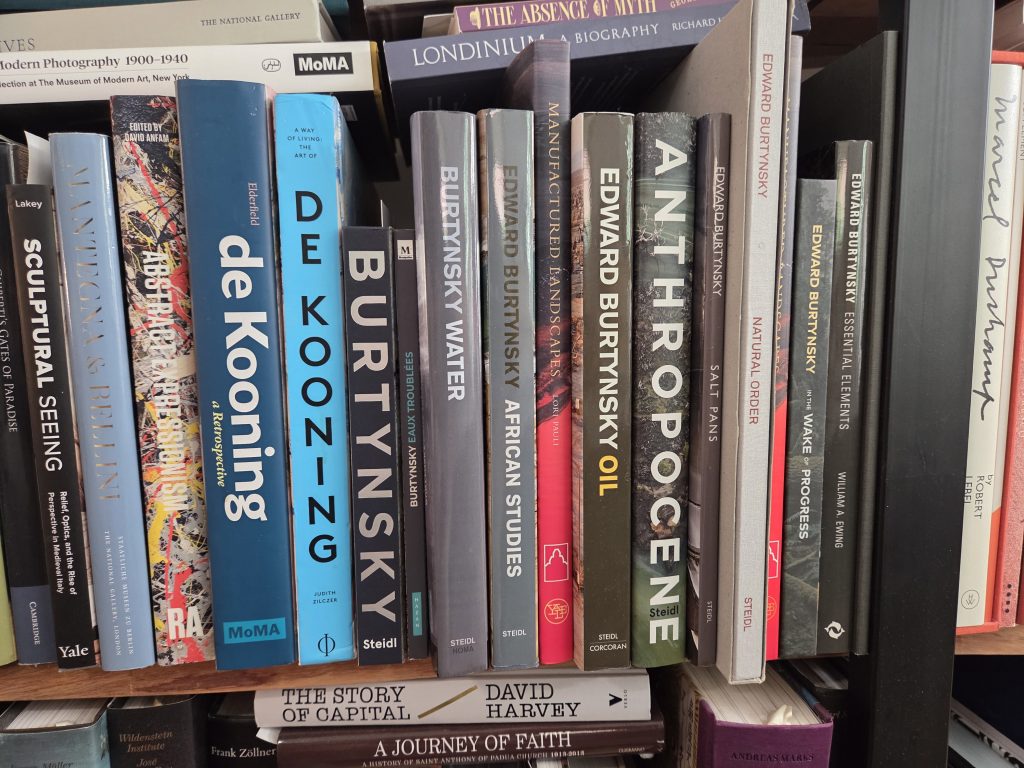

I frame Burtynsky’s photographs as icons after reading Hans Belting, who argues in Likeness and Presence (1990) that images do not merely represent but actively shape how we see; he shows how images produce a lived sense of presence. Applying that lens, I saw how Burtynsky’s photographs do not simply depict industrial sites but stage them with such scale and clarity that looking becomes an encounter; like icons, they organize attention and demand a sustained, almost devotional recognition of what we normally overlook. As opposed to John Berger’s seeing as a product of historically trained viewing, Belting treats icons as presences whose likeness becomes effective through embodied belief and particular sites of use.
Edward Burtynsky’s photographs produce an unsettling double effect: they are lucidly beautiful and insistently incriminating. The viewer is granted the pleasure of composition, including gradation, sheen, colour harmonies, and a near-architectural ordering of form, only to discover that what has been organized into visual coherence is also the residue of extraction, waste, and long afterlives of industry. The result is not simply “aesthetics of pollution,” but an art of perception that resembles, in function if not in theology, the ancient icon’s labour: to make the real visible in such a way that seeing becomes ethically charged.
To approach Burtynsky through Byzantine iconography is not to claim that his photographs are “religious” images. It is, rather, to treat the icon as a technology of address—an apparatus that teaches a viewer how to look so that perception cannot remain detached. Byzantine icons do not merely represent; they organize attention toward a presence. In Burtynsky, the presence is not divine but historical and systemic: the photograph makes visible the continuities by which human making outlasts intention. His tailing ponds, mines, and waste landscapes are terrible because they are beautiful enough to be looked at, yet beautiful in a way that refuses to let the viewer look away as though beauty were innocence.
The icon’s central achievement is to conjoin beauty with accountability. In the best-known account, icons are defended in the wake of iconoclasm by insisting that honour belongs to what the image mediates: Christ’s visibility in flesh, the salvific weight of matter, and the intercessory agency of saints and the Mother of God. But even before theology, the icon is a visual pedagogy. It trains the eye to receive images as sites where meaning happens: sites that solicit not contemplation in the modern, spectator sense of “seeing”, but recognition that binds the viewer to what has been shown.
Burtynsky performs an analogous operation, though his mediations are secular. Consider the tonal authority of his tailing ponds: the photographs often stage landscape as a kind of immaculate surface, as if nature had learned compositional grammar from industrial hands. A viewer may begin with the instinct to admire: colour fields that echo painting, geometric calm that resembles order, light that renders residue almost luminous. Yet the longer gaze insists on an interpretive reversal: what looks like aesthetic autonomy is in fact the stable afterimage of violent processes. The pond is not a scene; it is an outcome. And the outcome is beautiful precisely because it is made, managed, and refined into visual coherence by technical infrastructures.
This reversal can be described as the “iconic turn” of Burtynsky’s art that I perceived only when reading James King’s wonderful recent biography: the camera reveals not only what is there, but what the viewer has learned to misread. In everyday vision industrial landscapes are typically consigned to categories of ugliness, background, or failure: things to be endured rather than attended to. Burtynsky disrupts that classification by granting these environments a pictorial dignity that compels the viewer to recognize them as images in their own right. His photographs reveal how human systems transform extraction into surfaces residue into legible gradients and waste into an involuntary scenic design.
Here the icon is useful, because Byzantine aesthetics are never innocent of power. Icons are “terrible” in the sense that they establish hierarchy and command: faces address the viewer, gestures index relationships, and the gold ground abolishes the comforting assumption that the visible is merely the visible. The viewer is not free to treat the image as an object among objects. The icon demands a response. In Pantokrator imagery, the address is unmistakably severe: divine governance made frontal, nonnegotiable, and immediate. With Theotokos, the address shifts toward mediation: salvation arrives through particularity, through the body and the history of incarnation. Either way, the icon’s beauty does not soften authority; it makes authority perceptible.
Burtynsky’s “terrible beauty” similarly makes authority perceptible, but the authority is that of systems. If Pantokrator addresses with cosmic governance, Burtynsky addresses with industrial governance: the rule of logistics, extraction, waste management, and the time-scale of consequences. His images often resemble vast panoramas of command—an order so complete it becomes almost painterly. Yet the command is not divine; it is human. The viewer feels the uncomfortable intimacy between visual mastery and moral injury: the same capacity to compose and refine that makes the pond beautiful also made the pond.
In this sense, Burtynsky can be called an icon-maker only under a strict, functional definition. The icon-maker is not the one who reproduces sacred content; it is the one who constructs a viewing regime that turns perception into recognition. Icons train the eye to accept that the visible can bear theological truth. Burtynsky trains the eye to accept that the visible bears historical truth: that industrial residue is not an accident of the world but a stable form of human causality.
The icon’s production traditions reinforce this claim. Byzantine images are made within conventions such as fixed types, intelligible gesture, and/or regulated hierarchies .These things ensure the viewer can “read” what is depicted as meaningful. Burtynsky’s production is likewise highly disciplined, even when his subject seems to resist aestheticization. His photographs are not snapshots of catastrophe; they are composed, often with an almost astonishing control over tonal and spatial balance. This control matters because it is the mechanism by which the viewer’s interpretive reflexes are reprogrammed. Beauty becomes a bait only if it can be sustained. Burtynsky’s beauty is sustained.
That, in turn, is why his work feels like judgment rather than mere critique. Byzantine icon veneration, lived as ritual and not only as sight, operates through repeated recognition. The icon’s truth is not exhausted by one glance; it forms a habit of attention. Burtynsky creates similarly durable recognitions by presenting the afterlives of extraction as vistas designed for return viewing. The viewer can linger on surface pleasures, but the work’s compositional authority eventually forces the question: what kind of world makes this beauty possible? What kind of time produced this surface?
If Theotokos icons complicate the mood by relocating salvation in the vulnerability of matter, Burtynsky’s landscapes complicate mood by relocating moral consequence in the apparent autonomy of beauty. The ponds do not announce themselves as “waste” in the language of warning signs; they announce themselves as “landscape”. The beauty invites a split between aesthetic pleasure and moral knowledge. Burtynsky collapses that split by making the aesthetic inseparable from the after-effect. The pond becomes readable as both image and record: a record of what has been taken, what has been added, and what has been left to endure.
This is where “terrible beauty” becomes more than a phrase. It names a visual logic in which beauty is not the opposite of horror but its collaborator. The icon’s gold does not negate suffering; it transfigures visibility into a space where suffering can be understood within salvation’s order. Burtynsky’s gradients do not negate damage; they transfigure visibility into a space where damage can be understood within human order. In both cases, beauty functions as a bridge that carries the viewer from perception toward meaning and then refuses to let the viewer retreat into the safety of seeing only surfaces.
W.B. Yeats’s phrase “terrible beauty” appears in his poem Easter, 1916, where it encapsulates the paradox of revolutionary change and how violence and sacrifice can simultaneously horrify and inspire. The poem memorializes the Irish rebels executed for their uprising, framing their deaths as both tragic and transformative, a beauty born from bloodshed. In this tension, the phrase crystallizes how history’s most charged moments force us to confront beauty’s entanglement with destruction.
Iconic seeing, then, is not a synonym for devotion; it is a discipline of recognition. Burtynsky’s images ask for a form of attention akin to iconic readiness: the willingness to let the work’s formal power serve moral ends. The reward is not comfort but clarity. The viewer learns that the world already bears the traces of our making: it is organized, aestheticized, and stabilized into forms that can be looked at too easily. The threat is that we might learn to look at them without changing. Burtynsky’s photographs resist that threat by making the looking itself consequential.
In the end, Burtynsky’s tailing ponds function like secular icons insofar as they make the viewer confront what has been rendered visible by craft—craft here meaning photography, composition, and the long craft of industry. They are beautiful because they are made. They are terrible because they reveal what our making leaves behind, and because their beauty makes that leaving behind impossible to dismiss as mere background. To encounter “terrible beauty” is to discover that the real is always already addressed, and that the act of looking is never neutral.
By printing in monumental scale, Burtynsky borrows the prestige grammar of earlier image regimes, especially the one associated with history painting: the large picture is not just “bigger,” it claims an authority over reality (I make a similar observation about Kent Monkman and his work here). Scale becomes a contract with the viewer. You are positioned as if in the presence of something consequential, something that deserves duration, sustained attention, and a kind of civic seriousness. The icon’s power is not only in what it depicts, but in how it occupies space and commands attention within a ritual architecture. Burtynsky’s large formats do a parallel work in a secular register: they make the pond, mine, or quarry feel like the kind of image that history itself would preserve.
History painting’s authority comes from several interlocking features: stable composition, legible hierarchy, and an implicating viewpoint that elevates the viewer into the position of judgment. Burtynsky’s panoramic control and large-scale presence replicate this triad. The result is that tailing ponds stop behaving like environmental subjects encountered at a distance and begin to behave like historical facts staged for contemplation: events, not merely vistas; outcomes, not merely scenery. The photographs become, in effect, “tableaux of aftereffects,” and the viewer cannot easily demote them back into the realm of the disposable or the merely sensational.
Large format also amplifies the very mechanism behind “terrible beauty.” A small print can let the eye treat the image as aesthetic object. An object one appreciates and moves on from. Monumental scale makes that displacement harder. When the pond nearly fills the field of vision, the beauty stops functioning as a tasteful surface and starts functioning as a total environment. In icon terms, the viewer is no longer simply looking at an image; the image becomes a space of reception. The same is true for Burtynsky: his ponds and residues become almost architectural, and the viewer’s immersion produces the uncomfortable sense that the image is addressing you with the seriousness of a verdict.
This is also why Burtynsky’s authority does not come from documentary verisimilitude alone even though it is present; it comes from pictorial governance; composition, tonal orchestration, and the insistence on scale. The large format says that this is not a footnote to modernity; it is modernity’s monumental record. It deserves the honour historically reserved for imperial conquest, religious triumph, or national narrative; the record of what societies choose to remember. Burtynsky forces the viewer to confront the possibility that industrial extraction, waste, and their long temporal architectures are now what history looks like.
Other works consulted:

Hans Belting, Likeness and Presence: A History of the Image Before the Era of Art. University of Chicago Press (1993)

Paul Evdokimov, The Art of the Icon: A Theology of Beauty (1990)

David Freedberg, The Power of Images: Studies in the History and Theory of Response (1989)

Stuart Hall, Representation: Cultural Representations and Signifying Practices (1997)